Showing posts with label baptisms. Show all posts

Saturday, September 24, 2022

Grace in the margins

 I was going through files on my computer and came across this which I don't think I published, I made a few quick revisions and offer this as a reflection on one aspect of my ministry.

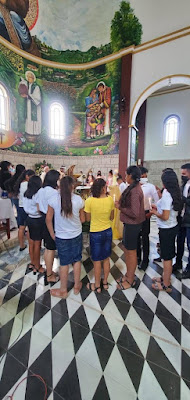
December 22, 2020, I went to Granadillal for the baptism of eight children (between 8 and 12 years old.) I had met with them about two week ago. The pastor had asked me to meet with them to see if they were ready, understanding what baptism means. That meeting was good. 

Today it’s been cloudy and rainy and a bit cool. I really had second thoughts about going up to Granadillal. It’s about 45 minutes from home and the roads were slippery. I really wanted to just find a place to sit and read, but my better judgment got me moving. 

We had a Celebration of the Word with Communion.

Before everything started, I talked with the kids and even asked their input on a trivial matter: Should I wear a purple stole because it’s Advent or should I wear white since it’s a sacramental celebration? Six said purple and two said white. I compromised. I wore white up until the actual baptism. Liturgists may cringe but I used the occasion to model compromise.

After the Celebration, it was time for pictures – with and without masks. I was in photos of the whole group as well as with some individual kids and their godparents. By the way, I always brought masks to celebrations and give them away. I don’t want to complain without giving people a way to respond. 

As the photos progressed, I noticed one kid who had come with an elderly woman as his godmother. He was in some of the other photos but there was none with him and his godmother and me alone. I asked them if they wanted a photo. They agreed – a bit reluctantly, I think. As we found a place by the altar to take the photo, another kid and his godfather also came to be in a photo with me.
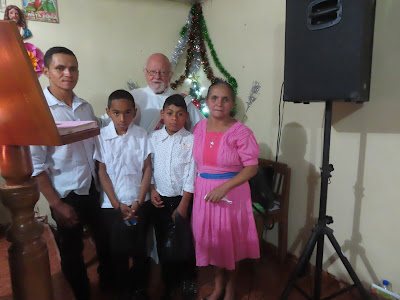
After they left, I took a selfie with the kid, Fredy, and his godmother, Blanca Rosa.
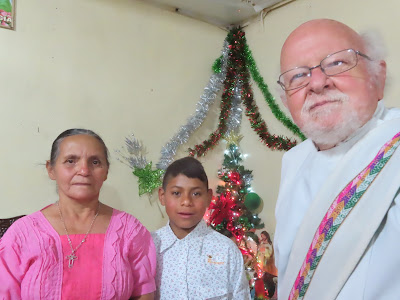
I had the sense that they were poorer than most of the other folks (who are by no means rich or even middle class).
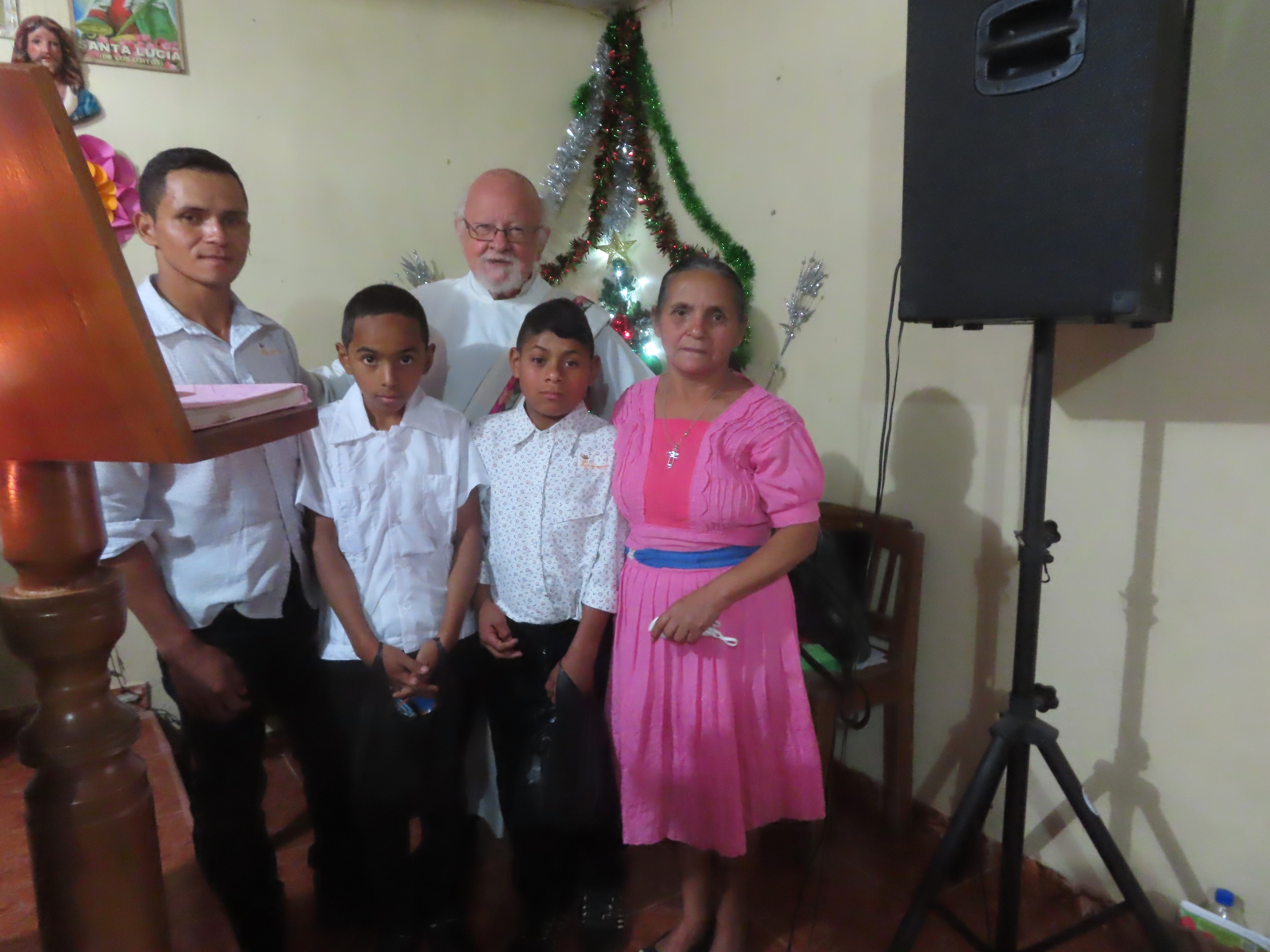
Why did I do this? I think it’s revealing a part of myself that I am discovering – a part that actually goes back many years. I have a sense of trying to connect with those at the margins.

A priest friend of mine, whom I worked with several times, talked about connecting with the back row Catholics. In a campus ministry setting, that meant saying hello to everyone, especially those who were not involved in the parish events.

But this is more than that. I noticed this a few weeks before this visit to Granadillal at a Sunday Celebration of the Word here in Plan Grande. It was the coffee harvest season and there are a fair number of young men who have been brought in from other parts of the country. In previous years, people were brought in from Guatemala, but with border restrictions growers have had to seek other sources of workers.

Before the Celebration one Sunday I noticed a family whom I hadn’t seen before who were very clearly indigenous. I went over and talked with them. I later saw a few other new folks and went over and talked with them, just to welcome them.

This reaching out is something that seems to be so much a part of my ministry. A few months ago, I stopped and spent some time talking with a woman and her son, asking them about their lives. 

As I drove away, I asked myself why I do this, stopping and talking with people. I think it’s really important to spend time with people, especially those who do not seem to recognize their dignity, their worth. I want them to know that someone thinks they are important and wants to listen to them.

But as I continued to drive,  I realized there was something more basic. I do this because I love them. 

I am an introvert, but I find this type of welcoming a challenge that gives me life. If I can give someone a sense of welcome, a sense that he or she is valued, that gives me joy. It is a gift that God has given me, and I am grateful. 

The other thing I’m noticing is that I use a sense of humor (that I’m sure is a gift from my father) that I often use to welcome people or to gently challenge them. That’s another reflection that I think is related to this one.

Monday, January 31, 2022

The confirmation rush begins - and more news

Wednesday, January 26, I met with the catechists of confirmation to prepare for confirmations next month, from February 10 to 12. There were about thirty catechists from about 36 towns and villages in the parish who have been preparing about 425 for confirmation. We were preparing the Masses in five different places as well as confessions in six places. I’ll be accompanying them in the next two weeks.

Last Saturday, we had the first round of confessions in the main church in Dulce Nombre. There were about 56 confirmation candidates and some adult sponsors who came; even though there was only one priest, the confessions were finished in about three hours. Among those to be confirmed there were 28 who had not made their first communion. They received the Eucharist for the first time at the Mass at the end of confessions.
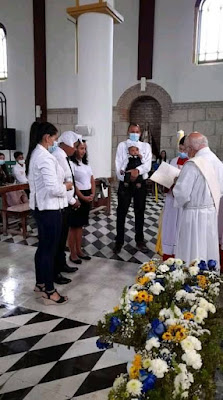
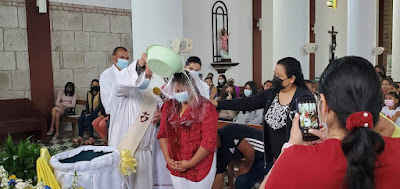
The pastor also asked me to baptize a couple and their child. I had recently done the final pre-marriage interview with them and I felt privileged to baptize them last Saturday, while the pastor was finishing up confessions. The couple also received their first communion at the Mass.
What a day for sacraments – baptisms, confessions, and first communions.

January has been a bit different this year. Father Kyle Digmann, the pastor of our sister parish, St. Thomas Aquinas in Ames, Iowa, came for a short visit. He had Mass in two communities, including one of the poorest and most distant, Debajiados. He concelebrated at two of the Sunday Masses and presided at the Mass to dedicate a new meeting space in the parish center, named after St. Thomas Aquinas (since much of the funding came from a donation from St. Thomas). We made a quick trip to the Mayan ruins in Copán Ruinas, about 80 minutes from my house. He had a chance to meet some members of the association that exports El Zapote Coffee to Ames. He even helped a short time with the harvest in the parish coffee field. It was all too short. I hope he and others from St. Thomas will visit in the near future.
Since November people have been harvesting coffee throughout the parish. This will continue until February in most places, though a few who have fields at higher elevations will be harvesting until March.

This year the coffee prices are better than I remember. That means that some harvesters are getting significantly more than last year. Last year they got 30 lempiras (about $1.22 for a five gallon bucket of coffee cherries)’ now some are getting between 40 and 50 lempiras.

But the costs have gone up. Some have told me that in some cases a bag of fertilizer costs about twice as much as a few months ago. We’ll see how this leaves the small coffee producers.

My pastoral work has been a little limited these past months. I try not to schedule many formation meetings in January, since the coffee harvest is one of the few ways people in the countryside can earn cash.

There was a parish assembly to do some planning for the year and there will be two small groups working on parish organization and evangelization in the next few days. 

For a number of reasons, exacerbated by the pandemic, the local community church councils have fallen apart in a good number of places; we hope to help revive them, but with an organization more participative than in the past. We also hope to revive the base communities and pastoral work in the towns and villages.

I have continued my custom to go on most Sunday mornings to various villages for Celebrations of the Word with Communion. Yesterday I went to Granadillal and next Sunday I hope to get to visit San Antonio El Alto; I plan to visit the sick after the celebration since they don’t have a communion minister to bring the eucharist to the sick.

One of the customs here is to have prayers in people’s homes on the night after a death, for nine days after the burial, and often for nine days a year after the burial. I was invited to two end of the nine days (novenario) here in Plan Grande. I also celebrated a funeral of an older woman here. 

Sunday a week ago, the pastor came for the funeral of a 97 year old man who is sort of the patriarch of the village, with many children (as well as grandchildren and great grandchildren) including two former mayors. I was also asked to be at the vigil on the night before the funeral. I had visited Don Máximo many times, once just before his death. But a local communion minister regularly brought him Communion, which sustained him. He will be missed.

I had two interviews of two couples who will be getting married. I have another one scheduled for February. I find it very hopeful that there are young people who are getting married in the church. Many have already been living together and have kids. They finally decide for one reason or another to get married. One of the more interesting cases is a couple who weren’t even baptized.

I hope there will be even more. The stability that may come from sacramental marriage can be a real blessing for families. this is important for these families, for our parish, and for Honduras.

Other more mundane concerns have taken up time.

I took the new parish truck for its 20,000 kilometer checkup. In less than 14 months I’ve driven more than 20,000 kilometers, mostly in the parish (though there were a few trips to San Pedro Sula). I also had to take another car to the mechanic in Santa Rosa and ended up buying a new battery.

I have reviewed scholarship applications for 159 young people for an alternative program for the equivalent of junior and high school. The students listen to radio programs, have home work in books, and get together with teachers about once a week. Help from St. Thomas Aquinas helps pay for half of the costs of books.

We had a clergy meeting which I attended. We have a deanery meeting in early February.

Such is life in the parish. I’ll try to offer a more reflective blog post after the confirmations are over.

I have not included any reflection at this time on the political situation in Honduras. The country's first woman president was sworn in at the National Stadium in Tegucigalpa in front of an enthusiastic crowd. Her inaugural speech was filled with hopeful signs of a new Honduras. Yet the National Congress is in disarray. Pray that this may be resolved in a way that furthers the good of the people and helps put an end to corruption and impunity.

I'll try to write more about this later.

---
Thanks to Elias for the photos of the baptism and first communion. They were published on the facebook page of the parish.


Wednesday, September 22, 2021

Death, life, and hope


Yesterday I presided at my third funeral in two weeks. Monday, I had interviews with two couples who will soon be married. Sunday morning, I visited a nearby village, brought communion to a 90 some year old woman and, in the afternoon, I baptized nine young children here in Plan Grande. Yesterday was the first of six workshops I’m facilitating in different parts of the parish to help the communities organize and prepare for any natural disasters. 

But yesterday’s funeral touched me in a different way. 

The woman died after a year of suffering. She had lived with her husband for 46 years and had six daughters. Last Thursday, Padre German married the couple in their home, On Sunday, I dropped off a communion minister to give her communion. Monday, she died.

One person noted that, after the marriage, she was in the grace of God after living in “union libre” for so many years. 

It is not uncommon for couple to live together for decades without getting married, either civilly or in the church. The causes are many – the costs of civil marriage, the expectations that a marriage involves a costly celebration, the lack of a culture of marriage, the lack of attention to remote villages by priests (except for those, who like our pastor, make an effort to visit them), unrealistic expectations of what marriage involves, overly strict church requirements (which are slowly changing), fear of commitment, machismo (why only one woman?), and more that I am not aware of.

But very often I come across people who have lived together for years and even for decades and are raising or have raised children with love and with a concern for their spiritual growth. So I have a very different approach.

At the funeral, I noted the 46 years of life together of the couple and the love they had shared with each other and with their children and grandchildren. I noted, with joy, that they had sanctified this love, explicitly inviting God into their life together, in the sacrament of matrimony which they had just shared.

I really need to do a little more study and reflection on this, since this happens so often.

Love between a couple and with their children is affirmed and brought into the life of God and the Church community through the sacrament of marriage. It’s God filling in what is lacking in our love and the community of faith present to witness this commitment and, hopefully, help them live their love together.

This becomes clear to me any number of times when I do pre-marriage interviews. There are some couples who have not lived together, but most often the couples preparing for marriage have lived together and have children. A good number of them have had their children baptized before their sacramental marriage.

Some of them I’ve known for a few years and I’ve encouraged them to consider sacramental marriage. I sometimes ask, with a mischievous gleam in my eye, when are you getting married in the church. It is a real joy when that happens.

And it is a joy when I baptize children, especially ones I know. This Sunday it was nine children under seven in Plan Grande. This is but part of my ministry here. 

In about half an hour I have another workshop to help different communities organize in the face of possible natural disasters - another part of my diaconal ministry. Yesterday’s workshop went very well.


Now, off to ministry.

Tuesday, July 13, 2021

The personal tragedy of migration

This morning I baptized a four-year old girl in a rural village, a village that suffered a bit from last year’s hurricanes. Her parents, the godparents, a village catechist, and about ten other people were there. 

It’s not the first time I baptized; in my five years as a deacon, I must have baptized more than several hundred.

But this one was different. A parent and the child will be setting out tomorrow, in the hope of reaching the United States.

This is not the first parent-child group from our parish to set out for the US. My guess there have been scores in the last few years, not counting those who have left solo. Some villages have lost many people, especially the young.
A few have had the fortune to be able to go to Spain, where many work under the table. A very few have had the chance to go as legal, hired workers to Canada, enduring six or seven cold months working in agriculture in Quebec.

But most leave – on their own, in a group, or assisted by coyotes (for a hefty fee). 

But here I was, baptizing a child who would go on a long journey, with no assurances. 

What to say?

I didn’t say much in the liturgy, though I did include invoking Saint Raphael the Archangel, patron of travelers, and Saint Turibio Romo Gonzáles, the Mexican martyred priest who has become a patron of migrants.

As I often do, I reminded the parents that in baptism is welcomed into the church, a member of the Body of Christ. I also reminded the godparents and those present on our responsibility to welcome and care for the newly baptized. Afterwards, I reminded the parents that the child was a member of the church and specifically told the father that there were members of the Catholic Church whom he could trust and call upon. The witness of so many people of faith is encouraging.

I also noted privately that I didn’t think it was a good idea but that I’d be praying for them. I didn’t tell them that I’d be crying for them – but I am, as was a woman at the baptism.

After the baptism the catechist asked me to bless a cross that was in the form of an anchor. I shared with them that the anchor is a traditional Christian symbol of hope.

The chain of the cross was knotted, and the father was trying to unknot it. I tried and thought it might be impossible. But then I remember Pope Francis’s devotion to Our Lady, the Undoer of Knots, and prayed to her. The knot came undone, and the mother put the cross around the child’s neck. I recalled the devotion to Mary and we prayed a Hail Mary.

I left with a heavy heart. But pray for the safety of that father and child – as well as for the many others who feel so desperate that they leave home and family. 

Migration is not an “issue” for me – the fathers, mothers, children, who migrate are those who call out to me in their agony.

Lord, have mercy.


Friday, November 06, 2020

Hope in the midst of a hurricane

Monday, in the midst of torrential rains, I went to Mass in the cemetery of distant community, as noted in a previous post. I sensed that there was something wrong with the car, since it was difficult to turn the steering wheel. 

On Tuesday, I decided to stay home – praying and reading. I had time to sit down and again read Henri Nouwen’s In the Name of Jesus: Reflections of Christian Leadership. I strongly recommend it especially to those who serve in the religious community. 

Wednesday morning, I took the car to be repaired in Santa Rosa de Copán. They replaced the power steering belt and a set of ball bearing – for the grand cost of 300 lempiras (less than $15, including parts.) 

I spent the afternoon at home, without water and without electricity, and thus without internet. The electricity in my section of Plan Grande was off from about 1:00 am Wedneday to about 3:00 pm Thursday.) 

I was able to do a little connecting through Facebook because I bought a smartphone a year ago and have a monthly plan that lets me access Facebook and the internet. But I don’t like trying to work on a phone and so I just did a minimal amount of digital connecting. 

I also didn’t try to follow the results of the US elections. This was a blessing. I was able to tune out the noise – and there probably was a lot – about the election. I was able to avoid having to deal with all the ramblings and rantings of people on the election results. It was good to be out of the Facebook frenzy for a day. 

Wednesday morning I did repost a post of a good friend who is an Episcopal monk which was much stronger and more pointed at the President than anything I had posted this year. But I think he had something to say, analyzing the pandemic of division, ill-will, and invective that has invaded the US. I am glad I did, it even though I got a response accusing me of passing on lies and being judgmental. So it goes. 

But what is really important is what is happening here around me. 

The winds and the rains have been fierce. Trees have fallen down and blocked the roads. In a few places there have been landslides and roads collapsing (deslizamientos y derrumbes). Here are just a few photos of what I’ve seen here. 

Wednesday

Wednesday

Wednesday

Thursday

Thursday

This morning, Friday, about 6:45, I got a call from a distant community that is isolated die to flooding. Two houses have fallen and others are in danger. Some of the persons affected have been given refuge in the village church. The person who called me asked me to go to the mayor since he wasn’t answering their phone calls. I went to his house and got him out of bed. He knew of their situation as well as of other cases of fallen houses in another community. 

But all this is nothing like what is happening in the north coast as well as in some parts of the department of Santa Barbara, Tegucigalpa, and other places. 

The flooding, the overflowing rivers, the collapse of bridges have made life even worse for the poorest among us, who often build their homes in the most vulnerable places. 

Thursday, Padre German mentioned a tragic case in Santa Barbara. A woman near flood waters dropped her baby who was swept away. The rescue workers did manage to quickly get the baby – but it had already died. How many more cases will we hear while this goes on?

But in the midst of this we need to see the signs of hope. 

Last Saturday I baptized a young man who has had serious health problems the result of an accident several years ago. Recently, in the first week of the pandemic, his situation deteriorated and he had to undergo three operations in Santa Rosa. The doctors at the hospital advised him to go to a public hospital in San Pedro Sula for another operation. He was reluctant to undergo the operation. 

 Earlier this year, he and his companion of more than ten years had decided that they wanted to get married and enrolled in the marriage preparation program in their village. But the pandemic hit and so the preparation was put off. 

But his situation deteriorated in the last month or so and he could hardly talk. Getting him the ENSURE that the hospital had prescribed helped and he is now able to talk a bit. During all this time his companion cared for him, feeding him, as well as caring for their two children. 

Thursday we celebrated their wedding. In the midst of a pandemic and a hurricane, two young people got married – with their children and scores of people from their village in attendance. As usual I brought along masks but ran out all the twenty-five I brought. 

There was much to give hope.

Waiting for the wedding Mass

*With help he walked from his house to the house of his parents-in-law up the hill.

*The couple celebrate the sacrament of matrimony after more than ten years together.

*He was baptized and received his first Communion last Saturday.

*We used the third form of the marriage vows so that he could just answer “Yes.” But he repeated the words when he put the ring on his wife’s finger. 

*After the prayer of the faithful, Father German celebrated the sacrament of the Anointing of the Sick. 

In the midst of all the evil, all the sickness, all the devastation of the pandemic and the hurricane, two people are manifesting their love sacramentally, showing the world that love is possible. They are sacraments of God’s love. 

These poor humble people are signs of hope.

Tomorrow, Saturday, I will go to San Agustín to baptize four little children. More signs of hope.

Sunday, December 01, 2019

Thanksgiving, death, baptisms – and Advent

This year, for the first time since I came to Honduras in 2007 I went to a Thanksgiving dinner. I was invited by Amigos de Jesús, which cares for and educates more than 100 Honduran children and adolescents, and a few young adults.


Their roots are with a priest from suburban Philadelphia and they have volunteers from the US in their program. A bilingual school also has volunteers from several countries. I got to know their co-director a few years ago and she invited me to speak with the volunteers, which I have done a few times. They also came to my home a few times for a meal and discussion. Their chaplain, a young Argentinian priest, is a good friend.

The meal was splendid – turkey which, as a vegetarian, I did not eat, sweet potatoes which I devoured, numerous side dishes, and splendid desserts. I brought two loaves of home-baked bread.

I stayed overnight at Amigos and headed home on Friday. I got a call asking me to preside at a funeral at 7 pm that night, but they rescheduled it since I don’t like to drive at night. I’m glad they did since the place was in a remote area with a slippery hill that I managed to climb in four-wheel drive. Henrique had died suddenly at 85 years of age, leaving his wife of more than sixty years, as well as numerous children, grandchildren, and great grand-children. He also had a few siblings still alive.

The Celebration of the Word with Communion was held in the family home, where the coffin occupied the main room. During the celebration the widow was there right at my side by the improvised altar. This faithful woman, who regularly walks up the hill for the Sunday celebrations, seem to me to be at peace.  Somehow – by the grace of God – I was able to say a few words of comfort and hope. It is a real blessing to be able to preside at funerals.

Saturday I had baptisms of five young children in another village. The children were quite attentive and not one cried! Several of the parents really seemed attentive during the baptism and Celebration of the Word with Communion.

I had another celebration in the evening and so I rushed off. I wish that I had stayed a little to visit the sick, since of the persons I had visited several times died the next morning. This is a sad reminder of my need to be more attentive and willing to spend more times visiting the sick.

The evening celebration, to begin Advent, was quite a miss-up. The town is used to a Mass on Saturday evenings and someone called the pastor, asking if there was Mass. I usually do a Celebration of the Word with Communion on Sundays when the pastor is out of town, but somehow the message got mixed up. But, we finally had the celebration.

Sunday morning I got up early and got to a community where the pastor usually has a 7:00 am Mass every Sunday. We celebrated the Word and I distributed Communion, There, many went to communion. I also saw a young couple I know with their six-month old daughter, a really charmer who readily let me hold her in my arms.

After that Mass I went to the church of San Antonio in Dulce Nombre, expecting to celebrate the rite of entry into the catechumenate with one young woman from Dulce Nombre. She was there but there were also five other young people from two other communities. Despite the lack of communication, it went well.

After the Celebration I started my road trip to Tegucigalpa where I’ll give four days of presentations for a certificate program with the Honduran Conference on Religious. I’ll be leading them in an investigation of how the reality affects the formation process of women and men religious. This is exciting, but it’s been quite a lot of work. I spent most of last week preparing. I pray that I’ll be able to help them in their endeavors to form new religious here in Honduras and Central America.

I stopped at Gracias to see the Dubuque Franciscan sisters for a bit (and to leave some stuff there for an ordination I’ll be attending Saturday.) Now I’m in Siguatepeque, relaxing a bit before I head out early tomorrow morning. I decided to do the trip in two parts, since it’s more than six hours driving from home to Tegucigalpa.

Such is my life here – full at times, but with moments when I can sit back, especially in the morning, and savor the beauty, the joy, and the presence of God in the midst of poverty and injustice.


It helps that during my preparation I read Walter Brueggemann’s The Prophetic Imagination, for the third time (at least). It’s a book I heartily recommend.

Tuesday, November 26, 2019

November a full month


November is almost over and I’ve only written two posts – not for lack of activity. But I have also been doing a lot of writing, in Spanish.

For the past three years, I’ve worked with three young priests to prepare materials for the base communities. The previous years we stuck to the Sunday readings but this year we wrote on themes for several months – as well as general themes on Advent, Christmas-time, Lent, and Easter. This threw me off a bit and so I kept procrastinating and ended up spending three days in the middle of the month writing themes for seventeen weeks.

I'm also preparing a series of presentation. A few weeks ago I received a request from CONFEREH, the Honduras Conference of Men and Women Religious, to do a week for their four-week study program on the theme of the "Social Reality and its influence on the stages of beginning formation.” I hesitated but spoke with two of the Dubuque Franciscan sisters here in Honduras. So I decided to say yes. Needless to say, this has meant a lot of work. I’ve been doing a lot of reading and thought, including re-reading Walter Brueggemann’s The Prophetic Imagination. It’s next week, December 2 to 5. So, lots of studying, writing, and praying. 

The month has also been full of meetings. I met with the village coordinators of Social Ministry as well as the catechists of the parish. I also was at the meeting of the missionaries our parish sent to another parish last month. I really appreciate the chance to be with all these people who are giving so much of their time and energy to the parish.

But there were evaluation and planning meetings – on the deanery, diocesan, and parish levels. I sometimes feel as if I’m getting too old for these meetings. All I want to do is to get out and be with the people. But… 

Yet, there were great moments at the diocesan meeting, seeing a young priest I know who is a good friend (and speaks English.) Also, at the diocesan meeting, Sister Nancy Meyerhofer, one of the Dubuque Franciscans here in Honduras, gave a presentation on pardon and reconciliation. Her presentation was great – what else can we expect from sisters like her. It was also very much needed. She was invited, in part because the pastoral theme at the national level is “A reconciled community builds a country in truth and justice.” I hope that this theme will be part of the programming of the diocese. I will try to involve our parish social ministry in some training on violence and the transformation of conflicts.


I also heard that our diocese will be going ahead to respond to the abuse crisis in the church and the country. I hope so, since it’s so desperately needed – especially in the light of violence and rampant domestic violence and abuse in the Honduran society. 

With all these other commitments I have not gotten out to visit the sick in the communities as much as I should.

Yet I continue my Sunday commitments – usually going to a village in the morning for a Celebration of the Word with Communion. I try to get to places where the people don’t normally have communion on Sundays. I also go to one of the Masses that Padre German has – at least four each Sunday. I almost always preach – so that he can rest a bit. This month I’ve baptized children twice, in San Agustín and Camalote, during a Sunday Mass. This Saturday I have a baptism outside of Mass (since Padre German is visiting family in Guatemala for about ten days.

There have been two other events that I’ll write about later this week – the opening of the process for the beatification of a Delegate of the Word and catechist in our diocese and the Christ the King celebration.

I also should write something about the continuing saga of drug-trafficking as well as the continuing destruction of a cemetery by a mining company. (Maybe next week.)

The weather is becoming cooler and there's more rain. It's also coffee harvest time and I see a lot of people going out to the harvest. More later.

God is good.

To prove it, here are a few photos from our world.