Showing posts with label migrants. Show all posts

Monday, June 20, 2022

Corpus Christi 2022 in the Dulce Nombre parish

Here in Honduras the feast of Corpus Christi is celebrated on Sunday, but in our parish it has been celebrated for almost a week in several different ways - hours of adoration, processions, Celebrations of the Word with Communion, Masses.

Our parish has more than 40 different places for community worship, mostly churches in the widely scattered towns and villages. Almost all the villages have Delegates of the Word who lead Sunday celebrations; more than twenty Communion Ministers serve in the countryside.

Devotion to the Eucharist is strong – even though there are not many who receive Communion with regularity (though this is changing).

Where there is a communion minister there is usually a Holy Hour every Thursday – and, in some places, exposition and adoration for several hours. Before the pandemic, we had days of prayer with exposition of the Eucharist every other month in the ten rural sectors of the parish. We began the year of the pandemic, 2020, with a theme of peace and reconciliation.

Corpus Christi is therefore very special. 

As has been the case for several years, Corpus Christi has been preceded by Forty Hours of Adoration.

I remember this devotion from my youth, where the altar boys would be scheduled for at least an hour before the exposed Eucharist. Parishioners would come for an hour, some in the middle of the night. 

Here some communities have forty continuous hours of adoration. Other places, having found it difficult in the past to have people come in the middle of the night, scheduled forty hours over three days.
Oromilaca where they had forty continuous hours of Eucharistic adoration

In some areas where there are not communion ministers, the ministers arranged to be in communities for between three and ten hours during the day so that all communities would have the opportunity to spend time before the exposed Eucharist. In many of these the ministers visited the sick. In some there were processions. I was available to go to communities where there is no communion minister, but the communion ministers had arranged visits to almost all the villages in the parish. 

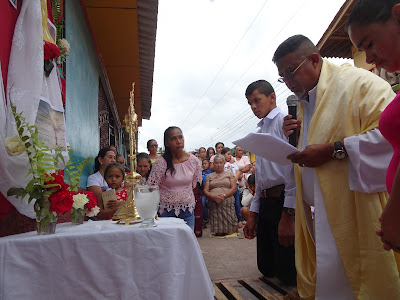
In a few sectors of the parish, the forty hours ended with Mass, preceded by a procession. We stopped at five altars for prayer and, where a priest or deacon was present, Benediction with the Blessed Sacrament.

On Friday I went to Delicias Concepcion where people from two sectors of the parish gathered.
Saturday evening, I was asked to preside at Benediction in Plan Grande, the village where I live. 

Sunday morning I went to Oromilaca where they ended forty continuous hours with a procession and a Celebration of the Word with Communion. 

Sunday afternoon, I went to Mass in San Agustín where Mass was preceded by a procession around the central square. At Mass, twenty-one children from eight to thirteen received their first communion. (Needless to say it was a long afternoon.)
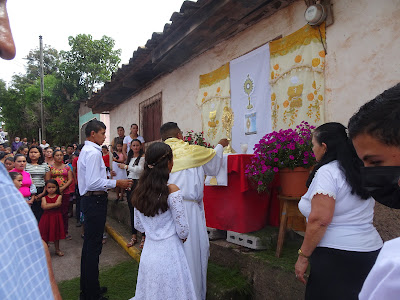
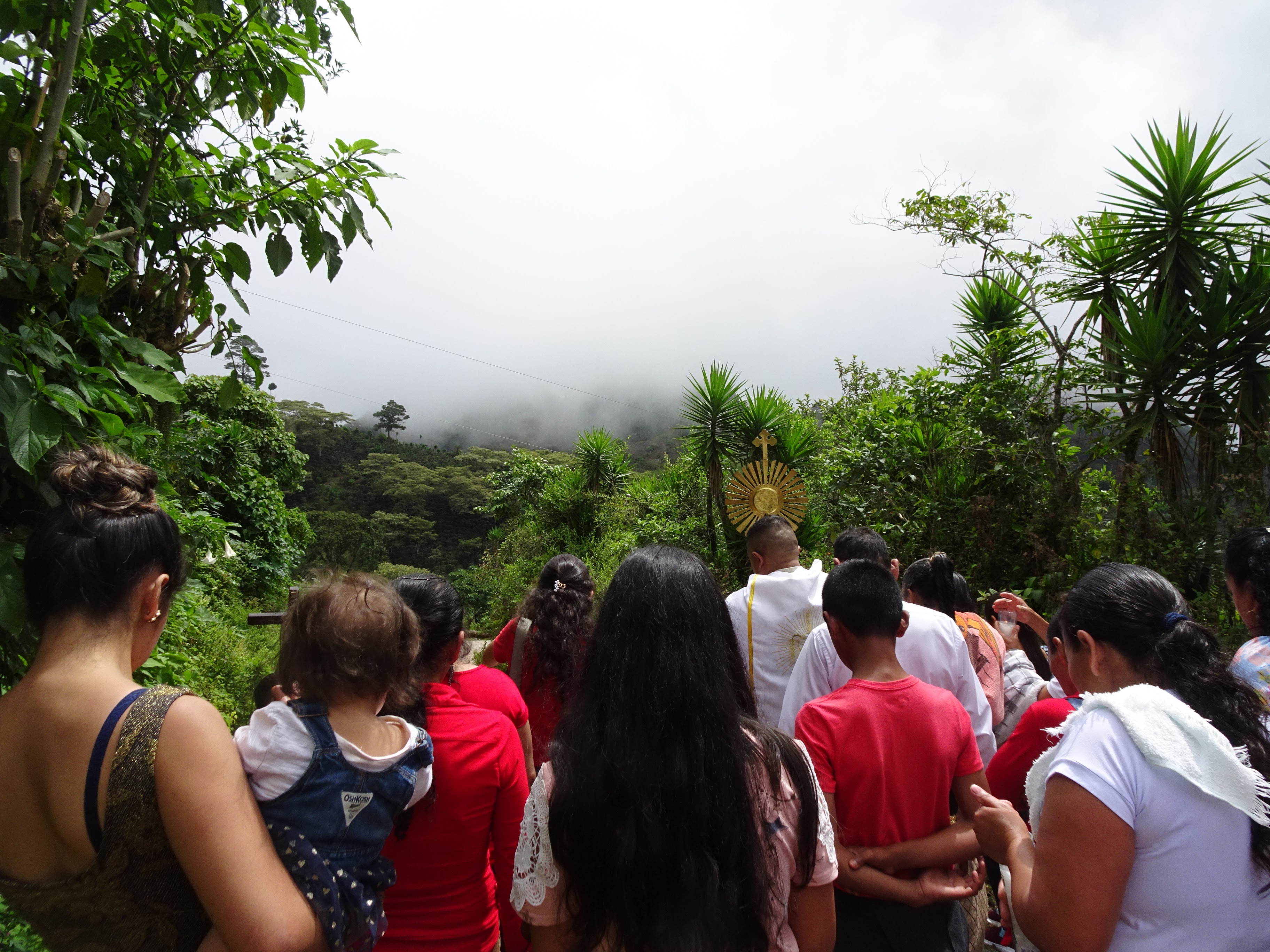
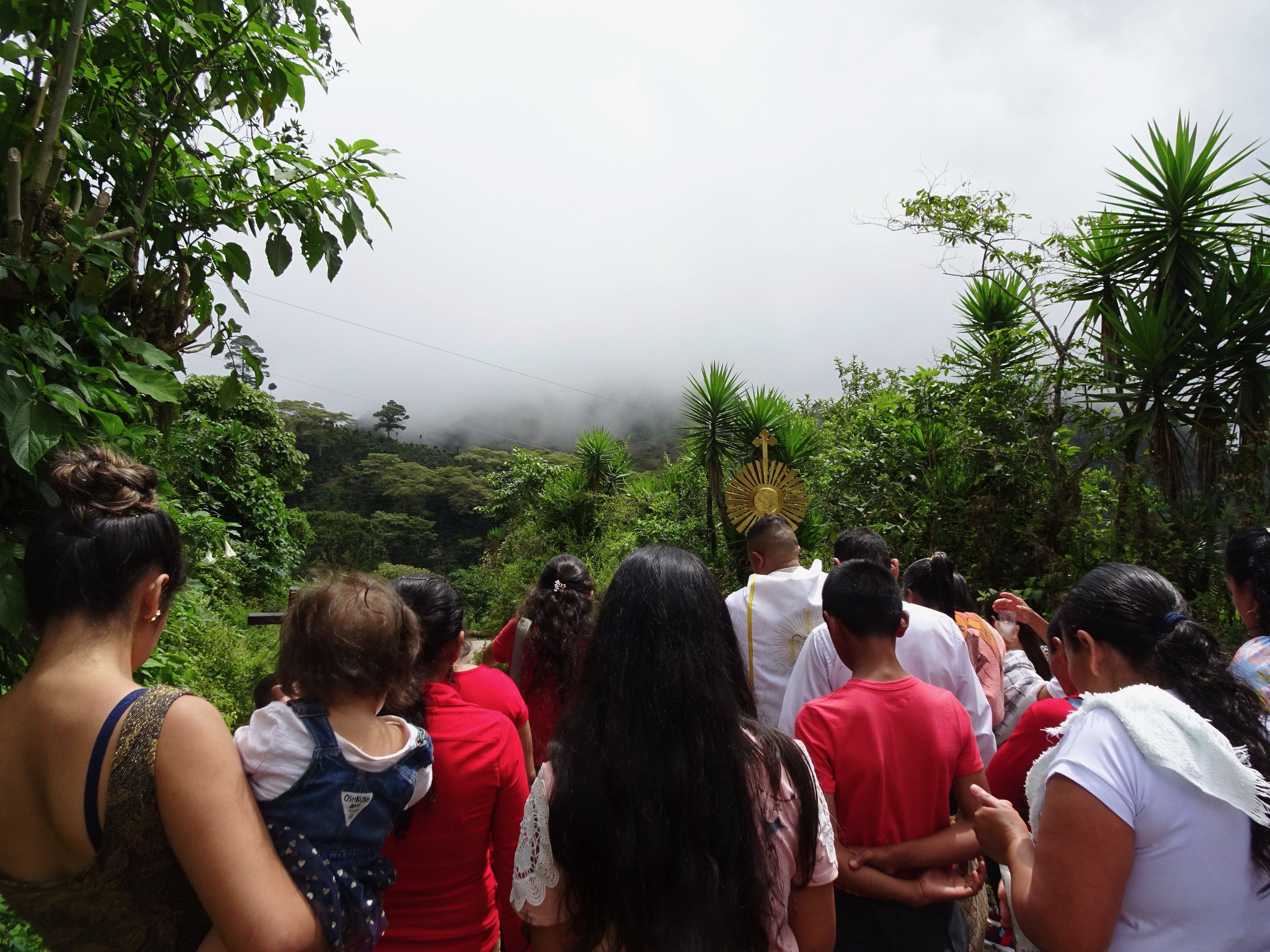
Since the pastor had participated in several processions over the course of the week, he asked me to carry the monstrance for part of the processions in Delicias Concepción and in San Agustín.

In each place we had five altars with prayers related to the situation of migrants. I wrote about this in an earlier post.

Our pastor, a Guatemalan, rooted in the popular piety of his hometown, sees the importance of connecting liturgy and popular devotions with the lived reality of the people. Each year our parish stations of the cross connect pointedly with the reality of life here. So, this year he asked me to prepare the prayers at the altar with the reality of migration in mind.

The reflections are quite strong. (The Spanish text can be found here.) But I shared them with the communion ministers who would be leading the reflections in the processions in different parts of the parish during their monthly meeting. One woman noted that though they were pointed they revealed the reality of what people experience – why they leave, what they experience on the journey and when they arrive, what those who are left behind feel.

Pointedly, we prayed at one altar for four groups of refugees, inviting people to name those they knew: those who have died in the US, those who are on the road at this time; those who are living in other countries (most notably the US and Spain); and those who have returned (by their own will or deported).
Benediction at an altar in Dulce Nombre in front of a mural on refugees.

Sunday morning, in one village, they mentioned more than 30 persons who have migrated, several who have died, some who are now on the road, and a few who have returned. I thought of a good number of people whom I know who are in the US as well as some who have been returned. I remembered several distraught families whose family members have been kidnapped and held for ransom in Mexico. 

The reality is hard for all concerned. We pray that Christ will sustain migrants and their families – and that the nations of the world will open their hearts and their borders to those in need, with just, non-discriminatory migration laws.

We began the procession with the prayer of Pope Francis for the 2022 World Day of Prayer for Migrants and Refugees. This is a good way to end this post.
Lord, make us bearers of hope,so that where there is darkness, your light may shine, and where there is discouragement, confidence in the future may be reborn. Lord, make us instruments of your justice, so that where there is exclusion, fraternity may flourish, and where there is greed, a spirit of sharing may grow. Lord, make us builders of your Kingdom, together with migrants and refugees and with all who dwell on the peripheries. Lord, let us learn how beautiful it is to live together as brothers and sisters. Amen.

Mural of migrants, Dulce Nombre de Copán


Saturday, June 18, 2022

Migrants - and Corpus Christi

On Monday, June 13, the feast of Saint Anthony, I went to one village for the Mass of their patron, Saint Anthony. Our pastor had four more Masses that day and another priest who is temporarily living in the parish to care for his ill mother had several Masses. There are six rural communities and a church in Dulce Nombre dedicated to San Antonio.

A custom here is to have Mass intentions mentioned at the beginning of Mass. They usually include those who have died, the sick, those celebrating birthdays, and more. They also include praying for migrants. At this Mass, there were more than twenty-three people who had migrated and were living mostly in the US. They also asked for prayers for migrants who were on the road, seeking to get to the US – they included on man and a couple and their child.

Yesterday I noted a young man I know who lived for a while in Plan Grande who had just arrived in the US and was with a sister there. 

Migration hits home. It is more significant than I had thought.

Recently I came across a report by the World Justice Project on a 2021 poll of Hondurans on migration.
“More Hondurans would prefer to move permanently to another country than respondents from regional peer countries. Forty-nine percent of respondents would prefer to move permanently to another country and 18% of respondents reported having plans to move internationally in the next 12 months.”
The report also noted that
“Seventeen percent of Hondurans have attempted to migrate to the United States. Most (63%) respondents who reported having attempted to migrate to the United States did not end up entering the country. Of those, 42% of respondents were unable to enter because they were sent back by law enforcement, 20% changed their mind, and 14% reported that the journey was too difficult. Of the 37% of respondents who were successfully able to enter the United States, 43% were deported by Immigration and Customs Enforcement (ICE) and another 17% left due to family or social reasons.”
I also just read in another report, that in contrast to 17,809 Hondurans deported from the US in 2021, in the first four months of 2022, 32,517 were deported.

Because this is so important and impacts the lives of those who remain or who have returned or been deported, our pastor asked me to write short reflections for Corpus Christs processions.

The custom here is to have Eucharistic processions for Corpus Christi in many places, at times led by the communion ministers. The pastor or another priest will have Mass at several of these places and I will have a Celebration of the Word with Communion in at least one place.

Corpus Christi procession in Delicias Concepción, 17 June

Before the Mass or Celebration the people will go in procession with the Eucharist and stop at five altars to pray. 

I shared the reflections I had prepared at a meeting of the communion ministers last Saturday, warning them that they were very pointed. I told them that if anyone complained, tell them that I wrote them. But one of the women affirmed that the reflections reflected the reality.

There are five themes, corresponding to the five altars where the Corpus Christi processions will stop and pray. 
  • Jesus: the Word became Flesh; the Word became Bread; the Word became poor. 
  • The vulnerability of Jesus and the vulnerability of migrants 
  • The presence of Christ in the Eucharist and among the migrants 
  • Jesus affected in those suffering from migration 
  • Mary, the Mother of Jesus and the Eucharist. 
You can find my reflections here in Spanish. 

Here are translations of a few excerpts. 

2. Vulnerability 

In their vulnerability, many, looking for something better, migrate, leaving behind their homes. The lack of work and of opportunities, poverty and, at times, violence push them to seek a way out.
The migrants are also vulnerable on their journey. Many endure hunger. Some suffer violence, extortion, kidnappings. Some are abandoned and others are objects of human trafficking.
At times, their dreams are converted into nightmares, deceived by the false promises of the coyotes [those who arrange transport for a hefty fee].
When they get to other countries, some are still vulnerable. Some feel alone, separated from their families. Others fear being jailed or deported. Some are exploited by their employers. Without legal recourse, others suffer violence, assaults, and thefts. God is with them in their vulnerability, in their sufferings.
Jesus, God made human, wants to accompany us in our vulnerability. 

3. Those affected by migration 

Jesus is always with those who suffer.
Migration affects not only those who migrate but also their families and the communities they leave behind. Migration leaves behind broken families - children who scarcely know their fathers, mothers without the assistance of their spouses.
How can we give migrant families the aid they need, especially moral and spiritual support? 
Migration has left some communities with few men or adolescents.
Families find themselves in debt to pay the coyotes and kidnappers. And so some seek to find money by means that are scarcely legal; therefore we find the increase of the sale of drugs and prostitution. 

5. Mary 

Mary is a woman who has seen the suffering of her son and has compassion for all whose who suffer. She can witness the suffering of women and girls who are abandoned, abused, raped, trafficked for prostitution.
She fled with Joseph and her son to escape the violence of King Herod, much like women today who flee violence.
Mary beholds the suffering of women who migrate, facing the dangers of the journey, the threats of violence, trafficking and rape, the days without food for themselves and their children.
Mary is also present with the women left behind, alone, by the migration of their spouses and children.
Mary, at the foot of the cross, shows us how to respond to those who suffer; her presence shows us the compassion of God.

Saturday, July 31, 2021

Out of the depths - crying with migrants

I just returned from the baptism of a six year old who will soon be leaving with his father for the US. 

This is the second baptism I have celebrated in the past two weeks of a child who would be going with his father on the long trek to the US.

But I can hardly call them celebrations in the normal sense. In some way, they can only be celebrations of the hope that God gives to people amidst the anguish, that drives people to flee their homes with a child.

In the last two weeks I’ve also been with family members who had someone who died in the US. One was at a Mass for a teenager who went with his father but who drowned. The other man was older but was killed in the US. There must be more, but these were in our parish and I spoke with family members. 

In the last week I’ve also come across two families whose family members have been kidnapped and held for ransom in Mexico. The kidnappers of one man and his child asked first for several thousand US dollars but lowered the amount significantly. But how can a poor family here afford even a thousand dollars? The family is distraught; I prayed with them – and cried with them. 
 
The numbers of migrants from our parish is staggering. The other day I was giving a ride with someone who was talking on the phone with family members or friends who had left and were waiting to cross the US border. 

I was in conversation with someone else who was talking about a number of persons planning to leave, as well as with a teenager who hopes to leave but wants to be baptized beforehand. 

I recently heard that a large group of young people from a village have left for the US. I don’t know who they are but I do know a good number of young people from that village.

I don’t know what is happening that is driving so many to leave. We don’t experience the violence and the presence of gangs, as do many in the cities and the coast. But there is a lot of poverty and a lack of opportunities for young people, even those few who have finished high school. 

In the midst of this, I feel powerless – as must many of the people around me, especially those who flee. 

And so, in the midst of this, I pray the first words of Psalm 130, as I did with a family today: 

Out of the depths I cry to you, 
O Lord, Lord, hear my voice.

Stations of the Cross, El Rosario Church, San Salvador


Tuesday, July 13, 2021

The personal tragedy of migration

This morning I baptized a four-year old girl in a rural village, a village that suffered a bit from last year’s hurricanes. Her parents, the godparents, a village catechist, and about ten other people were there. 

It’s not the first time I baptized; in my five years as a deacon, I must have baptized more than several hundred.

But this one was different. A parent and the child will be setting out tomorrow, in the hope of reaching the United States.

This is not the first parent-child group from our parish to set out for the US. My guess there have been scores in the last few years, not counting those who have left solo. Some villages have lost many people, especially the young.
A few have had the fortune to be able to go to Spain, where many work under the table. A very few have had the chance to go as legal, hired workers to Canada, enduring six or seven cold months working in agriculture in Quebec.

But most leave – on their own, in a group, or assisted by coyotes (for a hefty fee). 

But here I was, baptizing a child who would go on a long journey, with no assurances. 

What to say?

I didn’t say much in the liturgy, though I did include invoking Saint Raphael the Archangel, patron of travelers, and Saint Turibio Romo Gonzáles, the Mexican martyred priest who has become a patron of migrants.

As I often do, I reminded the parents that in baptism is welcomed into the church, a member of the Body of Christ. I also reminded the godparents and those present on our responsibility to welcome and care for the newly baptized. Afterwards, I reminded the parents that the child was a member of the church and specifically told the father that there were members of the Catholic Church whom he could trust and call upon. The witness of so many people of faith is encouraging.

I also noted privately that I didn’t think it was a good idea but that I’d be praying for them. I didn’t tell them that I’d be crying for them – but I am, as was a woman at the baptism.

After the baptism the catechist asked me to bless a cross that was in the form of an anchor. I shared with them that the anchor is a traditional Christian symbol of hope.

The chain of the cross was knotted, and the father was trying to unknot it. I tried and thought it might be impossible. But then I remember Pope Francis’s devotion to Our Lady, the Undoer of Knots, and prayed to her. The knot came undone, and the mother put the cross around the child’s neck. I recalled the devotion to Mary and we prayed a Hail Mary.

I left with a heavy heart. But pray for the safety of that father and child – as well as for the many others who feel so desperate that they leave home and family. 

Migration is not an “issue” for me – the fathers, mothers, children, who migrate are those who call out to me in their agony.

Lord, have mercy.


Tuesday, October 20, 2020

A Homily to get me in trouble

In some ways I am glad that I will not be preaching in the US this weekend. 


The first reading, Exodus 11: 20-26, is so strong that I fear that some people would walk out – if they took it seriously. 
“You shall not molest or oppress an alien, for you were once aliens yourselves in the land of Egypt. You shall not wrong any widow or orphan. If ever you wrong them and they cry out to me, I will surely hear their cry. My wrath will flare up, and I will kill you with the sword; then your own wives will be widows, and your children orphans.” 
From what I can see from a distance, this passage is an indictment of current US policy toward the migrant and the poor. (Note: when the scriptures speak of “the widow and the orphan” they are referring to those who are without support and who therefore are poor and marginalized.) 

Combine this passage with paragraph 39 of Pope Francis’ recent encyclical Fratelli Tutti, and we’ve got a real problem. 
Then too, “in some host countries, migration causes fear and alarm, often fomented and exploited for political purposes. This can lead to a xenophobic mentality, as people close in on themselves, and it needs to be addressed decisively”. Migrants are not seen as entitled like others to participate in the life of society, and it is forgotten that they possess the same intrinsic dignity as any person. Hence, they ought to be “agents in their own redemption”. No one will ever openly deny that they are human beings, yet in practice, by our decisions and the way we treat them, we can show that we consider them less worthy, less important, less human. For Christians, this way of thinking and acting is unacceptable, since it sets certain political preferences above deep convictions of our faith: the inalienable dignity of each human person regardless of origin, race or religion, and the supreme law of fraternal love.
Scapegoating migrants, treating them as less than human, characterizing their homelands as “shit-hole countries,” speaking about immigrants fleeing violence and poverty as an invasion, calling them animals, speaking of a political opponent as having a “plan to inundate your state with a historic flood of refugees,” seriously restricting the number of refugee admissions – neither Isaiah nor Pope Francis would tolerate these actions.  

These are appeals to our worse nature, to our fears, to our sinful selfishness. They are not the ways of God or of followers of Christ. 

I speak from Honduras. Hundreds of thousands have fled from here for many years – seeking refuge from the violence, seeking a way out of poverty (as my Irish ancestors did in the 1840s), fleeing a government (financially supported by the US) rife with corruption and probable connections to drug trafficking. 

I know some from our parish, some from the village where I live who have left and are living decent lives in the US, trying to support their families. They are real people whose names I know. 

But I am not just concerned about them. I am concerned about people in the US who support these xenophobic policies. 

What has become of their souls? What sort of fear has overcome them and silenced their better part? What sense of isolation has led them to look down on others? What spiritual pandemic has infected them? 

I grieve for them. I pray that they may find a wholeness of spirit to welcome the stranger. I pray that whatever has led them to this will be purged from the US culture. 

And I have a dream that migrants and the opponents of migrants may sit down at table, share their joys and hopes, their fears and anxieties, so that God can heal the US of the anger and fear, the anxiety and uncertainties and make of them a people who can be healed by the power of a loving God who loves all, especially those who are or feel themselves marginalized. 

May God heal us all.

Saturday, November 10, 2018

The Mexican widow's mite and the US rich man


A homily I won’t give, since I’m not in the US, and which I probably wouldn’t give – since it would probably raise a ruckus. (But then, a Bishop of Rome named Francis urged youth to raise a ruckus.)

Tomorrow's Gospel (Mark 12: 38-44) reads:

Jesus sat down opposite the treasury and observed how the crowd put money into the treasury. Many rich people put in large sums. A poor widow came and put in two small coins worth a few cents. Calling his disciples to himself, he said to them, “Amen, I say to you, this poor widow put in more than all the other contributors to the treasury. For they have all contributed from their surplus, but she, from her poverty, has contributed all she had, her whole livelihood.”

Jesus sat down on a boat in the Gulf of Mexico and observed how the nations reacted to the caravan of refugees travelling through Mexico toward the US.

Many US politicians put lots of money into their coffers and planned to spend millions building a wall and sending military and other armed troops to the border. They also talked about withholding aid to the countries from which these people had come. (They had already cut assistance to the poor in the US and so this was not something unexpected.)

A poor Mexican also came by and with some friends spent all night making 700 tamales; another took the shoes off her feet and gave it to a Honduran woman walking barefoot and soon found other shoes to give to the people passing by. A poor church opened its doors and gave them a place to sleep. Others prepared meals and some nuns came and spent hours caring for the bodies of those who were walking, especially taking care of their feet. Other religious thumbed rides for the migrants.

Calling his disciples, Jesus said, “Amen, I say to you, these poor Mexicans put in more than all the others. The others contributed pittances to the poor and put money into building a wall. But the poor have contributed what they have, their livelihood.”

The issues of the caravan are complex and no one I know of is calling for completely open borders. But when we close our eyes to the poor we are in danger of closing our hearts to God.

What should we do, as followers of Christ?

1. Open our churches to the migrants. If there are 7000 migrants, many in family groups, and there are more than 17,000 US Catholic parishes, each parish or groups of three parishes, could agree to take in a family or a few people.

2. Advocate that the US accept as refugees those fleeing violence and persecution – including those fleeing gangs and drug traffickers who threaten their lives and women and children fleeing domestic violence. The US could send 3000 immigration judges and 3000 public defenders to the border, instead of militarizing the border.

3. Advocate changes to US immigration law that open the way to temporary work visas, easily obtained. I think that people who want to work would gladly take advantage of this type of immigration.

4. Refuse to support regimes that oppress their people, such as Honduras which has received lots of military and police aid, when what is needed is sustainable development.

5. Pray for the people, open your hearts and pocketbooks to them in their need.

6. Refuse to denigrate anyone, to demonize anyone, to look down on anyone (whether they be migrants or US government officials.)

7. Open your heart to all the poor and needed – where you live and throughout the world. Love should have no boundaries.

8. Recognize the truth of these words of Pope Pius XII, in Exsul Familia Nazarethana, August 1, 1952:

"The émigré Holy Family of Nazareth, fleeing into Egypt, is the archetype of every refugee family. Jesus, Mary and Joseph, living in exile in Egypt to escape the fury of an evil king, are, for all times and all places, the models and protectors of every migrant, alien and refugee of whatever kind who, whether compelled by fear of persecution or by want, is forced to leave his native land, his beloved parents and relatives, his close friends, and to seek a foreign soil.”

Whether they flee, “compelled by fear of persecution or by want,” they are children of God and deserve a hearing.

9. Will we let ourselves be moved by love or by fear?


USCCB image

Monday, November 05, 2018

The Exodus


I have witnessed the affliction of my people in Egypt and have heard their cry against their taskmasters, so I know well what they are suffering. Therefore, I have come down to rescue them from the power of the Egyptians and lead them up from that land…
Exodus 3: 7-8

Up to this moment I have not commented personally in this blog on the caravan of Hondurans going through Mexico, seeking refuge in the United States. I have commented on Facebook, but I want to share a few thoughts on this blog.


First of all, I like what the Mexican bishops called it: “an exodus of liberation.” It is not a march. It is not an organized protest. It consists of people fleeing from harm, danger, poverty, violence – much as the people of Israel fled the oppression of Egypt.

Secondly, I see it as primarily a desperate measure, a survival tactic. People do not take a long journey, especially on foot, just for the fun of it – unless they are people with means seeking diversions. Most of these people are fleeing what I see around me and what I have heard about life in the cities.

But there is more.

In the last nine months I have been hearing of more and more people from our parish who are seeking to go to the US. People ask us to pray for their loved ones on the journey at Mass and sometimes they ask us to pray in thanksgiving to God for their safe arrival in the US.

I have spoken with a young man who tried to go but was caught and sent back. He left because of family debts but, after his experience in a US detention center, has no desire to try to go back.

One day a 15-year old boy dropped by. At first I thought he wanted to cut the weeds around the house but it soon became apparent that he wanted to talk about going to the US. I tried to talk him out of it, but a few weeks later I noted that he was no longer here. He had gone to the US. He was picked up and is being held by US immigration.

Why this sudden rise in the number of people leaving?

There are the ongoing concerns about escaping a situation where there are very jobs, especially for the young and especially if you don’t want to sell your soul for a job with the ruling political party. There is the violence in the cities and some areas, mostly due to gangs and drug-traffickers. There is the violence in the countryside – some due to abuse of alcohol and drugs, but much of the violence is due to impunity, the lack of a judicial system that responds to crime and violence and that is not corrupt. Sadly, some people turn to violence to revenge deaths and injuries when there is no legal recourse. Then there is domestic violence – all too common.

These and other factors lead to people leaving their families and their homes.

I would be remiss if I didn’t mention that the roots of the current crises in Honduras are in US policy – from its using Honduras as an “aircraft carrier” in support of the Contras against Nicaragua and in support of the murderous Salvadoran government of the 1980s to its support of the 2009 coup and the 2016 elections. These actions helped further destabilize the country. Other interventions – political, economic, and military – which began in the 1800s are further factors that continue to hamper efforts for integral development and true democracy.

But why the recent surge in our area? It did not make sense until I read an article that noted climate change as a factor.

This past year has been hot and dry. Some basic grain harvests have been poor. But even more the prices of fuel and of fertilizer and insecticides has gone up. With decreased harvests this means that people go into debt. And so they seek a way out – literally.

But why the caravans?

First of all, it is dangerous to go through Mexico – not only because of the presence of cartels and gangs. I have heard of people injured and killed, falling off the train, La Bestia, as they seek a quicker way to go through Mexico. And so, people began to seek ways of going together, for safety.

Secondly, if you hire someone to take you, often called a coyote, it’s expensive. The figure I’ve heard most often is $7,000. Some coyotes offer to accompany the person for three attempts. But that’s risky. Even more it’s expensive. People will take out loans to finance the trip – putting up their homes and lands as security. And there is no assurance that they will get to the US or get a job there to pay off the land.

And so people began to think that it might be good to get together in groups and go together. It seems that the first groups, organized through Facebook and other media, began in San Pedro Sula, Honduras, where there is much crime and violence. Groups came together and some people began to help the groups join up. The rest is history.

This is not an organized movement, but one which spread from the grassroots, out of desperation. The caravan – or better, the exodus – is a sign of the cry of the people, whose voice is heard by God but whose desperation is so often ignored by those with power and money.

What do the people want?

It's simple: Safety, security, a decent life for their families.

This morning a read a quote from a 1952 statement of Pope Pius XII:

"The émigré Holy Family of Nazareth, fleeing into Egypt, is the archetype of every refugee family. Jesus, Mary and Joseph, living in exile in Egypt to escape the fury of an evil king, are, for all times and all places, the models and protectors of every migrant, alien and refugee of whatever kind who, whether compelled by fear of persecution or by want, is forced to leave his native land, his beloved parents and relatives, his close friends, and to seek a foreign soil."

Though the exodus is the result of desperation, it can also be a sign of hope.

First of all, it has made apparent to the world the oppression, the violence, the suffering that the people of Honduras undergo daily. Making this visible is important.

Secondly, the solidarity of the poor in Honduras, Guatemala, and Mexico has been extraordinary. While some speak of sending soldiers to borders, women stay up all night to make 700 tamales to feed those passing through; religious sisters who care for people with AIDS come and offer medical assistance to the people and try to flag down trucks to get the people rides; churches open their doors so that people have a dry and safe place to sleep.

What to do?

Open the doors of the heart.

Change the US policies on immigration to facilitate asylum for people who flee violence and to provide more opportunities for temporary work for migrants.

But what about these 7500 or so people in Exodus? What should be done when they reach the border?

While in Ames, Iowa, a woman mentioned that maybe the church should sponsor a family. She was probably motivated to say this because of the experience of Iowa when its Republican governor offered to take in South East Asian refugees.

Inspired by this I proposed on Facebook, that each Catholic parish (and there are more than 17,000) open up its doors and agree to sponsor a family. That would definitely be a start.

There is much more to say, but these are my initial thoughts that I wanted to share before I go to a four-day diocesan meeting.

I’d like to close with this prayer from a 2007 pastoral letter of Tulsa, Oklahoma, bishop Edward Slattery:

Oh Mary, our Queen,
in this time of uncertainty and fear,
we ask you to hear the cries of the frightened
and console the lost and the lonely.
Show yourself to be our mother
and protect those families who have placed themselves
under the mantle of your mercy.
Change our hearts that we might seek always
the justice and peace promised to those who hope
in the Kingdom of Heaven.

Pray for us, Oh Holy Mother of God,
that we may be made worthy of the promises of Christ

Let us pray:
Oh Father of Mercy, Your only begotten Son suffered the threats of Herod and
the pain of exile though just a child. Grant, we beseech you, courage and hope
to immigrant families who sojourn in a land not their own and preserve them
from every injustice. By your grace may we live in this world, so as to give
witness that our citizenship is in heaven and our native home is the Kingdom
of your Son, who lives and reigns with You and the Holy Spirit, one God, forever
and ever. Amen.