Showing posts with label Pope Francis. Show all posts

Friday, February 17, 2023

Being Ill in Public

I had been a bit reluctant to make my prostate cancer known publicly – though the media.

I don’t want to call attention to myself when there are so many needs around me and so many people really suffering.

But sharing has been a blessed occasion. People who have had cancer have shared with me their experiences or the experiences of family members. A person who admits he rarely prays offered a prayer for me. As of today, more than 225 persons wrote a note on a Facebook post of mine asking for prayers and there were more than 420 who responded with a care, a like or a love. 

It has been humbling.

It also reminds of the net of connections and relations I have and the importance of these connections. As Pope Francis said to young people at a meeting in Skopje, North Macedonia in 2009 (Cited in Fratelli Tutti, 8):
“Here we have a splendid secret that shows us how to dream and to turn our life into a wonderful adventure. No one can face life in isolation… We need a community that supports and helps us, in which we can help one another to keep looking ahead. How important it is to dream together… By ourselves, we risk seeing mirages, things that are not there. Dreams, on the other hand, are built together.”
And I also remember the scene in Mark 2: 1-12, where Jesus heals a paralytic, assisted by four friends:
Then some came, bringing to him a paralyzed man, carried by four of them. And when they could not bring him to Jesus because of the crowd, they removed the roof above him, and after having dug through it, they let down the mat on which the paralytic lay. When Jesus saw their faith, he said to the paralytic, “Child, your sins are forgiven.”
Note that Jesus is touched by "their" faith, not the faith of the one who was ill. I tend to think that the man is healed because of the faith and prayers of his friends.


I don’t want to be the center of attention because I know that many others suffer in silence and without the support and resources I have. 

But …. 
If being ill in public can help some people recognize the presence of God in their lives, it is worth it. 
If my illness can open other to the illness of others – and open their hearts to accompany them, my being ill in public is not in vain. 
If my illness can help others recognize the resources they have in God and in their families and communities, then my words and example may help becoming a more caring community which respects and recognizes the gifts of everyone, even the poorest and humblest.
If my illness can move others to accompany the sick, to be at their side, to help them, my words move people to open their hearts (and their bank accounts) even more (especially for the ones who are really poor and in need.) 
If my illness can help others recognize our weakness, our fragility, then God may be using me to open others to His strength that is make complete in our weakness.

The words of Pope Francis' message for this year’s day of the sick have strengthened me:
"...it is precisely through the experience of vulnerability and illness that we can learn to walk together according to the style of God, which is closeness, compassion, and tenderness."
May God awaken in me and in all of us a deep tenderness and compassion, giving us the courage to accompany and touch the poor and suffering.

I will continue updates on what I’m experiencing in the hope that it may encourage those who are sick to live with peace and even joy in the midst of their suffering and to prod those who are well to accompany the poor – with funds, if they have them, but even more with their tender presence at the side of those who are ailing.

Be there – where God is.


---------------------------------------------
Graphic by Cerezo Barredo


Friday, February 10, 2023

The World Day of the Sick

Today is the World Day of Prayer for the Sick, initiated by Pope Saint John Paul II in 1992. 

This year’s message from Pope Francis is particularly touching, perhaps because I have prostate cancer and will begin treatment next week, God willing. 

But this message is above all a profound statement on illness and what the sick need. 

Visiting the sick and the aged has become one of the most meaningful parts of my diaconal ministry. I, like many, have not always been so open to visiting the sick and being with them. But I remember as a child going with my mother to visit her sister Ruth who was dying of cancer in a facility run by the Little Sister of the Poor. I also remember visiting my paternal grandmother is a home for the elderly in an old mansion in Philadelphia, where her bed was one of four or five in the same room. I remember visiting my mother when she was suffering with cancer and was in her hospital room when she died. I especially remember the last years of my dad’s life as he suffered several strokes and was finally bed-bound. I fed him, washed him, and cared for him – something not easy, but an experience I shall never forget.

But I also remember something that helped me make my decision to care for my father at homea dn influences my ministry even today.

I was in El Salvador in 1992 for a seven month-sabbatical, helping in the parish of Suchitoto, with five US sisters and a Salvadoran pastor.

During Lent, we went to various communities for a Lenten mission. I went one week to Agua Caliente and visited the houses. I entered one house and, amid the comings and goings of the children and all the family, there was an elderly woman in a bed. I still remember being awed that the people were caring for her at home. They may not have had much, but they were present to this elderly woman.

One of the points of Pope Francis’ message this year for the World Day of the Sick is the importance of accompanying and being with the ill, walking together with them.
Illness is part of our human condition. Yet, if illness is experienced in isolation and abandonment, unaccompanied by care and compassion, it can become inhumane. When we go on a journey with others, it is not unusual for someone to feel sick, to have to stop because of fatigue or of some mishap along the way. It is precisely in such moments that we see how we are walking together: whether we are truly companions on the journey, or merely individuals on the same path, looking after our own interests and leaving others to “make do”. For this reason … I invite all of us to reflect on the fact that it is especially through the experience of vulnerability and illness that we can learn to walk together according to the style of God, which is closeness, compassion, and tenderness.
I have learned the importance of just being there, walking with the sick and the elderly. I may not know what to say and I definitely don’t have the medical savvy to help them get better, but I can be there.
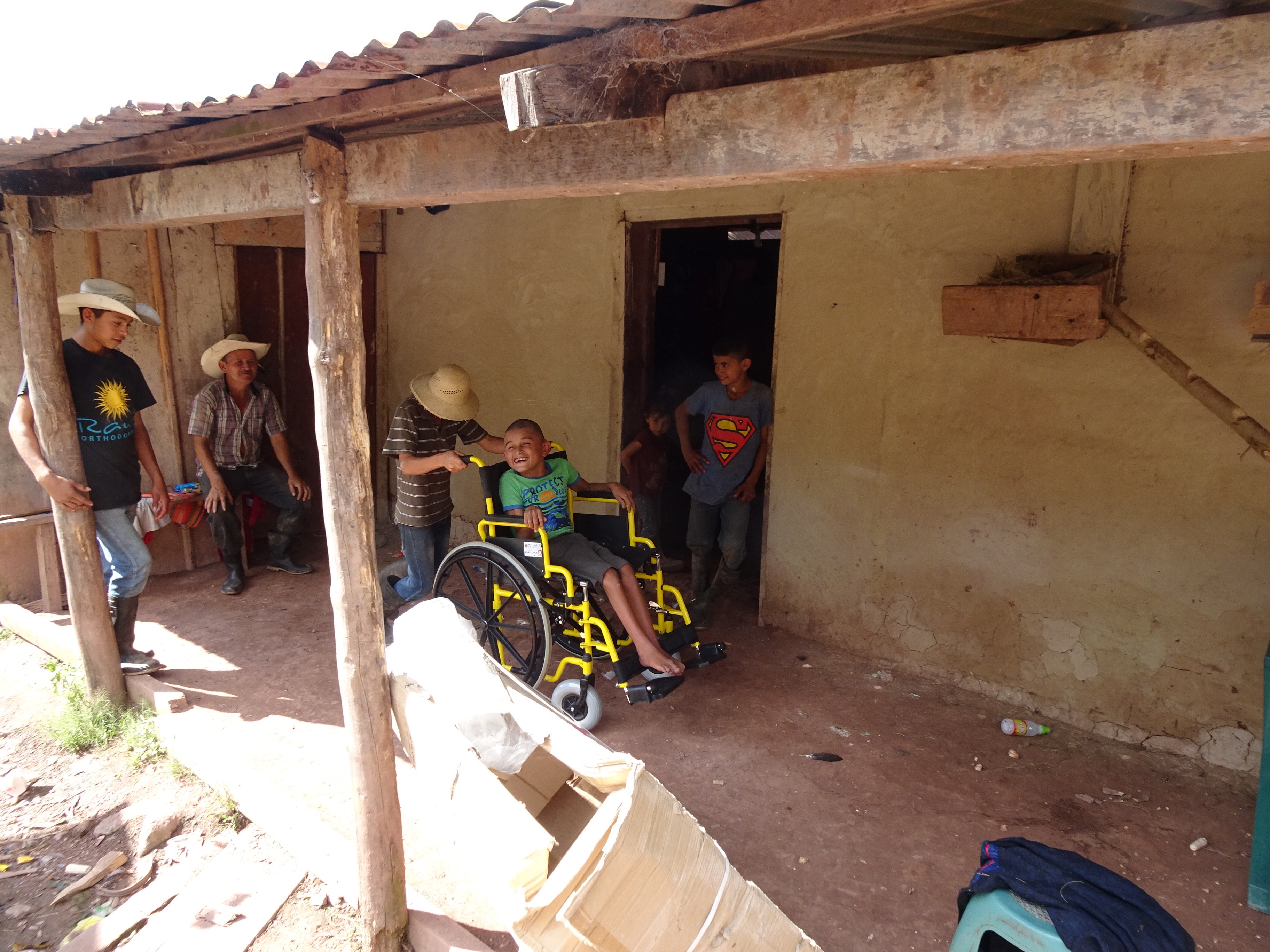
At times I can bring something - as this time when I brought a wheelchair donated by Honduras AMIGAS. But often I come with empty hands - except for the Eucharist, which means I have my hands full!

I usually bring Communion and so we have a very short prayer – with a Gospel reading, prayers for the sick person, the Lord’s prayer – and, if there’s someone there who can help, a song after the person has received communion. The Lord is walking with us, and we are called to walk with other, to accompany them.

If there is someone who has been taking care of the person, I normally talk with them and ask them how they are, recognizing how hard it must be to take care of someone who is ill. Sometimes, I’ll share that I know a bit of this since I took care of my dad.

But I really want to let the caregiver know that God is with them and that, in one sense, they are the hands of Christ caring for their loved one.

In this way, we can help people recognize their goodness and their dignity in the face of pain and suffering and we can open a space for hope and grace. Isn’t that we are called to do?

As Pope Francis goes on to say in his message:
It is crucial, … even in the midst of illness, that the whole Church measure herself against the Gospel example of the Good Samaritan, in order that she may become a true “field hospital”, for her mission is manifested in acts of care, particularly in the historical circumstances of our time. We are all fragile and vulnerable, and need that compassion which knows how to pause, approach, heal, and raise up.
Saint Lawrence, deacon, friend of the poor 

Monday, February 06, 2023

Pope Francis in South Sudan

I don’t often write about world events that don’t directly affect me and the people I work with, but I have to write a few words about the Pope’s visit to South Sudan which has moved me deeply. 

It was truly an ecumenical pilgrimage with Church of England Archbishop of Canterbury Justin Welby and with the General Assembly of the Church of Scotland Moderator Iain Greenshields. This gesture of ecumenism is so needed in our world.  

But what struck me even more personally was the site of the Mass, the mausoleum of John Garang, the “father of South Sudan.”

When I was a campus minister at St. Thomas Aquinas Church in Ames, Iowa, which was also the Catholic Student Center of Iowa State University, I was impressed by the number of students and families from South Sudan who were members of our parish. There are still many in Ames.
John Garang got a Ph.D. in Economics at Iowa State University in 1981, before I began ministry at St. Thomas.

I pray that the visit of the pope and the other religious leaders further inspires the courageous people of South Sudan in their pursuit of peace with justice. As Pope Francis said in his homily,
"Jesus knows your anguish and the hope you bear in your hearts, the joys and struggles that mark your lives, the darkness that assails you and the faith that, like a song in the night, you raise to heaven. Jesus knows you and loves you. If we remain in him, we must never fear, because for us too, every cross will turn into a resurrection, every sadness into hope, and every lament into dancing."

----- 

Here is the full text of the Pope’s homily. 

Monday, December 26, 2022

Saint Stephen, deacons, and the poor

Today, the feast of Saint Stephen, deacon and martyr, I’ve been reflecting on my ordination as a deacon on July 15, 2016.
Stephen, “a man filled with faith and the holy Spirit,” was the first among the seven “reputable men” chosen by the apostles to serve the Greek-speaking followers of Jesus who complained that “their widows were being neglected in the daily distribution.”

There are some scholars who say that these seven were not really “deacons.” Yet, the prayer of ordination of a deacon refers to the naming of seven men by the apostles, as narrated in Acts of the Apostles 6: 1-6. I remember that day, as the bishop prayed:
en los comienzos de la Iglesia, los apóstoles de tu Hijo, movidos por el Espíritu Santo, eligieron siete hombres de buena fama, como auxiliares suyos en el servicio cotidiano, mediante la oración e imposición de manos, los dedicaron al servicio de los pobres, para poder entregarse ellos, con mayor empeño, a la oración y a la predicación de la palabra. 
"in the beginning of the Church, the apostles of your Son, moved by the Holy Spirit, chose seven men with a good reputation, as helpers in the daily service; by means of prayer and the laying on of hands, they dedicated them to the service of the poor, so that they [as apostles] could devote themselves with greater commitment to prayer and the preaching of the Word." (My translation)
Though I had read and prayed over the prayer before that day, when I heard the words “los dedicaron al servicio de los pobres,” my body shook. It was as if all that I was trying to do in my life here as a missionary and all that I had tried to live in my life before coming here was being confirmed and indeed “ordered” as a public witness and ministry with the People of God. 


The English translation of the prayer of consecration is slightly different: “the apostles entrusted to those chosen men the ministry of serving at tables.” For me, the Spanish version has a fuller meaning: we are called to be at the service of the poor. 

The poor are at the center of my diaconal ministry, as they have been at many times of my life before coming here to Honduras, as they have been part of my missionary calling here in Honduras since I arrived in 2007.

I am convinced that being with the poor, at their side, serving them and accompanying them is central to who I am and to what I have been called. 

This past year, especially the last few weeks, I have been remiss in this – partly due to emotional pressures and, more recently, a series of colds. But I am convinced that we deacons ought to include this question as we examine our consciences: “When was the last time I was in the house of a poor person?” – more specifically, a physically poor person. 

It is good to be an advocate of the poor; it is good to minister to those who are poor emotionally or in terms of their faith. But I am convinced, partly by my experience, partly by the words and witness of Pope Francis, that Jesus calls us to be with those who are impoverished physically and that this is a special call for us deacons. 

In his Mass on December 24,  Pope Francis noted:
"...let us remember that it is not truly Christmas without the poor. Without the poor, we can celebrate Christmas, but not the birth of Jesus. Dear brothers, dear sisters, at Christmas God is poor: let charity be reborn!"
In that homily, Pope Francis cited the sainted archbishop Óscar Romero, who on Christmas 1978 preached these challenging words:
“No one can celebrate an authentic Christmas unless they are truly poor. The self-sufficient, the proud of heart, those who despise others because they do not possess the material goods of this earth, those who do not need or want God --- for these people there is no Christmas. Only the poor, the hungry, and those who need someone to come to them because they have need of someone, someone who is God, someone who is Emmanuel, God-with-us --- only these people are able to celebrate Christmas. Without the spirit of poverty, one is unable to be filled with God.”
Toward the end of his homily, Pope Francis said:
"He who lay naked in the manger and hung naked on the cross, asks us for truth, he asks us to go to the bare reality of things, and to lay at the foot of the manger all our excuses, our justifications and our hypocrisies. Tenderly wrapped in swaddling clothes by Mary, he wants us to be clothed in love. God does not want appearances but concreteness. Brothers and sisters, may we not let this Christmas pass without doing something good. Since it is his celebration, his birthday, let us give him the gifts he finds pleasing! At Christmas, God is concrete: in his name let us help a little hope to be born anew in those who feel hopeless!"
I believe that we ordained deacons need to show the love of God for the poor concretely, being at their side, listening to them, making their cause our own, suffering with them. This is not easy. It takes us out of our comfort zones. It takes us where we sometimes done want to go. It may even get us into trouble. 

But it is where our Lord Jesus, the Servant of Yahweh, is.
“For you know the gracious act of our Lord Jesus Christ, that for your sake he became poor although he was rich, so that by his poverty you might become rich." (2 Corinthians 8:9)

 One extra reminder of all this came in the early hours of Christmas. Just back from our Christmas Mass (our midnight Mass that began at 10 pm), I was doing a little computer work when a message arrived from a young man I know from one of our parish villages, with a Christmas greeting. In the course of our messaging back and forth, I found out that he was at the El Paso/Ciudad Juárez border, hoping to cross the bridge and get legally into the US. Jesus among the migrants.


Sunday, September 26, 2021

Novena of Saint Francis of Assisi Day Two

Going out to the margins 

 In The Joy of the Gospel, Pope Francis laid out his vision of our call to be disciples-missionaries. This means a church that “goes out” even to the peripheries, to the margins. In paragraph 20, he wrote:
In our day Jesus’ command to “go and make disciples” echoes in the changing scenarios and ever new challenges to the Church’s mission of evangelization, and all of us are called to take part in this new missionary “going forth”. Each Christian and every community must discern the path that the Lord points out, but all of us are asked to obey his call to go forth from our own comfort zone in order to reach all the “peripheries” in need of the light of the Gospel.
Saint Francis of Assisi went out to the peripheries in many ways, going beyond his comfort zone.

Francis enjoyed a comfortable existence as a young man. His father was a fairly prosperous merchant in fine cloth. He enjoyed a social life with other young people of his social class.

But after his experience as a prisoner of war something happened. My guess he may have been somewhat fastidious. He tried to avoid any encounters with lepers, but one day, moved by the Spirit, he embraced a leper. That was for him a moment of real conversion – what appalled him became a source of joy and peace. As he wrote in his testament:
The Lord granted me, Brother Francis, to begin to do penance in this way: While I was in sin, it seemed very bitter to me to see lepers. And the Lord Himself led me among them and I had mercy upon them. And when I left them that which seemed bitter to me was changed into sweetness of soul and body
He then began to attend the lepers – not as one who comes in, does a good work, and then leaves. He began to accompany them and to be with them. Soon after, reflecting on the Gospels and the call of the Lord in his life, Francis embraced holy poverty and mingled with the marginalized. I am sure that he shared the smell of the sheep, that Pope Francis has recommended.

For Saint Francis being poor and being with the poor were central elements of his calling. It wasn’t easy at first, but he embraced it and shows us the way to embrace the poor and marginalized not as objects of charity, but as our sisters and brothers.

As Pope Francis said in Havana Cuba, in 2015:
Service always looks to their faces [the faces of the most vulnerable], touches their flesh, senses their closeness and even, in some cases, ‘suffers’ that closeness and tries to help them. Service is never ideological, for we do not serve ideas, we serve people.
Saint Francis gives us an example of seeing the face of Christ in the face of the poor. Recalling his life and the admonitions of Pope Francis we can begin to bridge the gap between peoples and live as witnesses of the Reign of God, of the life filled with love and joy. As Pope Francis noted in The Joy of the Gospel:
We achieve fulfillment when we break down walls and our hearts are filled with faces and names!
We know the poor - by name.
Sculpture outside San Damiano, Assisi

Tuesday, October 20, 2020

A Homily to get me in trouble

In some ways I am glad that I will not be preaching in the US this weekend. 


The first reading, Exodus 11: 20-26, is so strong that I fear that some people would walk out – if they took it seriously. 
“You shall not molest or oppress an alien, for you were once aliens yourselves in the land of Egypt. You shall not wrong any widow or orphan. If ever you wrong them and they cry out to me, I will surely hear their cry. My wrath will flare up, and I will kill you with the sword; then your own wives will be widows, and your children orphans.” 
From what I can see from a distance, this passage is an indictment of current US policy toward the migrant and the poor. (Note: when the scriptures speak of “the widow and the orphan” they are referring to those who are without support and who therefore are poor and marginalized.) 

Combine this passage with paragraph 39 of Pope Francis’ recent encyclical Fratelli Tutti, and we’ve got a real problem. 
Then too, “in some host countries, migration causes fear and alarm, often fomented and exploited for political purposes. This can lead to a xenophobic mentality, as people close in on themselves, and it needs to be addressed decisively”. Migrants are not seen as entitled like others to participate in the life of society, and it is forgotten that they possess the same intrinsic dignity as any person. Hence, they ought to be “agents in their own redemption”. No one will ever openly deny that they are human beings, yet in practice, by our decisions and the way we treat them, we can show that we consider them less worthy, less important, less human. For Christians, this way of thinking and acting is unacceptable, since it sets certain political preferences above deep convictions of our faith: the inalienable dignity of each human person regardless of origin, race or religion, and the supreme law of fraternal love.
Scapegoating migrants, treating them as less than human, characterizing their homelands as “shit-hole countries,” speaking about immigrants fleeing violence and poverty as an invasion, calling them animals, speaking of a political opponent as having a “plan to inundate your state with a historic flood of refugees,” seriously restricting the number of refugee admissions – neither Isaiah nor Pope Francis would tolerate these actions.  

These are appeals to our worse nature, to our fears, to our sinful selfishness. They are not the ways of God or of followers of Christ. 

I speak from Honduras. Hundreds of thousands have fled from here for many years – seeking refuge from the violence, seeking a way out of poverty (as my Irish ancestors did in the 1840s), fleeing a government (financially supported by the US) rife with corruption and probable connections to drug trafficking. 

I know some from our parish, some from the village where I live who have left and are living decent lives in the US, trying to support their families. They are real people whose names I know. 

But I am not just concerned about them. I am concerned about people in the US who support these xenophobic policies. 

What has become of their souls? What sort of fear has overcome them and silenced their better part? What sense of isolation has led them to look down on others? What spiritual pandemic has infected them? 

I grieve for them. I pray that they may find a wholeness of spirit to welcome the stranger. I pray that whatever has led them to this will be purged from the US culture. 

And I have a dream that migrants and the opponents of migrants may sit down at table, share their joys and hopes, their fears and anxieties, so that God can heal the US of the anger and fear, the anxiety and uncertainties and make of them a people who can be healed by the power of a loving God who loves all, especially those who are or feel themselves marginalized. 

May God heal us all.

Tuesday, December 10, 2019

Walter Brueggemann and the consecrated life in Central America


The Honduran Confederation of Women and Men Religious has a certificate program for those forming those entering and considering entering their communities. They meet for four days every month for almost a year. About 2 men and 23 women from six countries are participating.


On November 1, I got an e-mail asking me to lead the study on reality and the stages of formation. I had to think about this carefully – first of all, I’m not a member of a religious community; secondly, I’m not an expert on the reality of Central America. I talked it over with two friends, Sisters Nancy and Pat, who are Dubuque Franciscan sisters here in Honduras and who gave the first week of presentations a few months ago. Finally, I decided to do it.

I talked a bit about the week over the phone with Sister Pat Farrell. She reminded me that the religious life today must be both prophetical and mystical.

Immediately I thought of Walter Brueggemann’s The Prophetic Imagination, which I first read in 1983 as I began working in campus ministry in Ames, Iowa. As I read it again I realized that this is an important book for ministry with its emphasis on an alternative vision of life in the face of the forces that seek to control and dominate. As he writes:


“The task of prophetic ministry is to nurture, nourish, and evoke a consciousness and perception alternative to the consciousness and perception of the dominant culture around us.”

I found a copy in Spanish and was able to extract the most important passages to help the participants understand the contrast he makes between the imperial/monarchical consciousness and the prophetic imagination.

Brueggemann suggests that lamentation in the face of the empire, the dominating monarchy, is one of the most important ways the Bible encourages us to respond and resist that consciousness.

“Bringing hurt to public expression is an important first step in the dismantling criticism that permits a new reality, theological and social, to emerge.”

The first day of our week of study we looked at the reality of Central America. I had them work in groups and then share what they saw around them.

The second morning we treated Brueggemann, after having opened up the reality the day before.

After treating Brueggemann’s explanation of the monarchical consciousness and the importance of lament, we had a short liturgy of lamentation. I asked them to think of situations which caused them to grieve and write them on a piece of paper. After sharing a reading from Isaiah, they placed their laments around a cross on the wall, while singing the hymn, Into your hands, I commend my spirit, O Lord.

I found it extremely moving – and it was for me one of the highlights of the week, it enabled us to name what causes us grief in our lives and in our world, opening up a place for a new vision.

As I was preparing this session, I came across a passage from Pope Francis in his exhortation on youth, Christus Vivit.  Paragraph 75 begins, “As a Church, may we never fail to weep before these tragedies of our young.” In the next paragraph he pointedly writes, “Some realities in life are only seen with eyes cleansed by tears.”

After the prayer of lament, we returned to Brueggemann and considered his call for the prophetic imagination which is critical of the dominant way of living and thinking but which offers hope, with an alternative way of thinking.

What I didn’t realize until my final preparation for the session was that Brueggemann notes that importance of the alternative community.

“The formation of an alternative community with an alternative consciousness is so that the dominant community may be criticized and finally dismantled. But more than dismantling, the purpose of the alternative community is to enable a new human beginning to be made.”

As we explored this, I realized that the religious life is – or, at least, should be – the living out of an alternative community. This resonated among many of the participants.

But, for Brueggemann, this alternative brings hope, cutting through the hopelessness and despair of the dominant culture which makes people feel worthless and helpless. To respond we are called to the language of amazement, of wonder.

“The hope-filled language of prophecy, in cutting through the royal despair and hopelessness, is the language of amazement. It is a language that engages the community in new discernments and celebrations just when it had nearly given up and had nothing to celebrate. The language of amazement is against the despair just as the language of grief is against the numbness.”

On November 22, Pope Francis spoke about wonder to religious, priests, seminarians in Thailand, taking up almost the same point.

“Let us be alert to beauty, alert to a sense of wonder capable of opening up new horizons and raising new questions. A consecrated life incapable of openness to surprises is only half a life. I want to say this again. A consecrated life incapable of openness to surprises each day – open to joy and to sadness, but open to surprises – is only half a life.”

For me, this morning session was one of the highlights of our time together. During other sessions we treated the reality of youth, using Pope Francis’s Christus Vivit as our guide. We also treated poverty, conflict and violence, and the Church, including the problem of clericalism.

I learned a lot both in the preparation for the sessions and in the interactions we had during and outside the sessions.

One great joy though was our Thursday morning prayer. Several sisters who work in Nicaragua led us in a joyful and noisy celebration as part of the novena before the feast of the Immaculate Conception of Mary on December 8.  With whistles and matracas (wooden noise makers) we sang to Mary. In the midst of all the troubles of our world, especially in Central America, it was a prophetic sign to be able to sing and praise God – what joy. 


It was also a joy to stay with some of the sisters for three nights. The first night, though, I spent in the CONFEREH office since I had a lot of preparation to do.  There I came across this banner promoting a campaign against human trafficking. Below the name of the organization was a phrase that could have been written by Brueggemann: Lamentos que siembran esperanza – Laments that sow hope.


What an important message for us – as we celebrate Advent, preparing for the Light coming to us in the midst of darkness.


Sunday, October 20, 2019

Mission Sunday - Iowa, Honduras, Bolivia, the Amazon, and the world


Today is Mission Sunday in the Extraordinary Month of Mission that Pope Francis called for to commemorate the hundredth anniversary of Maximum Illud, an apostolic letter of Pope Benedict XV on the missions.

Today is also the end of the week of mission in the deanery of Santa Rosa de Copán, Honduras. About fifty members of the parish of Dulce Nombre de María went on mission to the parish of Corquín, Copán, more than an hour away from Dulce Nombre. They spent the week – without money and without cellphone – visiting homes in scattered villages throughout that parish.

Missionaries of the Dulce Nombre parish
I had a less gruelling mission – visiting our sister parish, Saint Thomas Aquinas, in Ames, Iowa, and a visit to the Iowa City Catholic Worker.

At Thursday Night Liturgy at St. Thomas Aquinas, Ames
We prepared our missionaries with four sessions. At one of them, our pastor had asked me to share some thoughts on the letter of Pope Benedict XV.

The letter does respond to the situation of the early twentieth century, but there were several points that clearly redirected the sense of mission. One that I particularly appreciated the call to separate missionary activity from nationalism of any sort.

Part of the problem of missionaries has often been that they have come with the invaders – Franciscans and others came to the Americas with the conquistadors. I wonder if sometimes the native peoples identified them with the mother country and not with our real mother country – the Reign of God. A few like the Dominican priest and bishop, Bartolomé de las Casas, were exceptions.

But Pope Benedict XV advised missionaries to avoid nationalism. He noted that
“…such a situation could easily give rise to the conviction that the Christian religion is the national religion of some foreign people and that anyone converted to it is abandoning his loyalty to his own people and submitting to the pretensions and domination of a foreign power.”

And so, “it is not our vocation to expand the frontiers of human empires, but those of Christ, nor to add any citizens to countries here below but to our fatherland above.“

Pope Benedict XV goes on to characterize the missionary as humble, obedient, chaste, and a person of prayer. Meeting the unbeliever,
“...his bearing toward them is neither scornful nor fastidious; his treatment of them is neither harsh nor rough. Instead, he makes use of all the arts of Christian kindness to attract them to himself, so that he may eventually lead them into the arms of Christ, into the embrace of the Good Shepherd.”

In my meeting with our parish missionaries, I noted how they were going to different places not to impose our way of being a parish but to help open spaces for God to work.

As I look at the Synod of the Amazon, I see a part of the Church struggling to be a Church in place, not a church which is tied to any foreign nation or culture. I believe that some of the opposition comes from trying to hold onto a European/North American cultural expression of the faith – without noting that the Church in those places took much from the local culture in the early centuries of the Church.

What is important is to be open to the presence of Christ Jesus who was born into a particular culture and political situation but who transcends these. Christ and his message can find echoes and reception in many cultures. We should live in hope – and not in fear.

This afternoon, I had a few hours between Mass and dinner with some friends and so decided to spend time at the Saint Thomas Aquinas Catholic Student Center, here in Ames. I decided to visit the room dedicated to the Dulce Nombre de María parish, acknowledging our sister relationship, and also the room dedicated to “Cigar Box Ray.”


I entered the room and immediately saw the display in honor of Father Ray Herman, a graduate of Iowa State University, a priest of the Dubuque archdiocese, and a missionary to Bolivia. Reading one plaque I realized that today is the anniversary of his martyrdom in Morochata, near Cochabamba, Bolivia.


I wrote about him a few years ago here. He lived among the poor, responded to their needs, and died after getting a hospital built. And he did it with great austerity. His body was brought back to be buried in Iowa. His personal belongs fit into a cigar box.

I am far from that but he and many other missionaries, such as Blessed Stanley Rother and Blessed Tulio Marruzo, ofm, inspire me and encourage me to deepen my commitment to mission.


And so, today is a special mission Sunday for me, a time to recommit myself to the mission we all have as missionary disciples. For, as Pope Francis wrote in The Joy of the Gospel/Evangelii Gaudium (120):
"In virtue of their baptism, all the members of the People of God have become missionary disciples (cf. Mt 28:19)."