Showing posts with label Illness. Show all posts

Monday, February 20, 2023

I was sick and you visited me

As I have mentioned before in this blog, visiting the sick has been one of the most profound aspects of my diaconal ministry. Being able to visit, to talk with the sick person and with the caretakes, and to be able to share the Eucharist are a great gift, a privilege.

At times I don’t know what to say and so I just use the prayers in a book I have.
I’ll make a little small talk before I begin, asking how they are, and will often given a short commentary on a scripture passage.

Being present is the gift.

But yesterday I was on the receiving end.

I asked a neighbor, who is a communion minister, to bring me communion. She came with her young grandson; we prayed and I received communion. 

It was clear that she felt a little uncomfortable since she is accustomed to receiving communion from me or to accompanying me when I bring communion to others.

But I suddenly realized the significance of this ministry.

When we go to the sick, we bring Jesus in Communion, but we also come as the Church, the Body of Christ. Christ in the Eucharist is inseparable from Christ in His Body, the People of God.

All too often I’ve felt that some Eucharistic practices are too individualistic – me and Jesus, Jesus coming to ME. 

We look at the Eucharist from outside – as a spectacle. We even look at the Eucharist as MY food, as a commodity. 

But receiving communion from the hands of a communion minister helped me see that communion is a communal practice, a communal encounter with Christ – in the Eucharist and the Church.

We don’t give ourselves Communion; we receive it from the community of faith. 

This inspires me to re-envision how I will visit the sick in the future. 

We, both ordinary and extraordinary ministers of Communion, bring Jesus but we also bring the Church, the Body of Christ.

----

NOTE: I just began reading Monika K. Hellwig's The Eucharist and the Hunger of the World. Second Edition, published in 1992. I am sure that the introduction opened me to this insight. She mentions how, even with the post-Vatican II changes, we feel as if we are coming to the Eucharist as a "spectacle." But, as she notes, 
To take part in a eucharistic celebration is always an act of allegiance, of self-identification and of commitment, however slight. 

Friday, February 17, 2023

Being Ill in Public

I had been a bit reluctant to make my prostate cancer known publicly – though the media.

I don’t want to call attention to myself when there are so many needs around me and so many people really suffering.

But sharing has been a blessed occasion. People who have had cancer have shared with me their experiences or the experiences of family members. A person who admits he rarely prays offered a prayer for me. As of today, more than 225 persons wrote a note on a Facebook post of mine asking for prayers and there were more than 420 who responded with a care, a like or a love. 

It has been humbling.

It also reminds of the net of connections and relations I have and the importance of these connections. As Pope Francis said to young people at a meeting in Skopje, North Macedonia in 2009 (Cited in Fratelli Tutti, 8):
“Here we have a splendid secret that shows us how to dream and to turn our life into a wonderful adventure. No one can face life in isolation… We need a community that supports and helps us, in which we can help one another to keep looking ahead. How important it is to dream together… By ourselves, we risk seeing mirages, things that are not there. Dreams, on the other hand, are built together.”
And I also remember the scene in Mark 2: 1-12, where Jesus heals a paralytic, assisted by four friends:
Then some came, bringing to him a paralyzed man, carried by four of them. And when they could not bring him to Jesus because of the crowd, they removed the roof above him, and after having dug through it, they let down the mat on which the paralytic lay. When Jesus saw their faith, he said to the paralytic, “Child, your sins are forgiven.”
Note that Jesus is touched by "their" faith, not the faith of the one who was ill. I tend to think that the man is healed because of the faith and prayers of his friends.


I don’t want to be the center of attention because I know that many others suffer in silence and without the support and resources I have. 

But …. 
If being ill in public can help some people recognize the presence of God in their lives, it is worth it. 
If my illness can open other to the illness of others – and open their hearts to accompany them, my being ill in public is not in vain. 
If my illness can help others recognize the resources they have in God and in their families and communities, then my words and example may help becoming a more caring community which respects and recognizes the gifts of everyone, even the poorest and humblest.
If my illness can move others to accompany the sick, to be at their side, to help them, my words move people to open their hearts (and their bank accounts) even more (especially for the ones who are really poor and in need.) 
If my illness can help others recognize our weakness, our fragility, then God may be using me to open others to His strength that is make complete in our weakness.

The words of Pope Francis' message for this year’s day of the sick have strengthened me:
"...it is precisely through the experience of vulnerability and illness that we can learn to walk together according to the style of God, which is closeness, compassion, and tenderness."
May God awaken in me and in all of us a deep tenderness and compassion, giving us the courage to accompany and touch the poor and suffering.

I will continue updates on what I’m experiencing in the hope that it may encourage those who are sick to live with peace and even joy in the midst of their suffering and to prod those who are well to accompany the poor – with funds, if they have them, but even more with their tender presence at the side of those who are ailing.

Be there – where God is.


---------------------------------------------
Graphic by Cerezo Barredo


Friday, February 10, 2023

The World Day of the Sick

Today is the World Day of Prayer for the Sick, initiated by Pope Saint John Paul II in 1992. 

This year’s message from Pope Francis is particularly touching, perhaps because I have prostate cancer and will begin treatment next week, God willing. 

But this message is above all a profound statement on illness and what the sick need. 

Visiting the sick and the aged has become one of the most meaningful parts of my diaconal ministry. I, like many, have not always been so open to visiting the sick and being with them. But I remember as a child going with my mother to visit her sister Ruth who was dying of cancer in a facility run by the Little Sister of the Poor. I also remember visiting my paternal grandmother is a home for the elderly in an old mansion in Philadelphia, where her bed was one of four or five in the same room. I remember visiting my mother when she was suffering with cancer and was in her hospital room when she died. I especially remember the last years of my dad’s life as he suffered several strokes and was finally bed-bound. I fed him, washed him, and cared for him – something not easy, but an experience I shall never forget.

But I also remember something that helped me make my decision to care for my father at homea dn influences my ministry even today.

I was in El Salvador in 1992 for a seven month-sabbatical, helping in the parish of Suchitoto, with five US sisters and a Salvadoran pastor.

During Lent, we went to various communities for a Lenten mission. I went one week to Agua Caliente and visited the houses. I entered one house and, amid the comings and goings of the children and all the family, there was an elderly woman in a bed. I still remember being awed that the people were caring for her at home. They may not have had much, but they were present to this elderly woman.

One of the points of Pope Francis’ message this year for the World Day of the Sick is the importance of accompanying and being with the ill, walking together with them.
Illness is part of our human condition. Yet, if illness is experienced in isolation and abandonment, unaccompanied by care and compassion, it can become inhumane. When we go on a journey with others, it is not unusual for someone to feel sick, to have to stop because of fatigue or of some mishap along the way. It is precisely in such moments that we see how we are walking together: whether we are truly companions on the journey, or merely individuals on the same path, looking after our own interests and leaving others to “make do”. For this reason … I invite all of us to reflect on the fact that it is especially through the experience of vulnerability and illness that we can learn to walk together according to the style of God, which is closeness, compassion, and tenderness.
I have learned the importance of just being there, walking with the sick and the elderly. I may not know what to say and I definitely don’t have the medical savvy to help them get better, but I can be there.
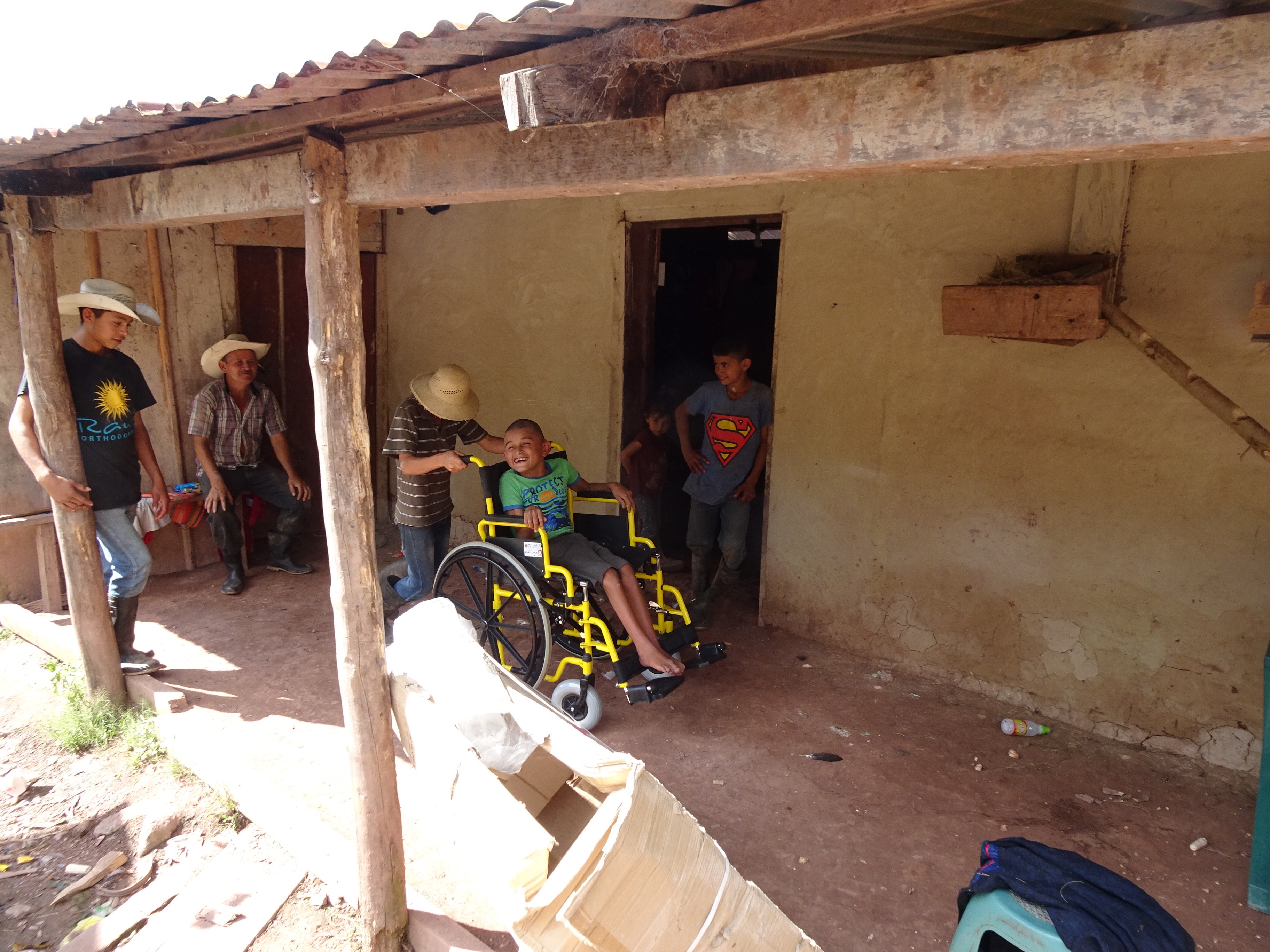
At times I can bring something - as this time when I brought a wheelchair donated by Honduras AMIGAS. But often I come with empty hands - except for the Eucharist, which means I have my hands full!

I usually bring Communion and so we have a very short prayer – with a Gospel reading, prayers for the sick person, the Lord’s prayer – and, if there’s someone there who can help, a song after the person has received communion. The Lord is walking with us, and we are called to walk with other, to accompany them.

If there is someone who has been taking care of the person, I normally talk with them and ask them how they are, recognizing how hard it must be to take care of someone who is ill. Sometimes, I’ll share that I know a bit of this since I took care of my dad.

But I really want to let the caregiver know that God is with them and that, in one sense, they are the hands of Christ caring for their loved one.

In this way, we can help people recognize their goodness and their dignity in the face of pain and suffering and we can open a space for hope and grace. Isn’t that we are called to do?

As Pope Francis goes on to say in his message:
It is crucial, … even in the midst of illness, that the whole Church measure herself against the Gospel example of the Good Samaritan, in order that she may become a true “field hospital”, for her mission is manifested in acts of care, particularly in the historical circumstances of our time. We are all fragile and vulnerable, and need that compassion which knows how to pause, approach, heal, and raise up.
Saint Lawrence, deacon, friend of the poor