Showing posts with label rains. Show all posts

Friday, September 16, 2022

Torrential rains - the effects of climate change in our parish

It rained again yesterday in the afternoon; then there was a torrential downpour about 7 pm; then it rained again, more gently, in the early hours of the night.

It feels as if it’s been raining here for over two months. Looking at weather.com, I find that it has been raining consistently for just the last two weeks.

But, before that, there have been major downpours at least since the vigil of Pentecost, June 4. As the procession began, the heavens opened and most everyone was soaked as they walked several kilometers in procession from Concepción to Dulce Nombre. 

In addition, the temperatures have been in the eighties since June, unusually hot for our area.

There has been a lot of damage from the rains, which are heavy and last for hours, often during the night. The earth is saturated, and the streams and rivers are high.

In June, a rainstorm left a major sinkhole in the road leading into Dulce Nombre from most of the villages in the parish, near the aldea de Caleras. 
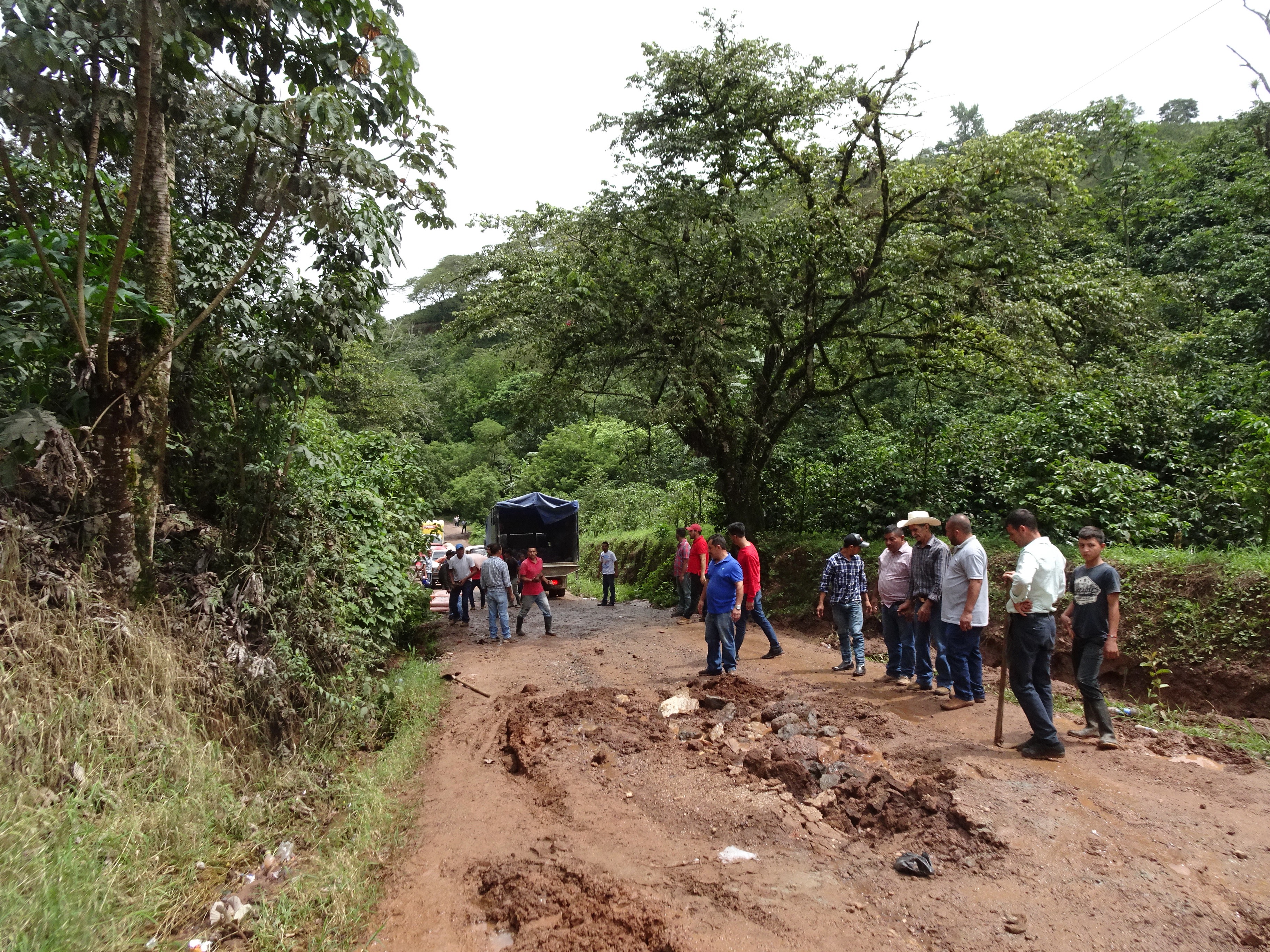

But there has been even more extensive damages to the infrastructure. 

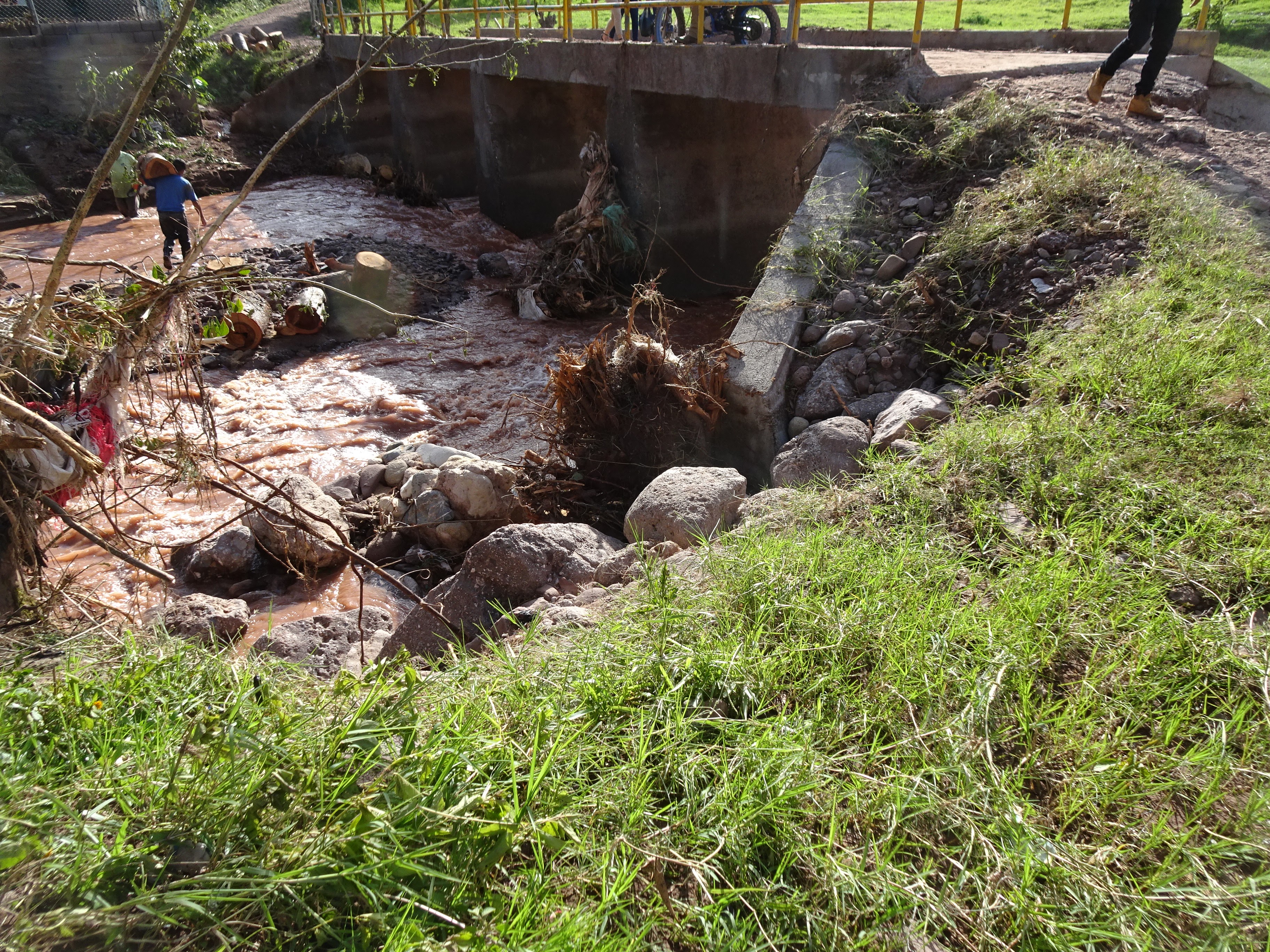
Because of the rains, part of the ramp up to the bridge by El Limón has washed away two times. The first time abut July 24.
It was “repaired.” But when I had to go to El Limón on August 16, I found it washed away again.
But the damage downstream was worse. Half of a road had collapsed and major damage was done to a bridge; several fields were swept away.
These left several communities isolated, with no access by vehicles or busses, except for motorcycles. 

About a week before the first collapse, I had scheduled a visit to San José Obrero, on July 17. I was warned to watch out for a problem. I proceeded in and took what was the former turn off and, if I hadn’t been alert, I would have gone off a ten foot cliff, where the road had collapsed a few days before.


I reversed the car and took the other path, which led through a stream bed.
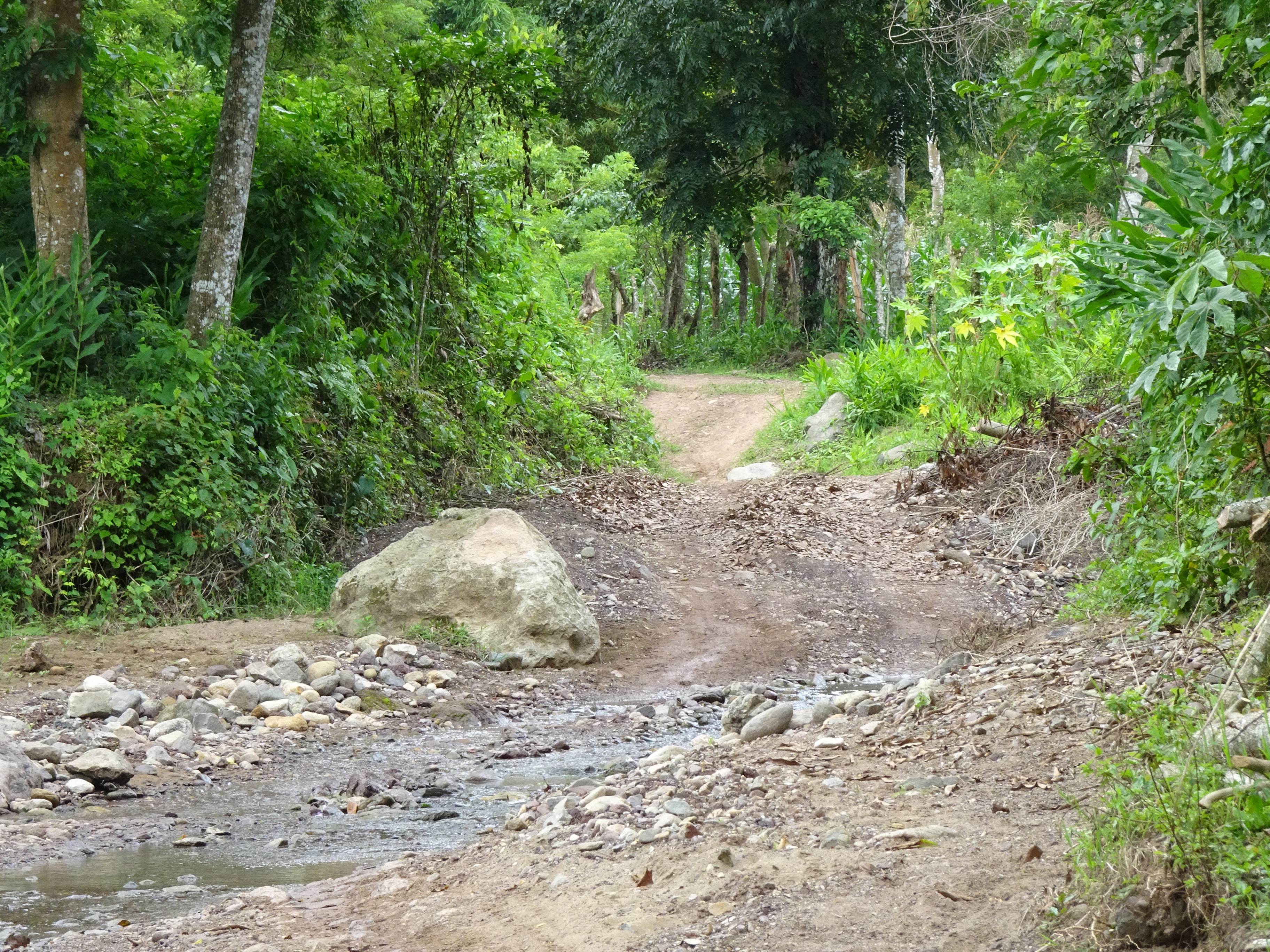


The people told me that they had gone out and prepared the path by themselves – no help from the municipality.

Just a few days ago, in another part of the parish, the ramp to another bridge was washed out. This bridge connected several villages with the highway to La Entrada. Here are some photos from Facebook, the first two from the page of the mayor of Concepción.


Heavy rains washed away the ramp and several villages are isolated (though there is a long way to go around to get to the paved highway).

This bridge was recently rebuilt and the area around the bridge (which had been flooded during the Eta and Iota hurricanes of 2020) was rebuilt. 


Photos from 2020

There was a major project to reconstruct the bridge with some other projects which, according to a sign at the site, cost 6,867,571.53 lempiras (about 279,000 dollars). 


 But a few years before that, the bridge had been replaced. Yet with the rains, it collapsed, revealing that the builders had taken short cuts and there was a part of the bridge where there were no reinforcement rebars. Ineptitude, shoddy work, short cuts to cut costs (for the construction firm), and corruption.

There are other problems. There have been a few landslides and there are several places where the threat of more landslides is great.

I personally had a problem with my sewage lines. After heavy machinery went down the road blow my house and smashed the underground sewer lines, a landslide detached the sewage lines (one for solid waste, the smaller one for liquid waste. 


I was fortunate to have a plumber and three guys fix it in two days. 


This is not just in our area. 

The paved road that goes from La Entrada to Copán Ruinas has suffered extensive damage in two or three places.

When I went to Santa Rita for the installation of the new pastor of the parish, on September 27, I had to pass a place near El Jaral where half the road collapsed into the river and traffic is reduced to one lane.


A friend posted on WhatsApp a photo of the road near Nueva Esperanza in the municipality of San Jeronimo where the highway has deteriorated significantly.
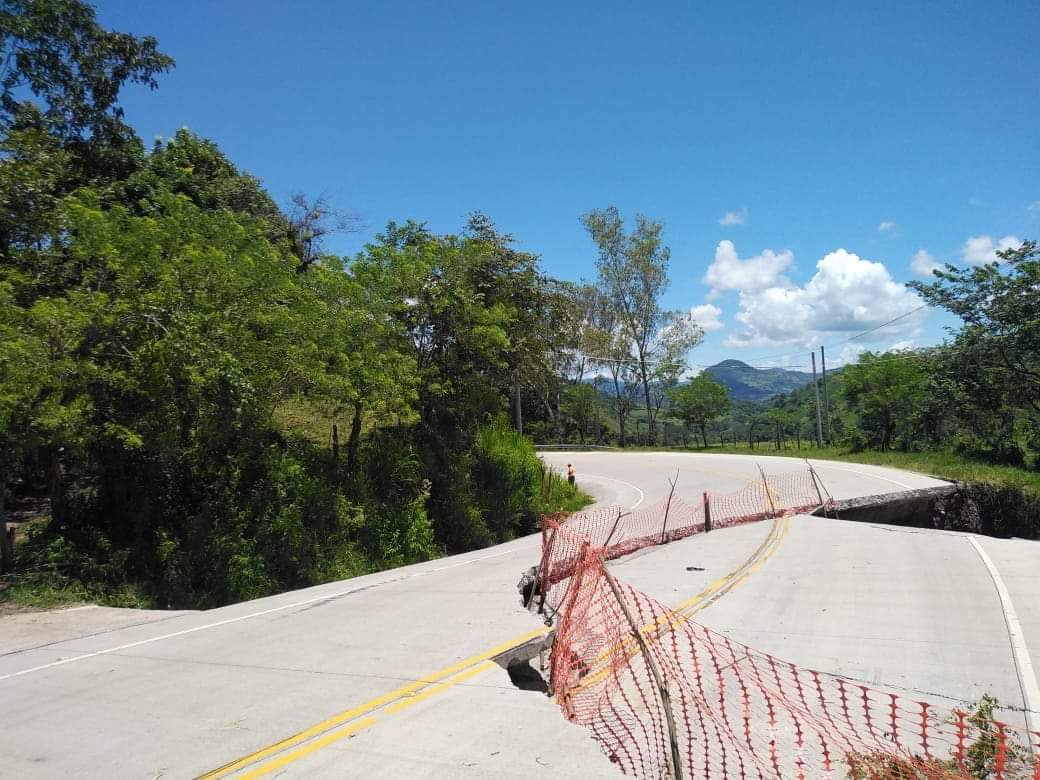

My major concern now is that we have not yet begun the hurricane season, which usually is in October and November. 

With the ground so saturated, with the roads in horrible conditions, with the river banks eroding, what will happen if we get the rains like we had in November 2020, with hurricanes Eta and Iota? I fear major disasters.

Last year I led a number of workshops in the parish to help people organize to monitor the situation and to be ready for disasters. I’ll be doing two more in October.

My hope is that the people will be organized, will monitor the situation, will be ready to response if there is a major threat, and so avoid loss of life, while at the same time avoiding panic.

It is really important that the people are organized to respond in their communities.

There is a great temptation is look to the political authorities (as well as non-governmental organizations) to provide the solution. In my opinion, this can lead to situations where the politicians manipulate the aid, especially here where corruption has been rampant and many politicians use aid to garner support.

And so we continue to struggle – in the face of the effects of climate change, the ongoing vestiges of corruption and ineptitude, and the ongoing impoverishment of our people.

May God accompany us in our struggles.

Tuesday, July 19, 2022

What's going on in Honduras.

In my visits to rural villages, I often ask people how they are doing and, especially, how are the crops.

The past week or so I’ve been hearing concern about the subsistence crops, especially the beans.

We’re in the middle of the rainy season and it has been raining a lot.

In some areas this has meant the ground is soaked - and there is concern about the harvest.

In other areas of the country there is concern about drought. There is a dry corridor, mostly in the south of the country which borders El Salvador. 

I have recently come across two articles on the crisis of food insecurity here. Honduras has about 10,225,526 inhabitants, 43% are children. According to the World Food Program, about 2.6 million are in a crisis situation. Another report suggests that this number could increase by half a million in the next three months.

One serious problem is the climate – too much rain in some areas, too little in others.

But there are other factors.

There have been significant price increases.

Fuel is up significantly.

The price of public transportation has almost gone up. Taxis in Santa Rosa de Copán used to be 20 lempiras; the most recent I paid was 35 lempiras. Bus fares have also risen.

The price of fertilizers has sky-rocketed; a few weeks ago, some one told me that one basic agricultural input had more than doubled in price.

The basic food basket is up to 60% of the minimum wage. 

Even the price of bottled water has gone up. A large water container used to be 20 or 22 lempiras. It’s now 25.

Inflation at the end of 2021 was 5.32%.

The extreme rains in our area have caused washouts of roads as well as landslides.

A few weeks ago, at least two villages in our parish were incommunicado – one for a landslide, the other for a washed out road. The municipality helped the first community; but the other community (in a different municipality) received no help and so they went out and cleared a “road” through a stream bed so that vehicles could come through.
The road into La Colonia was washed out in one place.
Las Pavas has suffered landslides.

And this is not the worst time for rains. We often get hurricanes in October and November. With a soaked earth, who knows what damage could result.

A year ago we had some workshops for forming emergency committees. I need to remind people to make sure they are organized in their villages and are on the watch for dangers and potential disasters.

In the midst of this, migration continues. I keep hearing about people I know who have left. Sunday, at Mass, people asked for prayers for some people on the journey north and for some who had arrived in the US.

The criminal deaths of migrants abandoned in a truck in El Paso don’t deter people. When things are desperate, people seek a way out.

A few days after the El Paso deaths, I was giving a ride to some folks for a parish meeting. One woman told of hearing the mother of one of those killed. Her son and several others from a town in the nearby department of Santa Barbara had left because they could find no employment. They had finished their education, but as they went around seeking jobs, they were often told they wouldn’t be hired because they had no experience.

In the midst of this, we go on, doing what we can.

The parish’s coffee field seems to be doing well and people keep on coming out to volunteer. Last week I went out to a distant community to pick up people early in the morning. They got done early and so I gave some of them a ride home (more than an hour away (in the early afternoon.
I keep on getting out to some villages.

Last Saturday I got to Debajiados for their feast day Mass. It’s a distant and very poor area – but the tiny church was filled with people from the community as well as from a nearby village in the neighboring parish. (Someone asked me if I could find some support for a new church since there is very small.)
Before Mass in Debajiados. Many more arrived latger.

Tomorrow, two sisters from a project near Tegucigalpa that provides five years of free education of poor kids will be in the parish to administer the entrance exams and interview the kids and their parents. A fair number of our parishioners have their kids in the program which goes from seventh grade to the end of high school. The kids also have opportunities to learn skills and the girls’ campus has a large pool where they learn how to swim! The programs also help some kids get into the university. It has been a good experience for many. I know of one young guy who got an internship with the mechanics section of Toyota in Tegucigalpa and who hopes to get a job with them.) 

We hope to start later this year or early next year some workshops on basic trades. Caritas Santa Rosa de Copán has been offering some in their installations in Santa Rosa but they are also willing to send instructors out to the parishes. I hope we can get this going.

But so much more is needed – not just small efforts, but real social and cultural changes.

I’ll try to keep you informed of what is happening – both in terms of the actual situations and also whatever local efforts we are able to initiate. 

One final note.

This week five stained glass windows were installed in the church in Dulce Nombre.


Tuesday, November 03, 2020

ETA - tropical storm, hurricane, and more

A hurricane is about to hit Honduras.

Since March we have had limitations on the days of circulating and in access to banks and stores, based on the last number of our identity cards. It was not easy, but it was an effort to cut down the agglomeration of people in public spaces. 

This week the Honduran government had called for the Feriado Morazanico, five days of free circulation throughout the country. This was touted as a way to benefit the tourist industry. Some of us believe this is ill-conceived and could open us up to further dissemination of COVD-19. But Tropical Storm Eta, which will probably be a full-scale hurricane, is coming and the government has postponed the feriado. 

The weather has been very strange this year. It’s been hotter than usual the past few months and we have had more rain than normal. The rain has resulted in terrible roads and in some landslides. 

Two weeks ago, a landslide destroyed a house in one rural community, while the family was inside. Thanks be to God they escaped. But it has been raining almost continuously for the past few days and we have rarely seen the sun. As a result, the roads are even worse and the danger of landslides is high. 

On the northern coast the situation is serious with major flooding in Tela, Atlantida, and other communities. 

What will happen when Eta comes into Honduras? 

 Some are suggesting that this could be very bad, as when Hurricane Mitch hit Honduras in 1998, which brought about 7000 deaths in the country. 

The roads here are treacherous in some places. The torrential rains are complicating a situation of roads that have deteriorated due to the earlier rains and the lack of maintenance. Massive ruts make driving an obstacle course and wreak havoc on the vehicles. Even in some cases when there have been repairs, the lack of putting down gravel has led to slippery roads. 

It rained almost all of Sunday night and Monday morning. I had planned to accompany the pastor to a 7:00 am Mass in the cemetery of Joyas Galanas and Plan de Naranjo, about an hour from where I live. 

When I got up at 4:30 am (since I couldn’t sleep), I wondered whether I should go. But I left at about 6:00 am. All went well till I got to a place a few kilometers before Joyas Galanas. 

A few weeks ago I had passed through here and taken a picture which I sent to the assistant mayor of Dolores. When I approached the site, I saw that they had done some work there. I thought I’d make it up the hill, but then I started slipping, although I was in four-wheel drive. I found myself straddling the road. After some efforts to more the car, with the help of someone who had come along, I saw the pastor’s car come up behind us. He ended up getting the car into a driveway nearby and I proceeded up the hill with him, though I felt at least once that we were “slip, sliding away.” 

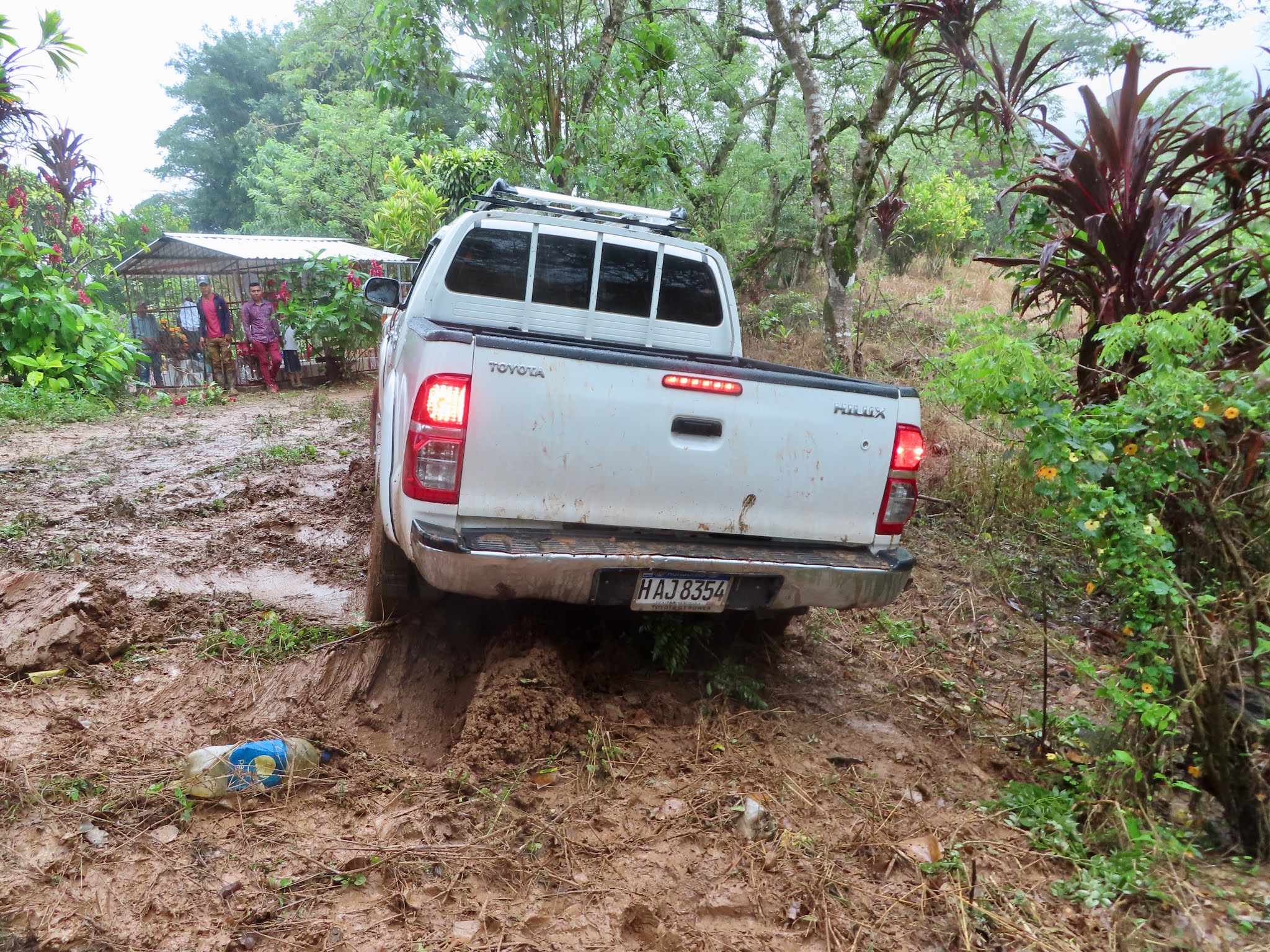
We got to the cemetery, where the people had prepared tarps for the Mass. All went well until we went to leave. The pastor’s car got stuck and it had to be pulled out of the mud by the people in the community. 


He left me off where we had left my pickup and I proceeded home safely. 

I decided to spend today at home – reading, writing, praying (for the US on election day), relaxing. It’s been raining almost continuously since last night and so I didn’t want to venture out. 

I’ll go out tomorrow since I need to have the pickup looked at and since I need to pick up a few things in Santa Rosa. Thursday and Friday should be the days when Eta most affects our area. We have a wedding scheduled in a rural community but the roads are fairly good to get there. 

 Please keep all of us in Nicaragua and Honduras in your prayers. A major tropical storm only makes the situation worse. 

One note. If you want to provide assistance, be very careful. The corruption and the inefficiency will most likely run rampant – as they did after Hurricane Mitch. This is especially problematic since the election campaigns are beginning and aid is often manipulated by the ruling political party. In addition, some international agencies prioritize their goals, instead of responding to the needs and goals of the country. A detailed study of this can be found in Jeffrey T. Jackson, The Globalizers: Development Workers in Action, published in 2005. (I read it in 2013.) 

On a personal note. I am doing well. I have enough food in the house and enough propane for the stove. I am at the top of a hill and so there is little risk of flooding. The pickup will be checked out tomorrow. The only serious concerns for me are the status of the roads and the availability of electricity and the internet – very much first world concerns. But my neighbors and others are not so privileged and so I’ll try to be available to help as I can.

Friday, October 27, 2017

I already miss Honduras

I’m sitting in the Atlanta airport waiting for a flight to Des Moines. But I’m already missing Honduras. Actually, I began to miss Honduras as I was sitting in the exit lounge in the San Pedro Sula, Honduras airport.

It has been harder to leave because of the difficult time Honduras is going through.
                                                                                                
The rains this year have been more than I remember and the roads are in worst shape than they have been in years. People are saying that this is the worst situation, in terms of the climate, since Hurricane Mitch.

Yesterday I drove to La Lima, near San Pedro Sula, leaving after confirmations in Dulce Nombre de Copán and lunch with the bishop. On the road between San Pedro and the exit to the airport, before La Lima, there were large crowds of people on the side of the road. I couldn’t see much more in the dark. This morning I saw that there was massive flooding in some of the neighborhoods and there were still homes under water. Of course, these are, for the most part, the home of the poor. I saw one house of wooden planks, about four meters square, with water up to where the “window” would be. I didn’t get my camera out fast enough, but here’s a photo from the plane.


I also will be gone in the middle of the election campaigns. I am glad for this, but this is sad. On the way to confirmations in Quebraditas on Wednesday I passed through El Zapote Santa Rosa and saw a truck unloading tin roofing and wood for buildings. A fired told me that the politicians were handing these out. The roads at the entrance to El Zapote are terrible – but the politicians are giving handouts. It’s election time, of course.

But I really miss the chances for me to serve. About 250, mostly young people, were confirmed in the parish this Wednesday and Thursday. The liturgies generally went very well. There were moments of great joy as I looked out on the crowd and saw young people I knew from visits to their communities. In Dulce Nombre, Padre German reminded me to add a petition for the ill, partly because one of those to be confirmed was suffering from cancer. For me, it was a blessing to be able to add that prayer to the prayers led by the recently confirmed.

Waiting for the bishop in Vertientes
There are lots more that I miss. I’m homesick – for Honduras. But I pray that my visit to Iowa may help build and deepen solidarity with the poor in Honduras and throughout the world.


But I’ll be back soon.

Monday, October 09, 2017

Environment and weather

Hearing of flooding in south Asia, hurricanes in Puerto Rico and the United States, and earthquakes in Mexico, it seems a little whiney to be writing about our weather here.

Rain, rain, rain – as well as heat. But mostly rain.

Water flowing over a concrete bridge, 8 October 2017
October to February is the part of the rainy season that is also quite cool. But we’ve been having heavy rains for weeks in September – more than I remember in any previous year. In many places the earth is almost completely saturated.

The results can be disastrous.

One section of the major international highway that goes between the Caribbean port of Puerto Cortez and El Salvador and Guatemala collapsed and cut off traffic for weeks. The breach in the road is between Santa Rosa de Copán and Cucyagua in a stretch of the highway that was recently repaired. The authorities are saying it is on a geological fault, which is probably partly true because up to sixty nearby houses were severely damaged and hundred displaced. But there also was a 4.3 earthquake not very far from there that may have exaggerated the fault line.

But the rains also have wreaked havoc here in our area. It is not yet as bad as it was in June and July but it could get significantly problematic.

Landslides abound. Even the retention wall below my house fell after a fierce rainfall. It’s now being rebuilt. But this is not merely a question of saturated soil. The former neighbor had excavated soil that had been keeping the wall up. This weakened the wall.


Sunday, October 1, I went to one of the most remote villages, San Marcos Las Pavas, for a Celebration of the Word with Communion. As I approached the church, I was stopped by a landslide that had left only a small muddy path for people to cross. Needless to say, I turned the car around and got out and walked through the mud and water to the church.


The people told me that there was another landslide the other side of the church. More than half of a road had fallen into the ravine below. 


This Sunday I went back with two of the missionaries who are visiting the villages of the parish this week. Part of the path had been cleared from the landslide, but I didn’t trust crossing it with a car. (I was told that the clearing was done by members of the community.)


 I then went to see the other landslide – which had gotten significantly worse.


There are also some very slippery patches of the roads. Last week I approached a curve (where I had slid into the side of the road in August) and saw a bus stuck on the side of the road. I passed with trepidation, but made it.

We also have an increases of deep holes and ditches running across the road in various places but most often down the middle or side of the road. It becomes very tricky negotiating these, mostly trying to avoid them, since they can be between six and twelve inches deep.

I also am seeing several places where the road is sinking. In one place there were deep spots a few months ago, it looks as if the earth will fall again.


 Why?

Climate change can be a major cause. People here say they haven’t seen such damage from rain since Hurricane Mitch in 1998. I haven’t seen such rain in the ten years I’ve been here.

But there is the problem of neglect.

In some places there has not been up-keep of the roads for a long time. So in a few places almost nothing has been done, even after previous damage. In the curve where the bus slid over to the side of the road, this has been a problem recently because some repair work was done and, in my estimation, not enough gravel was put down.

In this one municipality, people have gone out and done some minor repairs, mostly filling in deep holes with earth. But the municipal government seems to have done little.

In another municipality, the situation has been significantly better since they have put gravel on many roads which helps prevent slippery roads, since a lot of the earth here is clay.

In addition, when there’s a landslide, it is often left at the side of the road, waiting for the municipality to do something. In one case, nothing was done for about a month and so large fissures may driving on the road below the landslide very tricky. But in this case, some people took up shovels and picks and removed the landslide and filled part of the fissures.

In addition, these are narrow roads that often have a lot of traffic. There are busses that pass several times a day, but during the year there are often many truck carrying coffee.

Also, some land owners plant coffee and make roads into their fields without any concern for environmental effects or for possible landslides. There is at least one place where there have been more than four landslides this year. Luckily they have not blocked the whole road.

As for environmental laws or regulations for building, these are virtually non-existent. People build wherever they can. I can understand this when people in poverty build wherever they can. There is often no land available to buy and the large landowners keep grabbing more land and raising prices. But in at least one place a coffee purchasing warehouse and drying area was built where there have been serious problems of flooding of the highway. I doubt if anyone analyzed the environmental effects of the building.

I have not even begun to try to analyze the effect of large scale burning of the fields and the ensuing deforestation. This is most often the practice of large landowners, sometimes looking for a cheap way to clear an area so that they can plant coffee. 


Now one of these landowners did burn a significant area a few years ago, but he has planted hundreds of madreado trees in his fields; this will positively help the environment. But in other places I have seen scorched earth with trees deliberately cut down.

There is much more to write about, but I’ll wait and see how the rains in these next four months affects our lives here.