Showing posts with label floods. Show all posts

Monday, July 25, 2022

A Hard Rain's A-Gonna Fall

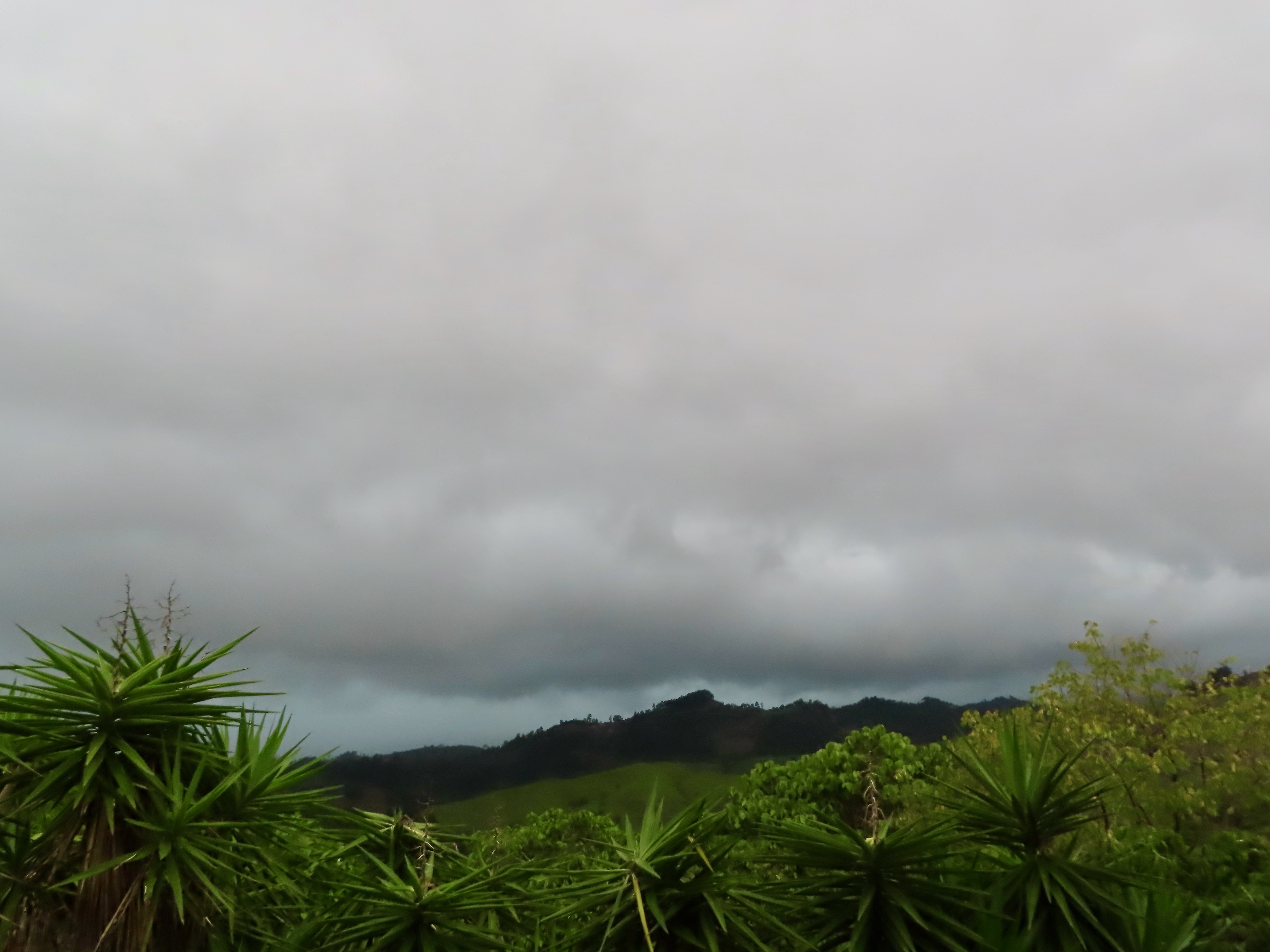
Saturday evening, a little before five pm, I looked out from my terrace to see a threatening sky, with large storm clouds coming in. “Ya viene la lluvia,” I thought. “Here come the rains.” Almost immediately, seeing the intensity of the clouds, I recalled the title of a Bob Dylan song, “A Hard Rain’s A-Gonna Fall.” And it did.
It rained hard for several hours. And it rained hard again during the early hours of the morning – not only in Plan Grande, but in other parts of the parish.

Sunday morning I went to San Antonio El Alto, above San Agustín. I had planned to visit all the sick after the Celebration of the Word, but the “road” down to one house was very slick and I decided to wait till next week.

After bringing Communion to four people in three houses, I got home about 12:15 pm, ate lunch, changed my pants. (That’s another story.) I then headed off for El Limón where Father German was going to celebrate Mass.

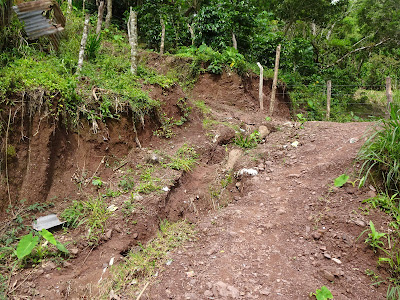
As I left my house a neighbor, who is the coordinator of the Parish Council, stopped me and showed me a few photos on his phone of damage from last night’s storm – houses and the school’s wall collapsed in Vertientes, about half of road between El Limon and Vega Redonda washed away by the river.

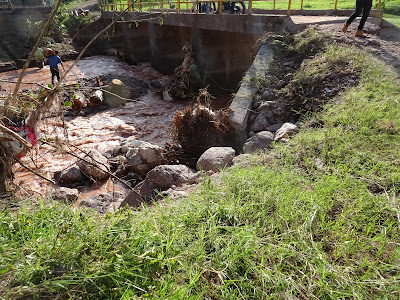
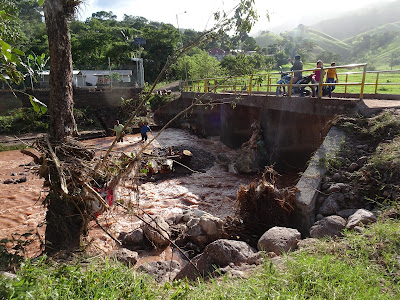
When I got to the turn-off to El Limón, I realized I wasn’t going to get to the church without walking. The ramp up to the bridge had been washed away. Cars couldn’t get up onto the bridge – only pedestrians or motorcycles. So I parked the car and walked to the church (about 300 meters.)
The washout leaves seven rural villages without access.

Walking back to the car after Mass, we saw some men cutting up tree trunks on a patch of sand in the middle of the river. Looking closer at the bridge, one could see tree trunks which had become stuck under the bridge.

I didn’t get to the part of the road that washed away on the way to Vega Redonda, but I remember stopping there on the way back from Vega Redonda a few months after the 2020 hurricanes. As I was taking a picture, a part of the road fell into the river.

There has been a lot of rain recently, more than normal, and the storms have been fierce. The soil is saturated – and it’s only July. The hurricane season is October and November. 

We may have some serious problems – again. 

Are we "On the Eve of Destruction"? 

It has also been extremely hot. This time of year is usually a little cooler, but the temperatures are more like April. The effects of climate change are serious in our area. 

And, of course, the poor suffer the most. 

---

For some strange reason, Bob Dylan's "A Hard Rain's A-Gonna Fall" and Barry McGuire's "Eve of Destruction" came to mind in the face of these disasters.

Tuesday, July 19, 2022

What's going on in Honduras.

In my visits to rural villages, I often ask people how they are doing and, especially, how are the crops.

The past week or so I’ve been hearing concern about the subsistence crops, especially the beans.

We’re in the middle of the rainy season and it has been raining a lot.

In some areas this has meant the ground is soaked - and there is concern about the harvest.

In other areas of the country there is concern about drought. There is a dry corridor, mostly in the south of the country which borders El Salvador. 

I have recently come across two articles on the crisis of food insecurity here. Honduras has about 10,225,526 inhabitants, 43% are children. According to the World Food Program, about 2.6 million are in a crisis situation. Another report suggests that this number could increase by half a million in the next three months.

One serious problem is the climate – too much rain in some areas, too little in others.

But there are other factors.

There have been significant price increases.

Fuel is up significantly.

The price of public transportation has almost gone up. Taxis in Santa Rosa de Copán used to be 20 lempiras; the most recent I paid was 35 lempiras. Bus fares have also risen.

The price of fertilizers has sky-rocketed; a few weeks ago, some one told me that one basic agricultural input had more than doubled in price.

The basic food basket is up to 60% of the minimum wage. 

Even the price of bottled water has gone up. A large water container used to be 20 or 22 lempiras. It’s now 25.

Inflation at the end of 2021 was 5.32%.

The extreme rains in our area have caused washouts of roads as well as landslides.

A few weeks ago, at least two villages in our parish were incommunicado – one for a landslide, the other for a washed out road. The municipality helped the first community; but the other community (in a different municipality) received no help and so they went out and cleared a “road” through a stream bed so that vehicles could come through.
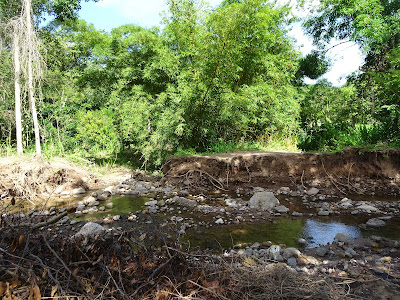
The road into La Colonia was washed out in one place.
Las Pavas has suffered landslides.

And this is not the worst time for rains. We often get hurricanes in October and November. With a soaked earth, who knows what damage could result.

A year ago we had some workshops for forming emergency committees. I need to remind people to make sure they are organized in their villages and are on the watch for dangers and potential disasters.

In the midst of this, migration continues. I keep hearing about people I know who have left. Sunday, at Mass, people asked for prayers for some people on the journey north and for some who had arrived in the US.

The criminal deaths of migrants abandoned in a truck in El Paso don’t deter people. When things are desperate, people seek a way out.

A few days after the El Paso deaths, I was giving a ride to some folks for a parish meeting. One woman told of hearing the mother of one of those killed. Her son and several others from a town in the nearby department of Santa Barbara had left because they could find no employment. They had finished their education, but as they went around seeking jobs, they were often told they wouldn’t be hired because they had no experience.

In the midst of this, we go on, doing what we can.

The parish’s coffee field seems to be doing well and people keep on coming out to volunteer. Last week I went out to a distant community to pick up people early in the morning. They got done early and so I gave some of them a ride home (more than an hour away (in the early afternoon.
I keep on getting out to some villages.

Last Saturday I got to Debajiados for their feast day Mass. It’s a distant and very poor area – but the tiny church was filled with people from the community as well as from a nearby village in the neighboring parish. (Someone asked me if I could find some support for a new church since there is very small.)
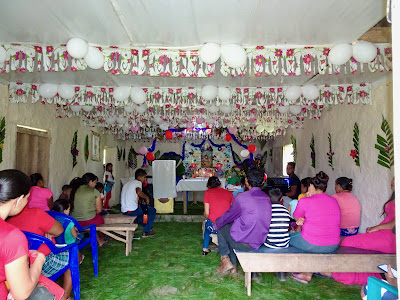
Before Mass in Debajiados. Many more arrived latger.

Tomorrow, two sisters from a project near Tegucigalpa that provides five years of free education of poor kids will be in the parish to administer the entrance exams and interview the kids and their parents. A fair number of our parishioners have their kids in the program which goes from seventh grade to the end of high school. The kids also have opportunities to learn skills and the girls’ campus has a large pool where they learn how to swim! The programs also help some kids get into the university. It has been a good experience for many. I know of one young guy who got an internship with the mechanics section of Toyota in Tegucigalpa and who hopes to get a job with them.) 

We hope to start later this year or early next year some workshops on basic trades. Caritas Santa Rosa de Copán has been offering some in their installations in Santa Rosa but they are also willing to send instructors out to the parishes. I hope we can get this going.

But so much more is needed – not just small efforts, but real social and cultural changes.

I’ll try to keep you informed of what is happening – both in terms of the actual situations and also whatever local efforts we are able to initiate. 

One final note.

This week five stained glass windows were installed in the church in Dulce Nombre.


Friday, October 17, 2014

The faces of an emergency

This morning it’s raining lightly in Santa Rosa.

The torrential rains on Tuesday night wreaked havoc on Honduras. As I noted in a previous post, Padre German and I experienced some of it in the village of Las Caleras, a village in the parish of Dulce Nombre. (The village is almost completely evangelical.)


Wednesday, before I left for Santa Rosa, I checked back in Las Caleras and visited the devastation near the turn off to Dolores.

At the side of the road I talked with a man who was standing there, watching some of the work being done to restore the road. He motioned to the coffee field behind him. The landslide had destroyed 1,000 coffee bushes which were full of berries which would have been picked in a few months.


Yesterday I went out to check on the house in Plan Grande. I got a call from Caritas asking me to investigate the needs of people, since the national office of Caritas has some mattresses and kitchen kits in a warehouse in Tegucigalpa.

So I stopped in Candelaria on my way back. I ended up visiting four sites where there was damage from the landslides caused by the torrential rain on Tuesday night.

The hill behind one house had fallen and a house at the bottom of the hill, though standing, had been evacuated. The family had relocated to the house of a friend. But they had only been able to retrieve four mattresses for the eleven family members.

I also visited the house at the side of the road that we had seen on Tuesday night where the wall had fallen in. A group was working on the hill, hoping to prevent future problems.

As I was about to leave I encountered Luis, a 79 year old man who lived with his 11 year old son. Yes. That’s what he told me. He also told me that he was partly blind and deaf. I did have to speak loudly and slowly to be heard, but he got around fairly well.

He had lost his house to a landslide. I went there and found a stick and mud house (called bahareque).


He had no place to go and was camping out in a house which is being repaired.


Then I went to Las Caleras, the site of our Tuesday night “adventure.”

The river was back to its original course but there was still a large puddle of mud in the road.

With the help of three young girls as guides, I visited several houses that had sustained serious damage. Clothes and mattresses were wet and mud-covered. A wall had fallen down in one house.

The last house I visited was a tin shack. I first talked with a few of the children there but finally the fifty-seven year old mother came by. Berta told me that 12 people lived there. I managed to get the names and ages of nine of the children (who were probably both children and grandchildren). What struck me was that all of them slept on the floor. They had no mattresses.


It was hard to see all this. But it was important for me to be reminded of the faces of the suffering.
  

Wednesday, October 15, 2014

Rain, rain, go away

The dry season here was very long. It usually ends in May or June, but this year the rains didn’t begin in earnest until September. And it’s been raining incredibly hard on and off since then.

Yesterday I went with Padre German to two distant communities – Agua Buena  Concepción and Cerro Negro. We got a late start since there was a deanery  meeting in the morning. Mass at Agua Buena began at about 4:30 pm, but I did a presentation to the people starting at 4:00 pm on base communities and the triple ministry. During our time there, it rained so hard that I could hardly hear myself. 

When Mass was over we went to Cerro Negro and arrived there late; Mass began at 7:00 pm. Padre had me do a presentation after the Gospel. As I was finishing, the torrents came and we could do nothing for about 15 minutes. The noise was that loud. Padre sat in silence.

Finally Mass went on; we had dinner at a house nearby and left for Dulce Nombre – usually about 45 minutes from Cerro Negro.

Leaving Candelaria we saw a landslide on the right side of the road and some men standing there. We got out of the truck and went to see if we could pass. We could, but there had been a landslide on the left side of the road that took out the wall of a house.

We continued on. In Caleras we saw another landslide on the right side of the road, near a house.

Caleras is one of the poorest villages in the parish; it is also the village that is almost completely evangelical.

At the bottom of the hill in Caleras, near the evangelical church. where there is a crossroads, the road and small bridge were covered with water. Some guys told us we could pass and guided us – but we got stuck in the sand and the river that replaced the small stream.

Guys came out of the nearby houses and tried to push us out. We finally gave up. The twelve to fifteen young guys, with lots of testosterone, left.


Padre called and asked Marcia to see if there was some way to get a truck to pull us out. We sat back and waited.

However, the water was rising. We abandoned a car and went up to the porch of a poor house nearby – to seek some shelter with the pig and two dogs there.

The people in the house invited us in. They even offered us their only bed! Evangelical Hondurans offering a Guatemalan priest and a US missionary their beds. The generosity of the poor is amazing. 

After about half an hour we saw the lights of a car coming down the hill. It was the mayor with several policemen and a local reporter.

The mayor went and looked around the village, one of the poorest in the area. The water was almost knee deep in some places. We passed a house where the front wall had fallen.


But there was a lot of hidden damage. A young guy told me that about 6:30 pm the waters began rising rapidly and by 7:30 pm were inside many houses and the small evangelical church – which lost its instruments.

The water in one house had reached about two feet high – and that house was about 6 inches above the level of the road.

Note the water line.
The mayor’s truck finally pulled Padre’s car, which – thanks be to God – started.


We followed the mayor’s truck.

The police had told us that they had to cut some trees that had fallen in the road and blocked passage. We barely passed through one passage and saw some serious landslides.

The situation is still pretty precarious and I’m probably stuck in Dulce Nombre for another say. Padre lent me a pair of pants since my jeans were soaked (especially after I fell in the water!)

But the lives of the people are seriously affected. Some communities are incommunicado. Others have suffered major flooding. It will take some time for recovery.

This comes just a day after a major earthquake hit the region. I didn’t feel anything here but there was major damage to the road that goes to the Salvadoran border, near the village of El Portillo which sits on the continental divide.

Why has all this happened?

That’s another post but I’d suggest that some of the causes include climate change/global warming, poor practices of land management, cutting of coffee plants on hillsides, and cutting roads through hills and leaving cliffs without retention walls. This is not really a natural disaster - but one with human causes.

What’s the next step?