Thursday, November 26, 2020

Thanksgiving in times of hurricanes and COVID

It's Thanksgiving in the US, but I will give thanks here.

Honduras

1992 was an extraordinary year in my life. It was a time of grace, a time of learning to say “gracias a Dios” – thanks be to God. 

I had managed to persuade the parish of St. Thomas Aquinas Church and Catholic Student Center in Ames to provide sabbaticals to lay employees and I was the first to take advantage of the opportunity after eight and a half years of service in the parish.

But I took a different type of sabbatical. Instead of going off to study in a university. I spent almost seven months in El Salvador, serving for most of the time in the parish of Suchitoto. The parish, at that time, was served by a Salvadoran priest and had five US sisters working there, mostly in the countryside. 

I arrived in time to celebrate a ceasefire and the peace accords that brought an end to a bloody civil war, in which many perished at the hands of a US-supported military. The war also precipitated the displacement of hundreds of thousands.

I ended up in Suchitoto thanks to my connections with the sisters – four Dubuque Franciscans and one New Jersey Sister of Charity, who had served the area during the war. They ministered to the many communities that had returned to the countryside and lived in precarious situations, not least of all war and poverty.

Dubuque Franciscan Sisters Nancy, Pat, Kay (RIP), Carol

The pastor and they sisters ended up sending me to a remote part of the parish. It was a four hour walk to get to the community where a family took me in. I stayed there usually for four or five days at a time, participating in the life of the village, visiting other communities – training catechists and other pastoral work. 

I stayed with the Clavel family in their provisional housing, that Esteban, who had to flee the country to escape being killed, had fashioned out of the cattle stalls that once stood where he, his wife Rosa Elbia, and their children lived. I brought along a hammock for sleeping so that I wouldn’t displace anyone from their beds.

Esteban and Rosa Elbia

Life was simple. A makeshift latrine, water brought by the family from a stream about thirty minutes away, bathing in the stream, eating tortillas and beans (often very salty) with the family. The housing was so provisional that during the rains water streamed in under my hammock. But, in the midst of this, I experienced the grace of God. Almost every morning in that simple home, I woke up in my hammock with the words, “Thanks be to God,” on my lips and in my heart. In that poverty, sharing it with good people, I experienced the giftedness of God. The only appropriate response was thanksgiving. 

Today, Thanksgiving in the US, I find myself giving thanks. I had plans to spend Thanksgiving with the Dubuque Franciscans (two of whom I know from Suchitoto) but the access to a major bridge between Santa Rosa de Copán was washed out and is provisionally repaired. So, I’ll have a different Thanksgiving. This may help me recall how I have been blessed to serve in rural Honduras. 

I don’t live nearly as poorly and simply as I did in Suchitoto 28 years ago. But we are in the middle of a pandemic that has restricted my ministry. Also, we have been buffeted by two hurricanes that have left villages in the parish isolated and many places without electricity for several days. Many villages also lack water because the water lines from the springs up the mountains have been broken. 

But God is good. And people have responded to the needs.

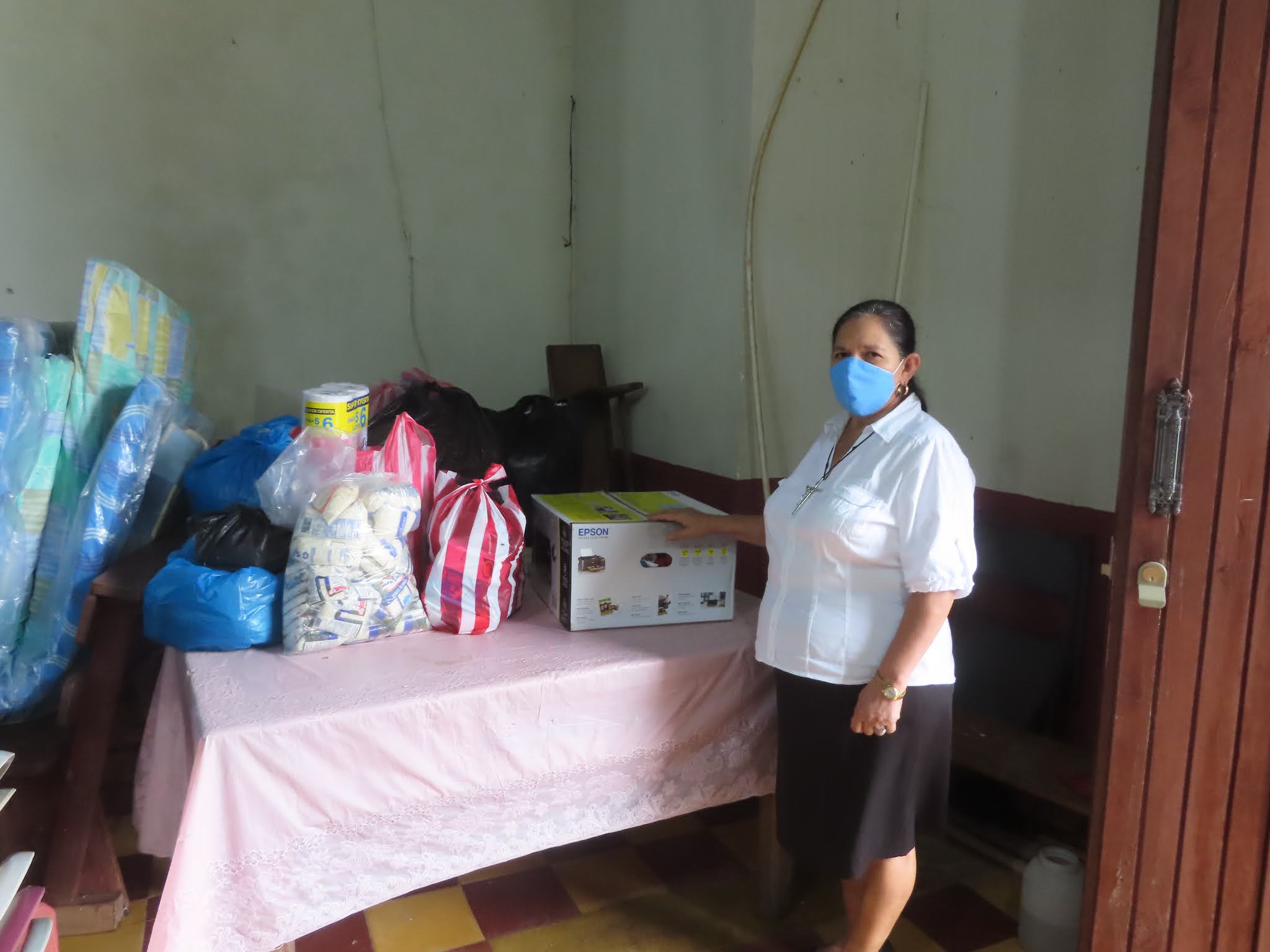
Local people have collected clothing and basic grains to share with those who have lost their homes or been displaced. Others, including some Hondurans who live in the US, have sent money to help buy basic food stuffs and cleaning supplies. Two friends are sending some money and our sister-parish, St. Thomas Aquinas in Ames, will be sending money for reconstruction efforts and may have a fundraiser for our needs. Today, God willing, I'll be going with the pastor and others to take food, clothing, and more to a village that has been isolated since the first hurricane. It may be a grueling trip since we will probably have to take the highway to La Entrada and then the highway toward Copán Ruinas, since there is no access to that part of the parish from Dulce Nombre. 

But I am grateful that we can help. 

This will be a different Thanksgiving, perhaps getting to the essence of what this day should mean – recognizing the graciousness of God, remembering that all is gift, and responding in joyful love. 

Thanks be to God.

Tuesday, November 24, 2020

The generosity of the poor

Today I spent some time at the parish and then in my home village. 

Part of the time I spent talking with Alejandro Carbajal who is the artist in charge of the mural in our parish church. He is now working on the image of Monseñor Óscar Romero, the sainted martyr of the poor, killed in El Salvador in 1980. The image is based on a photo of him receiving an offering of beans during a Mass in Chalatenango. 


There’s a family now staying in the village where I live who lost their home when a huge boulder (about 2.5 meters high and 3 x 5 meters) fell and crush and buried all their belongings about 7 am last Wednesday. They escaped with only an abode hitting one of the four children on the head. They are staying with the mother’s sister. 

Another family from the same hamlet is also here. They rescued some of the possessions but left food stuff and chickens in their home. They have an eleven-year-old who is physically and mentally disabled. We visited them and shared a few provisions. 

 I had gotten information on these cases in the morning and went to get some supplies for them. 

In the parish, there was a Honduran woman who has lived in the US for more than 14 years. She regularly sends clothing to her family for those in need. We went to her family’s house and got two bags of blankets and clothing for the family. 

We also went to the Concepción city hall to get a note that the municipality will pay for medication for two children in family that has lives in a village which has been cut off since Eta struck. We got the medicine and it will get to the kids sometime today or tomorrow. The woman who donated the clothes drove me to Concepción, to the pharmacy, and back to the church. 

Back in Plan Grande, I spoke to the delegate who had investigated the situation of the two families. When her son returned from an errand we went – she, her son, and a grandson.

We went first to the house where the family whose house had been crushed was staying. It was basically two rooms. We shared the clothes and some rice and cornmeal. As we left, the sister who was housing her sister’s family gave us a bag of beans, a donation for the parish’s efforts for those who have been displaced! 

The generosity of the poorest. She was feeding six more people, yet wanted to share with even more people. 

As I write this, I think of the image of Monseñor Romero, accepting the offering of a bag of beans. The gifts of the poor enrich our world.

Monday, November 23, 2020

Hurricane IOTA in the parish of Dulce Nombre

Hurricane Iota struck Honduras this past week, less than two weeks after Eta devastated the country. 

Eta mostly affected the north coast and left thousands without homes. Massive flooding of many cities, bridges washed out. Even the international airport in San Pedro Sula is flooded, under several feet of water and won’t be reopened until mid-December at the earliest. 

 Iota has affected us in the southwest a bit more than ETA, though all the rain will affect the already swollen rivers on the coast. One parish, not far from the parish of Dulce Nombre, has been badly hit, first by ETA and now with IOTA, with massive flooding, 93 homes destroyed in one municipality, and much, much more. 

In our parish, the rains connected with Eta provoked some mudslides which destroyed some houses and closed some roads (and made others treacherous.) A good number of trees fell, because of the strong winds and the rain-soaked land. A number of houses were lost due to mudslides. Iota came on top of this, although we had a few sunny days between the hurricanes. But when the rains and winds came, they came with incredible force – and it’s still raining, though not continuous and with less force. 

A large portion of our parish, including Plan Grande where I live, had no electricity for about three days. Downed power lines and problems with some equipment damage caused this for thousands of people. In addition, a major landslide near Candelaria closed off the one road that provides access to more than 18 aldeas. It was repaired provisionally in a day, with about half the road fallen, but it is still muddy and slippery. 

El Zapote Santa Rosa, an aldea just ten minutes away from Plan Grande was incommunicado, until Friday when a local coffee grower got some machinery to come and fix one part if the road, so that the village would have some access to and from Dulce Nombre. But still there is no access to aldeas north of there, due to mudslides, roads fallen away, and other obstacles. That means that more than fourteen communities have no access to Dulce Nombre. There are people who lost their houses or whose houses are in danger. They have moved in with relatives or into three places where they have set up shelters. It appears that the local people have matters under control - even trying to recover some water sources in the community, since their water lines from springs have been destroyed.

Many communities have only access on foot. In addition, many of the communities have not had electricity since Monday and cell phone service of the most common provider was almost non-existent. As of Sunday, there was some electricity and cell phone service in that part of the parish, but there was no access by vehicles. 

I am trying to be in contact with folks to see what is happening, what are the needs, and how we might begin to help better. There are isolated villages, with needs for food and more, but the only way to get supplies in is on foot or with horses and mules. 

In the parish of Dulce Nombre, we have had some serious damage, with houses destroyed by landslides. Due to damage to roads, many parts of the parish are inaccessible. Electricity was off in many places for more than six days and there has been no cellphone coverage in many parts. Many places don’t have access to water. Many people have also lost their crops and their coffee fields. 

 The parish has received aid from local sources, as well as donations from Hondurans in the US. The Santa Rosa Rotary club arrived today to give out some aid in Dulce Nombre. But a major problem is getting aid to the countryside, to those communities which are isolated because of landslides. 

Thursday, I want with Padre German and Fernando, a seminarian who is with us this year, to Vega Redonda. We couldn’t get there the normal way since a major road had been washed out. We had to go through a back road, crossing a stream two times and navigating a slippery hill. We got there and distributed some water. Padre went to see an area where there had been a landslide. Some of the people returned with us to stay with family who live in Dulce Nombre and Concepción.


Friday, we went to the mountain village of Vertientes. We again had to use an alternative route along slippery muddy roads, up and down hills. There had been two major landslides in Vertientes. One landslide left four houses destroyed and at least two more in danger. Padre went to see another site int he village, about an hour away, where more houses were destroyed. 


I fell trying to walk through the fields and went to a clinic in Santa Rosa on Saturday. No broken ribs, but I’m sore. Also, I had to take a COVID-19n test. Negative!

On Saturday, the pastor went to San José El Bosque which is almost completely isolated. I have been in contact today with someone in the remote village of San Marcos Las Pavas which has had at least five houses destroyed. The village has been isolated since ETA and there is no access for vehicles. In addition, it is in a part of the parish which has no access to Dulce Nombre because of major landslides and more, leaving about 14 communities isolated. I managed to call someone from Delicias, Concepción, which is isolated. There were four breaks in the road from Delicias to the villages north of there. The problem is that some communities don’t have enough food supplies – and so they were trying to transport some rice and other supplies on horseback. 

We are just beginning to get an idea of the effects of the hurricane and what will be needed for reconstruction. Right now, we are concentrating on finding ways to save lives and protect people. This week there are forecasts of rain every day and so recovery will be even slower.

I'm well, even though the water system in Plan Grande in not working due to the destruction of pipes from the water source - even metal water pipes have been affected by the landslides. But I have water from a tank as well as from barrels collecting rain water. And I have bottled drinking water.


Thursday, November 12, 2020

The deacon and the World Day of the Poor

“Stretch forth your hand to the poor.” 
Sirach 7:32


 This is the theme of the fourth world day of prayer for the poor, this coming Sunday, November 15. It is a theme that should be at the center of the ministry and spirituality of every follower of Christ and, especially, of every deacon. 

Recently I listened to a webinar of a prominent deacon promoting his recent book. As I listened, I felt a lack of connection of his spirituality of the diaconate with the materially poor. He had some good insights on spirituality, especially on Jean-Pierre de Caussade’s idea of “the sacrament of the present moment,” but I did not find any suggestion that, in the encounter with the poor, we are face to face with “the sacrament of the suffering Christ.” 

My question is: how can we have a spirituality of the deacon without a careful investigation of how service with the poor makes us who we are as deacons? 

I believe that a diaconal spirituality that does not incorporate the poor into an understanding of our identity as deacons is incomplete. In my opinion, a deacon without frequent and continuous encounters with the poor, the materially poor, may be missing part of our calling. 

Before I began working as a lay campus minister in the parish of St. Thomas Aquinas Church in Ames, Iowa, I had a very limited understanding of this. I was very involved in advocacy, especially of peace and human rights, but my direct contact with the poor was limited. But, through the witness of members of the parish and students involved in the service and justice team, I learned this truth and began to involve myself more directly with those at the margins of society. 

Now, I live in the midst of the poor – though my house is not anyway near as poor and simple as my neighbors. 

Recently, there have been several articles and books that refer to the work of John Collins that, in my opinion, displace the centrality of the poor in the diaconal vocation. This does not mean that the deacon’s ministry and identity are limited to “humble service,” but service to the marginalized is critical. 

Attempts to contextualize the diaconal service of the poor can lead to a marginalization of this central aspect of our vocation. What is needed is an integration of the triple diakonia: Word, Sacrament, and Charity. 

According to a recent Vatican document, the ministry of the deacon is both evangelization and charity, brought together at the Eucharistic table. (Congregation of the Clergy, The pastoral conversion of the Parish community in the service of the evangelizing mission of the Church, ¶ 82) 

I would suggest that the deacon should be seen as a sacramental presence of Christ the Servant, who became poor. 

Present at the altar we should bring the needs of the poor, especially the materially poor, praying for them in the Prayers of the Faithful. 

In our preaching we should bring to light the needs of the poor and God’s special love for the poor. A friend who worked with deacons in his archdiocese for many years has suggested that when the deacon preaches, he should make present the poor in our midst. 

When we send forth the assembly at the end of Mass, we should be sending them to live out their baptismal commitment of service and charity. We ourselves should be animating them to accompany the poor in our midst. 

Deacon Enzo Petrolino, commenting on a passage of the Syriac Testament of the Lord, writes, 
“The edifying role of the deacon in his community requires him to perceive the suffering and needs that are present in the community and, as much as possible, to spread the mercy of Jesus Christ in a concrete way, making it visible to man." (Pope Francis: Deacons: Servants of Charity, p. 245)
The deacon is a herald who should be “Good News to the Poor,” in what we say and do. We should make real the connection between the People of God and the poor and marginalized and help the Church live this.

Much has been made recently of the role the deacon has in relation to the bishop, and rightly so. But the deacon also has a role for the entire church, directly related to the poor and marginalized. 

Commenting on the Epistle of Clement to James, Bishop Shawn McKnight noted that the deacon is a bridge between the poor and the community at large. 
"Whereas the emphasis had been placed upon the deacon bringing the needs of the poor to the bishop, here the deacon is to motivate and challenge the community to satisfy the needs of the poor…. The bishop must be advised as to the needs of the people and be made aware of the charisms available within the community to satisfy these needs. Deacons are clearly described here as servants of the church, and not merely personal attendants of the bishop. The deacon serves to animate the faithful to fulfill their Gospel obligation, working to bind the church more closely in solidarity with those in need. (Understanding the Diaconate: Historical, Theological, and Sociological Foundations, p. 137) 
How then can we deacons “stretch forth our hands to the poor” and motivate the whole church to the charity and solidarity of Christ, in a world filled with suffering?

-----

The photo is a detail of a mural being painted in the church of Dulce Nombre de María in Dulce Nombre de Copán, Honduras. 

Sunday, November 08, 2020

Grace abounds


The last two weeks have been times of grace for me, despite difficult situations and the pandemic and hurricane. Here are some photos.


Travel has been tricky – and the pastor’s car got stuck in a cemetery on All Souls Day. 


I had the power steering belt changed on my pickup on Wednesday. This is what some of the roads look like, if you wonder why I have so many repairs.


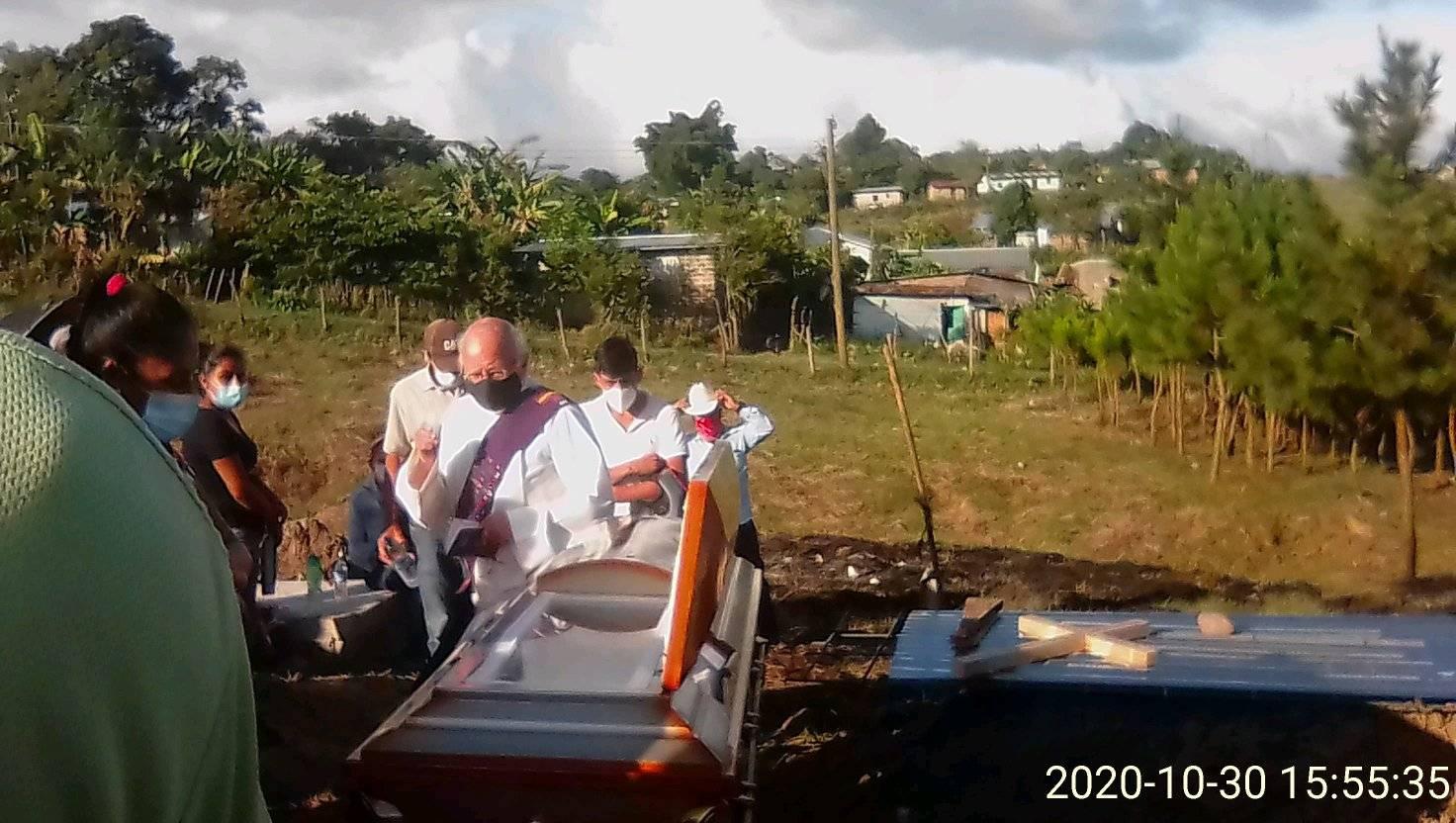
There was the grave-side service on October 30 in Dulce Nombre of a young man who died of electrocution at work. 


There was the baptism on October 31 of a young man who needs a fourth operation for cerebral blood coagulation.

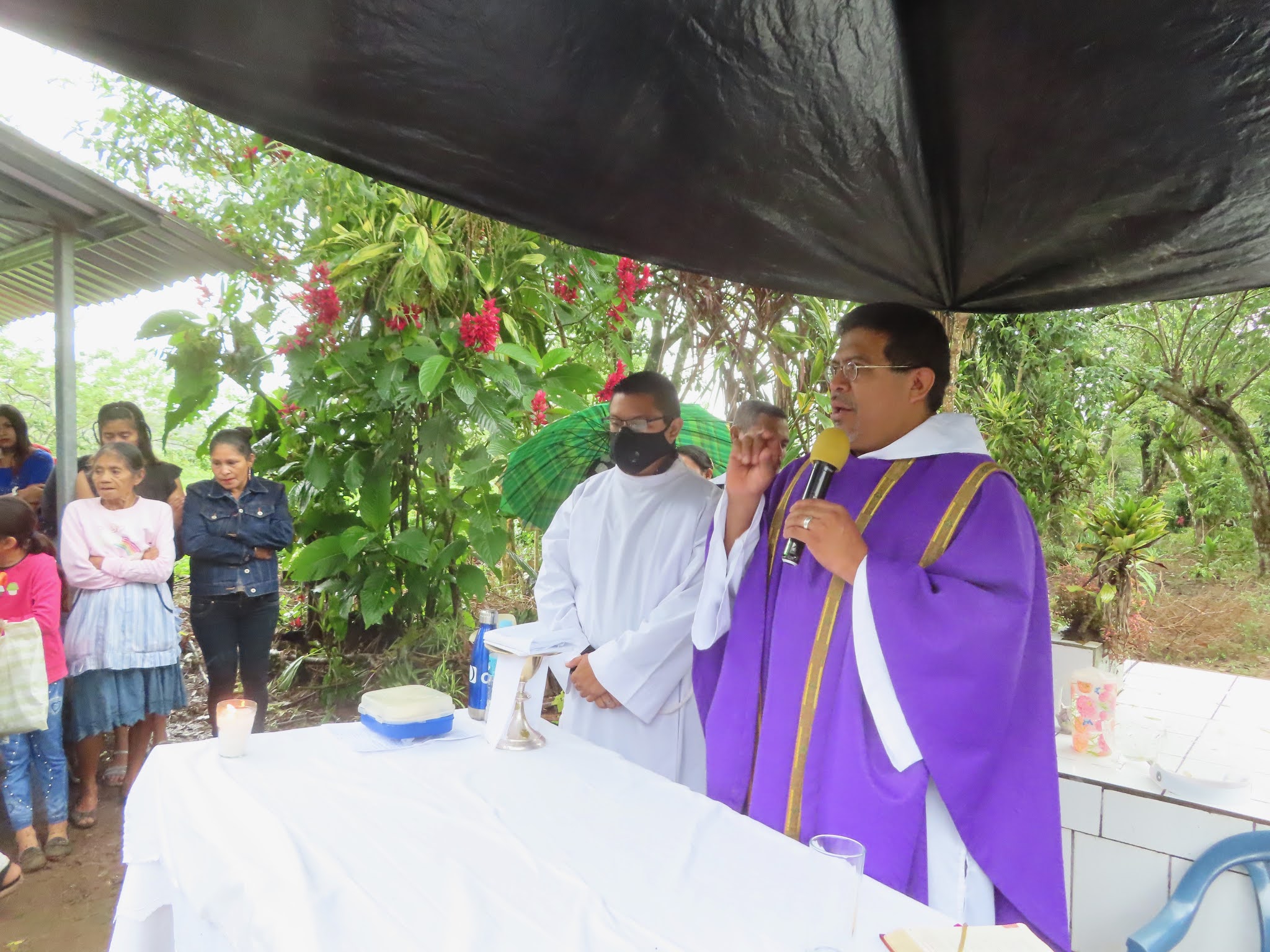
There was the All Souls Day Mass at the cemetery in Joyas Galanas (where I preached). HEre's a picture of the pastor with Fernando, the seminarian who's with us this year. 


There was the wedding of a young couple in Descansadero, last Thursday, November 5. 


There were the baptisms of four kids, ages 11 months to six years, in San Agustín, on Saturday, November 7. 


There was the joy of seeing that the church in San Agustín is collecting food stuffs and materials for the victims of the earthquake. One family donated four sacks of corn. 


And there has been my continuing amazement at the work on the murals in the parish church – with the mural of Saint Lawrence the deacon almost finished. 


 God is good.

And the sun came out for a time yesterday.