Friday, February 10, 2023

The World Day of the Sick

Today is the World Day of Prayer for the Sick, initiated by Pope Saint John Paul II in 1992. 

This year’s message from Pope Francis is particularly touching, perhaps because I have prostate cancer and will begin treatment next week, God willing. 

But this message is above all a profound statement on illness and what the sick need. 

Visiting the sick and the aged has become one of the most meaningful parts of my diaconal ministry. I, like many, have not always been so open to visiting the sick and being with them. But I remember as a child going with my mother to visit her sister Ruth who was dying of cancer in a facility run by the Little Sister of the Poor. I also remember visiting my paternal grandmother is a home for the elderly in an old mansion in Philadelphia, where her bed was one of four or five in the same room. I remember visiting my mother when she was suffering with cancer and was in her hospital room when she died. I especially remember the last years of my dad’s life as he suffered several strokes and was finally bed-bound. I fed him, washed him, and cared for him – something not easy, but an experience I shall never forget.

But I also remember something that helped me make my decision to care for my father at homea dn influences my ministry even today.

I was in El Salvador in 1992 for a seven month-sabbatical, helping in the parish of Suchitoto, with five US sisters and a Salvadoran pastor.

During Lent, we went to various communities for a Lenten mission. I went one week to Agua Caliente and visited the houses. I entered one house and, amid the comings and goings of the children and all the family, there was an elderly woman in a bed. I still remember being awed that the people were caring for her at home. They may not have had much, but they were present to this elderly woman.

One of the points of Pope Francis’ message this year for the World Day of the Sick is the importance of accompanying and being with the ill, walking together with them.
Illness is part of our human condition. Yet, if illness is experienced in isolation and abandonment, unaccompanied by care and compassion, it can become inhumane. When we go on a journey with others, it is not unusual for someone to feel sick, to have to stop because of fatigue or of some mishap along the way. It is precisely in such moments that we see how we are walking together: whether we are truly companions on the journey, or merely individuals on the same path, looking after our own interests and leaving others to “make do”. For this reason … I invite all of us to reflect on the fact that it is especially through the experience of vulnerability and illness that we can learn to walk together according to the style of God, which is closeness, compassion, and tenderness.
I have learned the importance of just being there, walking with the sick and the elderly. I may not know what to say and I definitely don’t have the medical savvy to help them get better, but I can be there.
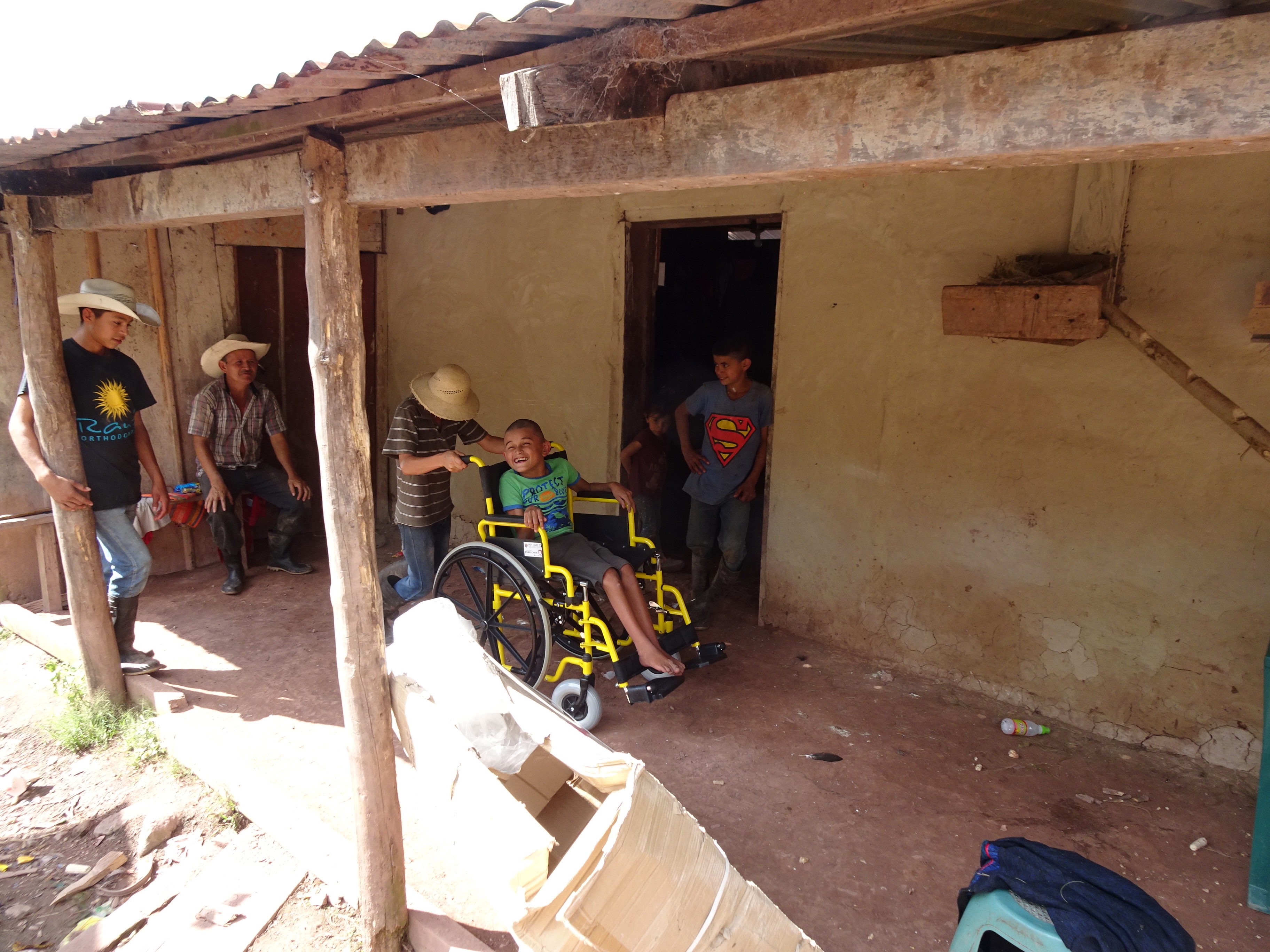
At times I can bring something - as this time when I brought a wheelchair donated by Honduras AMIGAS. But often I come with empty hands - except for the Eucharist, which means I have my hands full!

I usually bring Communion and so we have a very short prayer – with a Gospel reading, prayers for the sick person, the Lord’s prayer – and, if there’s someone there who can help, a song after the person has received communion. The Lord is walking with us, and we are called to walk with other, to accompany them.

If there is someone who has been taking care of the person, I normally talk with them and ask them how they are, recognizing how hard it must be to take care of someone who is ill. Sometimes, I’ll share that I know a bit of this since I took care of my dad.

But I really want to let the caregiver know that God is with them and that, in one sense, they are the hands of Christ caring for their loved one.

In this way, we can help people recognize their goodness and their dignity in the face of pain and suffering and we can open a space for hope and grace. Isn’t that we are called to do?

As Pope Francis goes on to say in his message:
It is crucial, … even in the midst of illness, that the whole Church measure herself against the Gospel example of the Good Samaritan, in order that she may become a true “field hospital”, for her mission is manifested in acts of care, particularly in the historical circumstances of our time. We are all fragile and vulnerable, and need that compassion which knows how to pause, approach, heal, and raise up.
Saint Lawrence, deacon, friend of the poor 

Medical care here or in the US

As some of you may know, I have prostate cancer and will soon be undergoing chemotherapy.

Before anyone asks, I'll be getting the treatments here in Honduras.

Several times people I know as well as the doctors have asked me about going to the US for treatment. Usually, the question was breached by asking me if I have medical insurance in the US. I answer that I don’t have medical insurance in the US since I am in the US at most a few weeks a year. 

I don’t expect to just fly to the US and get medical care. I am seeking medical care here since this is my home.

In a sense, this is a way to share with my neighbors, though I do have many privileges and advantages that they don’t have.

First of all, I do have the economic resources to have high quality treatment here – I get Social Security payments and a tiny pension (from teaching at Iowa State University); I also have a decent amount set aside in an IRA (Individual Retirement Account). In addition, several persons have offered financial assistance. 

 But I recall that most of my neighbors would not be able to get this type of care in a private clinic and would have to depend on the public hospitals or do some serious fundraising. How many times I have seen people collecting money, even stopping cars on the roads, to try to help someone with major medical expenses.

But to just get up and fly off for medical care doesn’t seem right. I want to be here among the people I know and love.

One relative on learning of my illness sent me an urgent message, telling me to come home. But this is my home. I didn’t respond to her in this way, respecting her real concern for me. But it’s what I think and feel. 

And I am at peace with this decision. Of course, I may change my mind in the middle of the chemotherapies. But now I am at peace and want to stay here – where my heart is.

I hope and pray that this experience may open me deeper to the needs of mys sisters and brothers here.

Monday, February 06, 2023

Visiting the sick and being the one who is ill

Visiting the sick is one of the ministries that I’ve grown to love here in the parish of Dulce Nombre. 

I would often go to a community on a Sunday morning for a Celebration of the Word with Communion; after the celebration, I would go to visit the sick and the elderly. I tried to visit communities where there was no communion minister.

I have also accompanied the communion ministers in their monthly meetings. 

February 11 is the World Day of the Sick, promoted by the popes, on the feast of Our Lady of Lourdes, whose shrine is a center for healing. 

The month before the pandemic, we had a special activity for the World Day of the Sick in San Agustín. A large group of communion ministers got together and visited the sick there and in a neighboring village, Descombros.

At that time, there was only one communion minister and she visited the many sick, but it was hard for her to attend so many people. At that time, I would come several times and visit the sick.

This was a special occasion. We met for prayer in the church. Several people from San Agustín served as guides and each communion minister visited two or three people. We got together afterwards for a reflection and a lunch together. It was a good experience.
This year, the communion ministers will visit the sick, the elderly, and those confined to their homes on February 11 and 12. I won’t be able to accompany them because I have two pre-marriage interviews on Saturday morning. I’ve had five so far since January 1. These couples want to receive the sacrament of matrimony before Lent! 

Last year, we also visited the sick in San Agustín as well as in other nearby communities.

In the last months of 2022, I didn’t make many visits, partly because of a serious chest cold that took months to get over – even with visits to two doctors.

This year, the day of the sick has special relevance for me, since I have been diagnosed with prostate cancer and hope to begin treatment shortly. 

The words of Pope Francis touch my heart. Pope Francis begins noting the importance of accompanying the sick: 
 Illness is part of our human condition. Yet, if illness is experienced in isolation and abandonment, unaccompanied by care and compassion, it can become inhumane. When we go on a journey with others, it is not unusual for someone to feel sick, to have to stop because of fatigue or of some mishap along the way. It is precisely in such moments that we see how we are walking together: whether we are truly companions on the journey, or merely individuals on the same path, looking after our own interests and leaving others to “make do”. 
 How many of the sick and the elderly live in isolation, with little care by their family and friends.

But I have seen so many of the sick accompanied and cared for by family members. I recall the older woman cared for by her young grandson, the young man who fell and hurt his back who was cared for by his companion, the young man who cared for his future wife after she had a difficult birth, the family that cared for their ill grandfather, and so many more. I have felt so connected with them since I cared for my dad in the last years of his life. I have sometimes shared this with the caregivers, commending them for their care and reminding them that they are the hands of Christ caring for their sick or elderly relative.

I was reluctant to share news of my cancer. But after sharing with a few people, I have been overwhelmed with prayers, offers of support, real solidarity. Some survivors of prostate cancer have told me of their experience.

It’s overwhelming and gives me great consolation and, in some mysterious way, it has given me renewed strength to live my diaconal vocation.

But it is important to face my vulnerability. In his message, Pope Francis wrote:
…it is especially through the experience of vulnerability and illness that we can learn to walk together according to the style of God, which is closeness, compassion, and tenderness.
In the last year or so, I have become more conscious of my vulnerability and weakness; I am, after all, 75 years old.

Now with this cancer, I am experiencing illness, though I have resources that most others here don’t. 

Thanks be to God, this has opened up depths of compassion that I didn’t realize that I had. When I drove to San Pedro Sula last week to meet with the urologist and the oncologist, I had a deep sense of connection and compassion to all the people I saw – especially the poor walking, working, and living at the side of the road. I think of the experience of Thomas Merton at Fourth and Walnut in Louisville, Kentucky, on March 18, 1958, as related in Conjectures of a Guilty Bystander, pages 141-142.
In Louisville, at the corner of Fourth and Walnut, in the center of the shopping district, I was suddenly overwhelmed with the realization that I loved all those people, that they were mine and I theirs, that we could not be alien to one another even though we were total strangers. It was like waking from a dream of separateness, of spurious self-isolation in a special world, the world of renunciation and supposed holiness. The whole illusion of a separate holy existence is a dream....
We are part of each other. We are all brothers and sisters, as Pope Francis wrote in his last encyclical Fratelli Tutti. Our illness and vulnerability can open us to the sick and vulnerable around us – remembering that Jesus too shares our vulnerability.

Pope Francis in South Sudan

I don’t often write about world events that don’t directly affect me and the people I work with, but I have to write a few words about the Pope’s visit to South Sudan which has moved me deeply. 

It was truly an ecumenical pilgrimage with Church of England Archbishop of Canterbury Justin Welby and with the General Assembly of the Church of Scotland Moderator Iain Greenshields. This gesture of ecumenism is so needed in our world.  

But what struck me even more personally was the site of the Mass, the mausoleum of John Garang, the “father of South Sudan.”

When I was a campus minister at St. Thomas Aquinas Church in Ames, Iowa, which was also the Catholic Student Center of Iowa State University, I was impressed by the number of students and families from South Sudan who were members of our parish. There are still many in Ames.
John Garang got a Ph.D. in Economics at Iowa State University in 1981, before I began ministry at St. Thomas.

I pray that the visit of the pope and the other religious leaders further inspires the courageous people of South Sudan in their pursuit of peace with justice. As Pope Francis said in his homily,
"Jesus knows your anguish and the hope you bear in your hearts, the joys and struggles that mark your lives, the darkness that assails you and the faith that, like a song in the night, you raise to heaven. Jesus knows you and loves you. If we remain in him, we must never fear, because for us too, every cross will turn into a resurrection, every sadness into hope, and every lament into dancing."

----- 

Here is the full text of the Pope’s homily. 

Saturday, February 04, 2023

Father Pedro Arrupe and the missionary

On February 5, 1991, Father Pedro Arrupe, S.J., died.
A few days after arriving in Honduras in 2007, I came across this passage from Father Pedro Arrupe, SJ, who was for many years superior general of the Jesuits and had to suffer powerlessness after a stroke. (The full text is found in Pedro Arrupe: Selected Writings, p. 83-86.)
…what a missionary must be ready to undergo in a foreign country is highly instructive. To find oneself alone in a great city, without a single friend or acquaintance, without provision of any kind, whether it be physical equipment or the support and security one derives from ordinary human relationships; to be poor even as far as language is concerned, unable to express oneself, to tell people what one is, what one knows; always to be in a position of inferiority, a child just learning to speak, contemptuously dismissed in every discussion, painfully aware of the poor impression one is always making, and of the pity, or else the hostility, with which one is regarded – all this brings home to a person better than empty theorizing what poverty, in the radical sense of dis-possession, really means. Not only does it take away external attachments, it makes one truly humble of heart; for to be poor is to be humiliated, and it is from being humiliated that one learns humility.
How true. What we missionaries need above all is humility, the recognition that we are not the saviors of the world (nor even of the town we work in). We do not have all the answers, nor do we have the solutions to the problems around us. If we are really honest, we will recognize that we live among others who are as good as we are and have many deficiencies as we do. We are brothers and sisters in grace and in sin. And we will find joy in sharing the sorrows and joys of the people around us. 

---------


The photo of Father Arrupe is taken from the page of the Jesuits in Argentina and Uruguay which has a good article on his life and witness in Spanish, found here.
The photo of me was taken before Mass in Dulce Nombre de María a few weeks ago.