Saturday, October 02, 2021

Novena of Saint Francis Day 8

Francis and the performance of the Gospel Lawrence Cunningham speaks of Saint Francis as performing the Gospel life:
“Francis was more a performer of the Word of God than a commentator upon it.”
Here are a few random thoughts - to make up for several missed days.

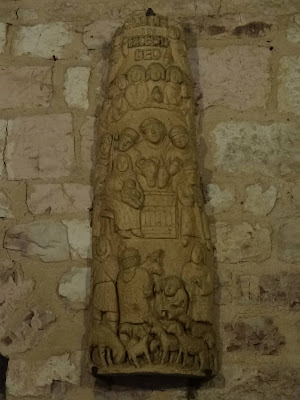
Some of the early legends try to make this performance a type of reliving of the life of Christ in Francis. Some commentators place the birth of Francis in a stable. There is a tiny chapel in Assisi, near the Chiesa Nuova (which is over the site of Francis’s family home). Some say it was his birthplace; others claim it was his father’s textile shop.
Two years before his death, during a time of fasting and praying on Mount Alverna, Francis received the stigmata, the wounds of the crucified Jesus, on his body. 

Francis practiced poverty because he saw the Lord Jesus as poor.


Welcome the children

September 30 I went for the first time to the aldea of San Jerónimo for the Mass on their feast day.

It’s a small community and they are just getting re-organized. They have no catechist and for some time have functioned without a Delegate of the Word. When Padre Fernando, a newly ordained priest was with us for a few months, he went out once a month for Sunday Mass. Their church was not in very good condition but they are working to restore it. They have had donations from people in the village as well as those who’ve gone to the US. An albañil, more than a bricklayer – more like a construction supervisor, has worked for free.
There is also a real desire to rebuild the life of the church in the village. 

I noted a fair number of young people, but what I most noticed was a ten-year boy with multiple disabilities. He doesn’t walk and seems to have little motor capabilities. He doesn’t speak and it is hard to know how much he understands. But he is loved and cared for. 

When we got to the village, I noticed an older man hold him in his lap. When we were about to start Mass, I went and greeted the boy, Jefrey, and the man. During most of the Mass, the boy was held by his mother. I also noticed a young man, who was there with his wife and child, gently touching Jefrey’s arm.

Jefrey was also one of the seven celebrating his birthday. We have the custom of inviting all those celebrating birthdays that day or another day that month to come forward at the end of Mass. We sing the traditional birthday song, Las Mañanitas, pray with them and then pour a bit of water over their heads and then have them blow out a candle. In San Jerónimo there were seven celebrating their birthdays. The pastor had me pray and pour water. I poured a little water over Jefrey and two young children, but I soaked two older kids. (When it’s someone I know I often soak them with water. On my birthday, I often get a real shower.) 


Friday morning as I read the special Gospel for the feast of St. Theresa, the Little Flower, I thought of the community and of the importance of welcoming children.
“Who is the greatest in the Kingdom of heaven?” Placing a child in their midst, he said “…unless you turn and become like little children you will not enter the Kingdom of heaven”.
Interestingly, this part of the Gospel is also being used today for the feast of the Guardian Angels and is the end of the Gospel for Sunday.

Seeing the care of the San Jerónimo community for Jefrey reminds me of my diaconal call to be attentive to the marginalized. It also helps me to make sense of what I often do when I see a child or a person with special needs. I don’t know how many times I feel pulled to respond, talking with the person, at times gently touching them – and trying to encourage the caregiver.

Becoming like a little child and welcoming them is central to our call as disciples.

Friday, October 01, 2021

Saint Therese of Lisieux and unbelievers

A few months ago, I read Tomáš Halík’s Night of the Confessor. I had bought it a while ago but never got around to reading it. Perhaps I wasn’t ready for it. I found it intriguing and helpful. After finishing it I began another of his books, Patience with God. I am now reading another, I Want You To Be. 

 This is a short and somewhat hurried reflection on an amazing insight he has written on St. Thérèse of Lisieux, whose feast we celebrate today. 

Print of Ade Bethune

 In a chapter of Patience with God, Halík reflects on St. Thérèse of Lisieux and what some have described as her dark night of the soul. But for him, it is not merely her personal struggle but a path toward solidarity with unbelievers, in the dark night of nothingness. Might St. Thérèse’s experience and Halík’s reflections, combined with Pope Francis’ call to go to the margins, reveal an opening to a new path of faith and mission.

For me, it has been important to open spaces for those on the margin to encounter the presence of God. Most recently, it has been personally important to reflect on those times when God seems absent. Saint Thérèse is important for this. 

As Halík notes, she describes how Christ led her into a subterranean space “where no sun shines any longer.” She experienced months of darkness, even until her death of tuberculosis. 

But what is striking is what Halík describes:
“Little Thérèse's” principle was “to accept even the strangest thoughts” out of love for God. What is therefore most remarkable about Thérèse is the way she accepted and perceived her contest with God, with darkness and forlornness, her experience with the absence of God and the eclipse of her faith. She accepted it as a mark of solidarity with unbelievers.
“Solidarity with unbelievers” – unbelievers are not seen as threats or as opponents to be conquered. As Halík notes:  
However, if I am correct in my understanding of Thérèse and of her path through paradox and constant reinterpretation, then her concern was something else: not simply to draw these unbelievers back into the heart of the church, but rather to broaden that heart by including their experience of darkness. Through her solidarity with unbelievers, she conquers new territory (along with its inhabitants) for a church that has previously been too closed.
I get frustrated when people dismiss or minimize the concerns of atheists or agnostics. I get even more upset when people rail against secularism or blame it for the problems of lack of interest in the church. I wonder how much of discontent or opposition to the church flows from what those in the church have done, not only the abuses of many kinds, but even more the failure of many to take seriously the concerns of those outside.

I think Halík offers us a serious challenge.
“Hasn't the time come for Thérèse's spiritual path, and particularly “solidarity with unbelievers,” to be an inspiration as a hermeneutic key toward new theological reflection on present-day society, its spiritual climate, and the church's mission at the present time?”
We need to take the darkness of Saint Thérèse seriously. This cold lead us in a very different direction. As Halík notes,
I can't help thinking that the world and the church would look very different if there were more people willing to view the Council's call for solidarity with this world (including the world of the “unbelievers,” those who are most radically “other” and different), not as a cue to superficially modernize the rhetoric and external resources of “evangelization,” but as a profound awareness of God's hiddenness, of how He “reveals” Himself through the experience of “unbelievers,” as we were taught by Thérèse de Lisieux on her deathbed. Thérèse could only indicate the path—which is what any good teacher does in any case—and bequeath to us the task of thinking through and accomplishing the spiritual journey.
----------- 
 Thomas Halík is a Catholic priest, who, while practicing as a psychotherapist in Czechoslovakia, was secretly ordained. After the fall of Communism, he worked with the Czech Bishops’ Conference and was an adviser to Vaclav Havel. He has been a professor of sociology and philosophy at Charles University and taught in other institutions.

Tuesday, September 28, 2021

Novena of Saint Francis of Assisi, day four

Francis and the sacredness of life 
 
Let all creatures praise the Lord – and let us respect all of them. 

Visiting Assisi in 2018, I came across this statue at the exit from the friary at Our Lady of the Angels. Francis sees the glory of God in a locust and treats the creature with respect.
Today I came across this quote in Jack Wintz, ofm, Lights Along My Path, A Friar's Journey in the Footsteps of St. Francis:
“Where the modern cynic sees something ‘buglike’ in everything that exists,” observed the German writer– philosopher Max Scheler, “St. Francis saw even in a bug the sacredness of life.”
Here's one that visited my home during Holy Week, 2017:


Monday, September 27, 2021

Novena of Saint Francis of Assisi Day Three

Francis – the austerity of solidarity 

Austerity was for many years considered a nasty word. It usually meant that international institutions forced poor countries to take austerity measures – especially cutting social programs – in order to receive aid to bolster a failing economy. With this type of austerity, the poor suffered. 

Several decades ago, I came across a different notion of austerity in the works of Denis Goulet, whom I first met in the early 1970s at a week-long educational program. A scholar of development, he lived among the poor in several parts of the world including France, Spain, and Algeria, and he has done research in Guinea-Bissau, Lebanon, Mexico, Brazil, and other countries. His final work was at the University of Notre Dame.

In The Uncertain Promise: Value Conflicts in Technology Transfer, he looks at two different notions of austerity:
An important difference is to be found in the underlying imagery: austerity seen as a necessary evil or as a permanent component of developmental humanism. The former conception is purely instrumental: under certain conditions austerity or belt-tightening is accepted as undesirable but necessary. But the second view considers austerity as a value for its own sake, even if it is not strictly necessary on purely economic grounds. (p. 161) Austerity understood as “sufficiency for all as its first priority” is the only path which can directly attack the poverty of the poorest majorities. (p. 164)
Many may argue whether this is possible but reading a passage a passage of The Mirror of Perfection reminded me that this is the wisdom of the saints. The anonymous author (whom some identify as Brother Leo) recalls:
Blessed Francis was used to say these words to his brethren, “I have never been a thief concerning alms, in getting them or using them beyond necessity. Always have I taken less than I needed, lest I should defraud other poor folk of their portion, for to do the contrary would have been theft.”
The poverty of Francis is directly related to his desire to identify completely with Christ, who emptied himself and became poor for our sake. But his poverty also has this dimension of solidarity with the poor. 

Many of us live lives that are fall from austere. And I acknowledge my lifestyle is far from the forced austerity of my neighbors here in Honduras.

But Francis gives us a real challenge. Will we live in real solidarity? 

The saints suggest that this emptying, austerity, detachment, brings freedom and joy. Denis Goulet noted this in A New Moral Order: Development Ethics and Liberation Theology:
Gospel poverty is not a disdain for material goods but the refusal to let the desire for even necessary goods destroy one’s spiritual freedom…. Not by accident have Dorothy Day, Charles de Foucauld, and others discovered liberating joy in gospel poverty to the degree that they have fought unrelentingly against social privilege and the institutional idols of wealth and acquisition. (pp. 138-139)
May Saint Francis open for us the way of spiritual freedom through giving up, solidarity, and sharing.

Francis and the beggar, in a chapel near Chiesa Nuova, Assisi