Saturday, May 17, 2014

Sacraments galore in Dulce Nombre


Today we had a meeting of the parish council. I shared with them that there are about 600 young people preparing for confirmation. We’ll have the confirmations in five locations October 1 to 3.

But that is only the tip of the iceberg in the ministry of the parish of Dulce Nombre.

As I noted earlier this year, we had about 80 young people baptized at Easter.

What I didn’t know until I happened to look at the parish book of baptisms is that, between August 2013 and this month, there have been over 2,000 baptisms. Yes, that’s two thousand – and a lot of water.


I just finished the second series of workshops for catechists this week. There were 97 catechists in the four locations where we had the workshops.

Padre German continues to celebrate the Eucharist in the 47 villages at least once every two months. Last week he went to the village of Barbascales, a very remote village that had not had a Mass for 17 years.


So goes the ministry.

Monday, May 12, 2014

Plan Grande house drama - continued

Last week Padre German suggested that I consider building my house in a different location in Plan Grande. The location is beautiful, spacious, near coffee fields, and would allow a slightly larger house and a garage.

My first reaction was positive. But I began to think and pray about it a bit more. I also called someone in Plan Grande whom I trust. She didn’t want to say anything – but it was obvious that she would prefer me to continue to build on the church grounds.

I prayed over this a lot on Sunday.

At a certain moment things became much clearer for me.

The place near the coffee fields is beautiful but it is a short distance down the hill from the central road through the village. There are a few houses nearby by, but it is in a rather deserted place. It is a great place for a retreat house. But to get to the church I would have to climb the hill and then walk a few blocks to get there.

In contrast, the current site is very close to the church, as well as to the school and several houses. I would be more available to the community.

As I consider my mission here I see it as accompanying the people, being with them. The house down the hill would be great and could be used for workshops, etc. But to me it feels like a distancing from the community.

Where am I to be?

I think I’m called to be in the midst of all this. Maybe later I’ll need a retreat spot, but for now, I see myself being called to be in the midst of the people.

digging the foundations


Saturday, May 10, 2014

Moving out to the countryside

If I doubted whether I should move out to a village in the Dulce Nombre parish, this week should put most of my doubts to rest.

I’ve been out in the parish six times in the last seven days.

Sunday, I went out for Mass in the San Antonio church in Dulce Nombre and then spoke with Padre German for about an hour. There was a lot to catch up on – since he’d been gone for a week of much-needed rest.

Tuesday began the series of four workshops for catechists in these first two weeks of May.

The first was in El Limon. It was a good group with several new faces. We’re still working on catechesis preparing for sacraments. I also asked them to help me with ideas for a retreat for godparents of candidates for baptism and confirmation. I asked them to list responsibilities of godparents. The responses were an interesting mix – among them: counsel the godchildren, pray for them, and – to my surprise – respond to their spiritual and material needs. I was delighted to see that they see it as more than a merely spiritual relationship.

Wednesday I went out with two Caritas workers to El Zapote de Santa Rosa to take samples from their source of water for tests. It was great to go out with about six of the members of the town’s water board (Junta de Agua) and walk down to the source – which provides abundant water to several villages.

At the source

Members of the EL Zapote Junta de Agua with a Caritas worker (second from the left)
 It was good to see a water board at work, especially since I know most of the members.

On the way back we passed several coffee fields in bloom – a sign of hope. Also, I was refreshed by the incredible smell of coffee blossoms. The closet US smell is that of honeysuckle.


Thursday I was back in El Zapote for a workshop with catechists. On the way back I stopped in Plan Grande to see how the construction was going on the house.

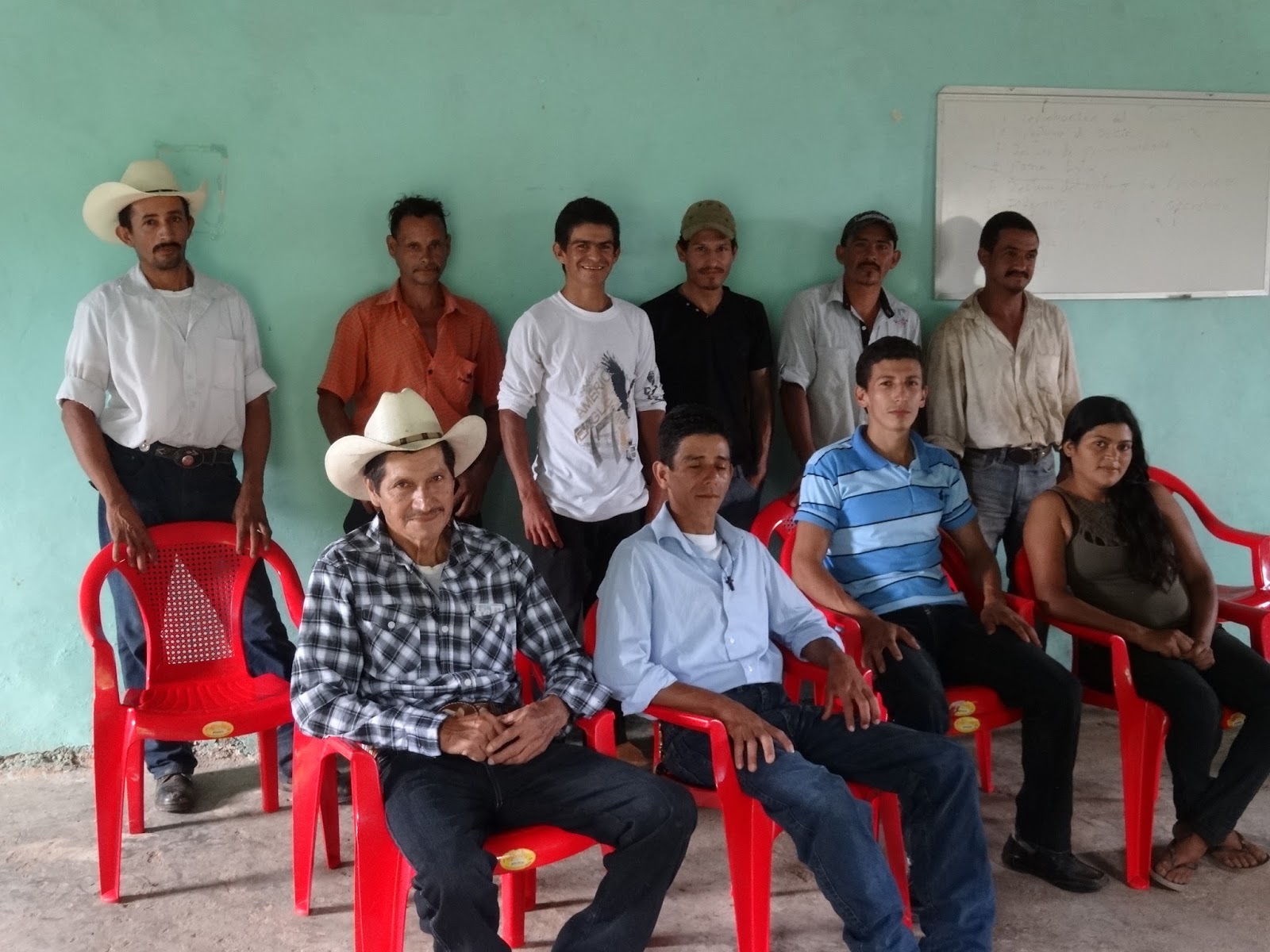
Friday afternoon I was back in El Zapote, this time for a meeting of a group that is forming to work on a possible direct marketing of coffee from small coffee farmers with people connected with St. Thomas Aquinas in Ames. Ten guys showed up as I explained what the people in the US were looking for and how the US people could help. It was a fruitful meeting. They formed a board and will be meeting again at the beginning of July. In the meantime they will be looking at issues connected with the project and seeing what other sources of help they might find. I hope they can work this through.

What's important is that most of these are small coffee farmers, with only one or two manzanas - only three have three manzanas or more.

The cafetaleros
Padre German had told me that he was going to Plan Grande in the afternoon to look at a parcel of land – one manzana  (1.68 acres) - that was being offered to the parish. He had asked me to join him and two other persons from the parish. I called and he told me to come. That was easy since Plan Grande is only about 10 minutes from Plan Grande, on the way back to Dulce Nombre de Copán.

As I arrived he told me he had a suggestion for me. He would like me to move the building site to the area being donated. All except about one tenth of an acre is planted in coffee. The free area is in a beautiful spot, with great views (only a little less spectacular than those by the other site.) But the site is more open, has a place for a small garage, and is in a less populated place. Padre German also would like to build a small building for parish meetings there. 

He, the two other parishioners, and the donor kept trying to persuade me to do this. Padre also wants me to have a small chapel with the Blessed Sacrament on site. The building will become more like a house of hospitality and place for retreat than I had originally thought. Padre also thinks it would be good to have a second floor so that I can have some privacy.

I am almost convinced – although this might stretch my budget. But it will be a quieter place and will also help the parish of Dulce Nombre, since we could have parish training sessions here and I’d only need to fall out of bed to help.

I have until Monday to decide. But I probably will go ahead. That means working on a new design. Watch for news.

Today I went out to two meetings of zones in the parish.

At one, I had an issue with the zone. The catechists’ meeting on Tuesday was in their zone but no lunch or snack was offered. I was a bit perturbed.  I told the people – to their laughter – that I was angry. These women and men have come a distance, often walking. Two of them women are nursing mothers. These catechists work at least once a week with children and youth. They need to be helped.

The question was how to bring up the issue. I first asked them if they would have lunch. Yes, they said. “And how is it paid for?” I asked. Each village gives 25 lempira ($1.25). “And what about the catechists?” They got the point and promised to figure out how to provide the catechists a lunch.

Now I’m back in Santa Rosa for an afternoon of rest and reading.

Next week I’ll be busy again – with two workshops for catechists and the parish council meeting. I’ll also have Wednesday off to go to nearby Gracias to meet with the Dubuque Franciscans there for a retreat day.

Life is good. God is gracious.

What I ask for now is patience – while the house is being built. I want to move out to Plan Grande yesterday!


Friday, May 02, 2014

Really helping?

A question that ought to be central for anyone from the first world who works with the poor is whether we are really helping.

Do we help when we give people things?

Sometimes, yes – sometimes I wonder.

Do we help when we bring backpacks for kids with toothbrushes, toothpaste, soap and a washcloth?

When a group brought these a few years ago and wanted to “teach” the children how to brush their teeth, I insisted that they do the demonstration with a salt and bicarbonate of soda paste that is easy to make and is very cheap. When we got to the first group of kids, I looked around and knew that there had to be kids who knew how to brush their teeth and so I insisted that the kids show the other kids how to do it. I don’t think this went over very well with some of the visitors.

Do we help when we use aid as ways to win people over to political or religious ideological positions?

Do people really help when a group of evangelical Christians from the US stay a week in a rural village, which is mostly Catholic, giving out clothes and goods and use the school as a place to “evangelize” the kids? Is this not another version of the “rice Christians,” a term used of Christian missionaries in China who arrived with rice to convert the starving.

A woman from a village who experienced this asked me to come to the village in June when the group will be showing up again.

How do we really help?

Do we help when we bring them together for meetings and pay their way and give them snacks and lunch?

All too many non-governmental organizations do this as part of their work.

Doe we help when we bring technologies that the people did not ask for in response to “needs” that didn’t surface from the community?

I have seen a few agricultural projects that do this, including a project to promote soy production. How many people here drink soymilk or eat soybeans?

Do we help when we come into a community and don’t take the time to listen, to hear what they have been doing, to rejoice with them in their successes?

Do we help when we come and the first question we ask is “What’s wrong here?” or “What do you need?”

Do we help when we come to share our solutions rather than listen to them?

Friday I went to Gracias, Lempira, facilitating a workshop for Caritas on Catholic Social Teaching for the Social Ministry of the Gracias parish.

The first thing we did was identify where they have been successful in their ministry. A marvelous list of their accomplishments followed. We put the papers on the front of the altar.  I identified these accomplishments as signs of the presence of the risen Christ in their communities.


Then they worked in groups to identify their dreams. The dreams were different but complimentary – a good place to live and human rights, reforestation of the water sources and organic agricultural practices, and harmony in communities and solidarity with people in need.

Then we identified difficulties.

In the afternoon, a Caritas worker led them in an exercise to identify what the Reign of God would look like in their communities. The drawings showed their hopes for a full life for themselves and their families – with a school, a health clinic, a community center, and decent roads. What each drawing contained was a large church – faith is central to their understanding of a full life.


Afterwards Simon asked them to identify what they needed to attain such a community.

Tomorrow we’ll deal with two concerns they mentioned – the need for a solid spirituality and issues about the environment.

In this type of working with the poor we in Latin America owe a lot to Paolo Freire who died on May 2, 1997, who promoted a liberating styling of education, beginning with his classic work, The Pedagogy of the Oppressed. He once wrote:
Authentic help means that all who are involved help each other mutually, growing together in the common effort to understand the reality which they seek to transform. Only through such praxis — in which those who help and those who are being helped help each other simultaneously — can the act of helping become free from the distortion in which the helped dominates the helped. For this reason there can be no real help between dominating and dominated classes, nor between “imperial” and so-called “dependent” societies. 
It is so easy to be a “do-gooder” if one does this from a position of power. But can we do good, working at the side of people in need, listening to them, letting them lead us in a common pursuit of a decent life for all God’s children on this earth?