Showing posts with label Saint Oscar Romero. Show all posts

Sunday, May 15, 2022

Philip the Deacon and Saint Nunzio Sulprizio

On Thursday night, May 5, I went to Mass in Dulce Nombre. Before Mass, I had a meeting with a few people to begin to form a committee to oversee a new project of workshops on trades for young people.

The Mass was to celebrate the feast of Saint Nunzio Sulprizio, who is remembered in one of the murals in a side chapel in the church. I also ended up preaching.
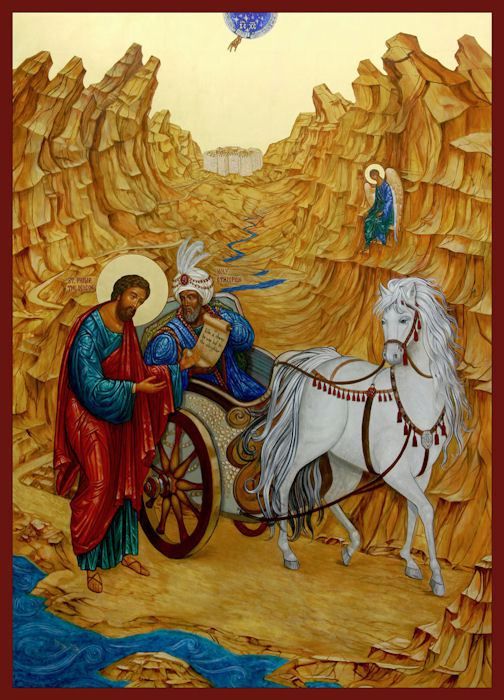
We used the readings of the Easter weekday. The first reading (Acts 8:26-40) was the encounter of Philip the deacon with the Ethiopian eunuch.
Philip was among the seven, chosen with Stephen, to serve the incipient Christian community in responding to the needs of the non-Jewish members who had felt that their orphans and widows were not sufficiently cared for. 

Other than Stephen, only the work of Philip is told in the Acts of the Apostles. He goes to a Samaritan city and is then called to accompany an Ethiopian official, returning home after a visit to Jerusalem. He reaches out to those on the margins, those rejected by the authorities – the Samaritans, an Ethiopian, a eunuch. And he brings them to faith.

The encounter of Philip and the Ethiopian is emblematic: Philip asks “Do you understand what you are reading?” The Ethiopian official responds, “How can I, unless someone instructs me?”

Who helps us understand the scripture? Who instructs us?

We cannot understand the scriptures alone. The scriptures are spoken to a people, and we need the people, the assembly, the church to help us understand. This does not mean that one person might not be the voice through which God gives us a newer, deeper, and broader understanding of His Word. 

In this passage, Philip as representative of the community helps the Ethiopian to understand the scriptures and to lead him to baptism.

In our days we also need the community to help us understand the scriptures and the call of God in our lives – in the liturgy, in the sacraments, and through others in the community, bishops, priests, deacons, religious, catechists, delegates.

But we also need the witness of the saints to help us understand the scriptures.

Saint Nunzio Sulprizio, whose died on May 5, 1936, can help us understand the mystery of suffering, the mystery reflected in the passage of Isaiah which the Ethiopian official was reading.

Barely 19 years old this young man had experienced much suffering in his short life. 

Orphaned as an infant, his grandmother raised him and nurtured him in the faith, She died when he was nine.

A brutal uncle took him in and had him work in his blacksmith shop. He treated him brutally, worked him cruelly, and hardly gave him enough to eat.

Nunzio developed gangrene in one of his legs and had to spend four months in a hospital. Another uncle found out about his nephew’s plight and took Nunzio to stay with a friend of his, a colonel who took care of Nunzio and provided him the medical care and the love he needed.

His uncle’s friend found a place for him in the hospital for the incurables in Naples. There he prepared for and received his first communion.

In the hospital Nunzio did not sit back and feel sorry for himself. He ended up evangelizing the others in his own way, preparing some children for their first communion.

His patient suffering and his care for other sick young people show us a way to respond to illness.

He was later found to have bone cancer which contributed to his death at an early age.

Meditating on his life, his patient disposition, and his life and death we can begin to understand even better the passage of Isaiah that the Ethiopian was reading:
Like a sheep he was led to the slaughter, and as a lamb before its shearer is silent, so he opened not his mouth. In his humiliation justice was denied him. 
Nunzio suffered not only the physical effects of gangrene and cancer, but also the emotional effects of being an orphan, of being abused and maltreated. 

How many young people suffer like him.

Saint Nunzio can help us understand how to live, how to face suffering, and how to die. He can also inspire us to work for and with the ill, the victims of violence and abuse, the young who are abandoned and abused. 

Saint Nunzio was canonized in October 2018, in the same Mass where Pope Francis canonized Monseñor Óscar Romero and Pope Paul VI (who had beatified Nunzio).

Wednesday, December 26, 2018

Being a deacon and the witness of the martyrs


This morning I awakened remembering a dream in which I reaffirmed my commitment as a deacon. It was very fitting since today is the feast of Saint Stephen, according to the tradition, the first deacon and the first martyr.

I will be preaching today at Mass in at least one village and so I spent a lot of time praying and meditating on the scriptures. (The homily in Spanish can be read here.)

What strikes me today is how much I feel the diaconate is connected to martyrdom. We deacons prepare the bread and wine, lift up the chalice with the Blood of Christ at the end of the Eucharistic prayer, and are ministers of the Eucharist, especially the Blood of Christ.

For me this year has been marked by Central American martyrs.

In January, Padre German, my pastor, and I made a pilgrimage to Santiago Atitlán, where we prayed in the room where Blessed Stanley Rother, Padre Aplas’, was killed and in the church where we celebrated the Eucharist – Padre presided and I served as a deacon. (An account here.) Padre Aplas’s commitment as a missionary from the US and his desire to stay with the people remind me of the importance of accompanying the people – not just for a short visit, but to share their lives, their joys and sorrows, and to let oneself be vulnerable. 


In October. Padre German and I went to Rome for the canonization of Monseñor Óscar Romero. As I was preparing for my diaconal ordination, I visited his tomb about two weeks before my ordination and dedicated my ordination to him. (My account of that visit is here.)


A month before his martyrdom, Monseñor Romero wrote this in his notebook:
“My disposition should be to give my life for God, however it should end. The grace of God will enable us to live through the unknown circumstances. He aided the martyrs and, if it should be necessary that I die as they did, I will feel him very close to me at the moment of breathing my last breath. But more important than the moment of death is to give him all my life and live for him and for my own mission.”
I will share these words in today’s homily – since we are all called to be martyrs, witnesses.

After coming back from the canonization and a short visit to Iowa, I went to the beatification of two Franciscans in Guatemala, an Italian missionary priest, Fray Tulio Maruzzo, and Luis Obdulio Arroyo, a lay Franciscan, catechist and helper in the parish. Another missionary martyr. But I was impressed by the simplicity and the commitment of Blessed Luis Obdulio, who helped in the parish and drove the sick to the hospital in the parish vehicle. (My reflection after the beatification Mass is here.)


This month, on December 8, nineteen martyrs of Algeria were beatified. When I first read the story of the Trappists monks of Tibhurine, I was touched by their commitment to be with the people in the midst of violence. The testament of Père Christian de Chergé, written before his death, is one of the most moving letters I’ve written, displaying his love and his willingness to embrace the person who might kill him in the future.  (You can download and read it from this site. Also, here’s a short reflection on their witness.)

The witness of these martyrs sustains me and give me courage hope in the midst of difficulties.

I have no desire to be a martyr, especially now that I have permanent residency here in Guatemala and want to enjoy that for many more years.

But the third century document Didascalia of the Apostles (chapter  XVI, iii, 13) notes:
“And know what the ministry is, according as our Lord and Savior said in the Gospel: Whoso among you desires to be chief, let him be your servant: even as the Son of Man came not to be ministered unto, but to minister, and to give his life as a ransom for many. So ought you the deacons also to do, if it falls to you to lay down your life for your brethren in the ministry which is due to them.” 
But laying own my life means dying every day – becoming more available for the poor, becoming more flexible, putting aside my desires to be in control or undisturbed.

So, today, I pray to Saint Stephen. May God make me a better deacon, a better servant, to be of service to God, to the church, and, most of all to people in need.


---

The image of Saint Stephen is from the works of Ade Bethune whose drawings were often published in The Catholic Worker.  Saint Catherine University has a collection of here works.