Showing posts sorted by date for query Manos Unidas. Sort by relevance Show all posts

Wednesday, January 30, 2013

The 2013 coffee crisis in Copán, Honduras


Coffee is, in some ways, the life blood of the area of western Honduras where I live and minister.

The coffee harvest in our region of Honduras is almost over, though there may still be some areas at higher elevations still to be harvested.

It has not been a good year for coffee.

First of all the prices for coffee are almost half of what they were last year. Last year the prices were much higher than for the 2010-2011 harvest. But this year’s price is even lower than two years ago. 

Catuai coffee leaves affected by roya

But the other problem is that a disease – roya – has infected many of the coffee plants, leaves have fallen off and many of the coffee berries have not matured. Yesterday I saw a pile of green coffee berries that had been harvested. They will probably be used for coffee for the family - but they will not bring in needed cash.

Catuai coffee plant affected by roya

Roya has infected the most common variety of coffee grown by the people with little resources – catuaí. It has had a good yield and produces a good-tasting coffee. However, it is not as resilient as other varieties which, though they produce less than catuaí are more resistant.

A few people had planted a variety of coffees and so have not been as affected by roya, but it is still hard for all of them.

Lempira and 90 coffee - not affected by roya

The low prices and the poor harvests will seriously affect the small coffee farmers. Another consideration is that after last year’s good harvest and good prices, some small coffee farmers may have planted coffee in some of the fields they had been using for corn and beans, the staples of the Honduran family budget.

Also, since the harvest will be poor, the small coffee farmers may find it difficult – if not impossible – to pay off the loans they took out earlier for fertilizers or for planting new coffee plants.

Since the harvest is poor this will also probably affect the coffee pickers, those who have been out on the fields since late November, in all sorts of weather (including the cold and rainy spell of the last two weeks). Some of these may have small coffee fields of their own (less than quarter an acre) but many are the poor who live by manual labor throughout the year. This is one of the few times when the people can earn cash for their expenses for the year.

I have seen large cattle trucks and small pickups packed with people going to pick. 

Off to pick coffee

What will all this mean for the people here?

May through August are the lean months, partly because the corn and beans harvested the previous year have been used up and the harvest is still months away. There is almost always hunger during these months. Even if people want to buy corn and beans, the prices are high (sometimes up to twice as high as the price farmers receive at harvest time.)

My guess is that the situation mid-year will be critical. We may find a real hunger crisis in the region.

What can be done?

There are long range solutions that need to be considered, including finding ways to get the small and medium coffee farmers better returns for their investment. A group visiting from Shelby County, Iowa, at the beginning of this month, is looking into ways to facilitate direct trade between the farmers here and markets in Iowa and the Mid-West. This is what I call “direct trade” which can be much better for small farmers than “fair trade.” (That’s another discussion.)

Juan Ramon and healthy coffee plants

But in the short term, what can be done?

This year, because of the changes in the parish of Dulce Nombre, we will probably not have the Manos Unidas–funded agricultural project which helped a good number of families. (Right now we have a priest as pastoral administrator; if he or another priest is appointed pastor, it will be easier to execute an agricultural project.)

The mayor of one of the municipalities in the parish has begun thinking about a family garden project with the 15 women’s groups in the rural villages of the municipality. This will need some technical assistance, though it appears that the mayor would use government funds for providing the seeds.

There may be a need for more direct assistance and I’ll try to work with the pastoral administrator and the pastoral workers in the villages to monitor the hunger situation.

Such is the life of the people here – people who live on the edge and who, even though they work hard, have major problems providing a decent livelihood for their families.

Saturday, December 22, 2012

Seeds of hope

What are all these people doing gathered outside the door of the church in El Limon?


They are members of the church council for the San Miguel zone of the parish of Dulce Nombre de María.

They are getting vegetable seeds, which Adán is distributing.


The past few years the parish has had an agricultural project to help villages throughout the parish. The first year the three field workers did a lot of work helping small farmers improve their practices in the production of basic grains – corn and beans. There was also a component of vegetable production in groups which has continued. Another component has been the promotion of small family gardens not only in the 18 villages where they worked but also with the pastoral workers of the parish.

One of the most popular aspects of the project was providing seeds for family gardens. People are diversifying their diets and are also selling the surplus for a little needed cash.


The funding for the project ends this month. A proposal was sent to the Spanish Catholic organization, Manos Unidas, which funded the project up to now, but there has not been any response.

I hope we can find a way to continue this project.

Any suggestions for funding or other help are most welcome.


Sunday, December 09, 2012

More signs of hope in Honduras

Friday the Dulce Nombre de María parish celebrated the closing of the agriculture project, financed by the Spanish Catholic organization Manos Unidas. I’ve written about this several times before. (Several of the posts can be accessed here.)

The project has been a success, but we are not sure if it will continue. Even though it been only about $2,500 a month, we are waiting to hear from Manos Unidas to hear if they will continue to help finance it.

In early stages the project helped people with tools, fertilizers, and training in improved methods of production of basic grains. It also has helped people learn how to make organic fertilizers and fumigants.

More recently it has included projects of family gardens, as well as the promotion of production of vegetables by organized groups in the community. This helps promote better diet but also generates some funds.

There have also been some efforts in planting trees, both hardwoods and fruit trees.


Agricultural project celebration

Eighteen communities participated in the most recent stage of the project and so it was good to see about 200 come out for the celebration.

It was held in Colonia San José, Dulce Nombre, a small community which was very hard to get to because of a water-soaked road with six inch deep mud at several place. But I got there in the parish truck. (My truck has been in the mechanic’s shop for over a week because of a cracked camshaft.)

There was, of course, a Mass with Padre Efraín, the Dulce Nomrbe pastor, followed by recognition of the communities, songs by the Primos de Occidente of Quebrada Grande and a few cultural events by the young people of the village of Yaruconte.

The two most memorable was a song that Los Primos de Occidente had written on the project, which they promptly named “Huertos familiares/Family gardens”. They sang about “tajadas of plantains and a good salad of fresh vegetables for breakfast.” You can see and listen to it here.

The young people of Yaruconte and several other youth groups had prepared cultural events for their villages. The Yaruconte youth presented an indigenous dance.


   There were also tables of vegetables and fruit that several communities had brought to sell. I bought a few turnips and was given a bag of oranges as I left. 


Looking over the vegetables, I talked with a number of young men who were involved in the project. One was eating a raw carrot, something I seldom see here. He told me he liked carrots. So it appears, at least in one case, the project is helping people diversify their diets.

One event, though, touched me. There is a young man, Toño, from a village who is mentally handicapped. He walked up to the altar and shook Padre Efraín’s hand and then several pastoral workers brought him a chair so that he could sit in front of the altar with them. Instead of marginalizing him because of his differences, he is accepted and welcomed.

The project is important for its results but also for the community organization it promotes. But all this needs to be based on a love of God and neighbor that embraces those who are different. At least in this case, it does.


A water project in San José Quelacasque

The day before I had gone with a group from Caritas of the diocese of Santa Rosa de Copán to San José Quelacasque for the inauguration of their water and sanitation project.

Caritas has worked in San José Quelacasque for four years, first with a Community Management of Reduction of Disasters, project and since January with a water and sanitation project.

It is in many ways, a model project, not just for the latrines, improved piping of water, a system of water meters for houses, but for an improved culture of health which the community has embraced. Thus they hope to conserve their distinction as being the one place in the whole municipality of Gracias where people can drink water from the faucet without worry.


The celebration began with Mass with Padre Loncho, the pastor of the parish of Gracias, Lempira, followed by the blessing of the new water tank. There were songs composed by village members Ester and Joel, as well as several skits from the students. One was particularly funny and appropriate, satirizing a boy sick with diarrhea going to a clinic. There were even pigs rooting around the “clinic” – a true health hazard.


Also, because it was December 6, the feast of Saint Nicholas, San Nicolás showed up and gave out candy. 


After lunch I talked briefly with a representative from the Salvadoran non-governmental organization that has been the conduit for funding. He was impressed with what the people had done and had they had worked together. He noted that the community was poor, relying mostly on the production of basic grains.

If the community continues to be vigilant in its protection and conservation of water and their efforts in maintaining a clean and healthy environment on the community, they will continue to be a model for other communities.

These are small efforts, mostly done with the help of outside agencies but with amazing contributions of the people involved.

These people are the hope for the future of Honduras.

Sunday, September 30, 2012

Many stories to tell


These past few days have been somewhat busy and there’s a lot I’d like to write. So this will be a somewhat unfocused entry.

Wednesday I went to La Labor to see the work of Caritas there. I met briefly wit the two workers there and we went to see a little of the countryside. We passed over a widened bridge that was part of the project's effort to mitigate natural disasters, but we passed on to another bridge where three people had drowned a few days before when a flash flood passed over the bridge and pushed their car into the riverbed. The Caritas workers told me that this often happens this time of the year and the municipality will build a double bridge so that the water can pass under the highway and thus avoid other preventable tragedies.

The bridge where three people in a vehicle were swept into the river

Thursday, the director of Caritas asked me to go to San José Quelacasque to pick up a worker who was doing a study there. It's a long ride to this remote community but it is good to see what they have done. They are almost finished with a major water and sanitation project which has brought lots of good, clean, drinkable water to the people living there who now also have sufficient good latrines. It's great to see a community that has come together to improve their lives.

Friday, there was a workshop for new preachers. Sadly, only one of those who had been there last month returned. I don't know why. Also it was a small group but we worked together from 9:15 to 2:30. Next year we hope to have a more systematic training for them and some continuing formation for all those now preaching at the Sunday celebrations of the Word in the villages. All were men except for one woman who just moved to the area from Choluteca. Brenda was most impressive and I hope we can continue to encourage her participation and leadership.

Sunday morning I went to Mass at the San Martín de Porres church up the hill where Padre Fausto Milla presided. His homily was long, but it held my attention since he connected the readings with the reality of life here and also invited the participation of the congregation.

For the third time in three weeks he mentioned a friend of his, a 105 year old man, who died. He has written an article which may be published in El Tiempo,  which I’ll translate. What impressed me was the way Padre Fausto revered this man as a just and generous man, full of wisdom. He was, in the eyes of the world, an insignificant farmer, a campesino who devoted his life to planting corn, beans, radishes, and other vegetables. He told Padre Fausto that he had not done any harm ever with his hands. He was ready for death – in more ways than one.

Padre Fausto also talked about an Australian Marxist who came to his office some forty years ago and ended up devoting himself to the poor, especially during the aftermath of Hurricane Fifi. He was an example of some one, not of the church, who really did God’s caring love. But he was expelled from the country for being a Marxist. (Padre Fausto related this to today’s Gospel, Mark 9: 38-48.)

As the offertory began he mentioned the death of a woman whom he knew, the wife of Salatiel. All of a sudden I was struck because I know Salatiel – an 89 year old-gentleman – and his son Olvidio.

With Don Salatiel

I met his wife once about 4 years ago, when I went with Olvidio to meet them. His father, Salatiel, greeted me as he was coming in from the fields carrying a load of firewood. He dropped the wood, hugged me, and then proceeded to ask me questions. When I told him I was born in Pennsylvania, he asked me if Harrisburg was the capital of Pennsylvania. Astonished, I said yes. Every time I meet him I feel like meeting an  old friend who welcomes me with great love. The death of his wife of many years will be hard. Keep his family in your prayers.

Yesterday, Saturday  I spent time with a group of five persons from Manos Unidas, a Spanish Catholic aid agency, which has been aiding an agricultural project in the parish of Dulce Nombre.

We went to three villages (of the eighteen working with the program.) It was great to hear the people speaking of their work together in an organized group, of their gains in improving the health of their families, and their efforts to decrease or eliminate use of chemical fertilizers.

The first group, in El Ocote, Vera Cruz, was composed of ten women and two men. We found them working on a hillside where they had planted their second crop of yucca.

Women in the El Ocote group, weeding the yucca field.

We talked and you could hear the pride these people had – but also some frustration. We met in what was meant to be a coffee beneficio – a small processing plant which had begun but never finished. A group came in with funding for the project, had the people sign, and then left the work unfinished. (So goes one type of corruption here.) Padre Efraín, the pastor, urged them to get together and ask the mayor what had happened, trying to expose the corruption and perhaps get the project up and starting. (This might be a good project to start a coffee project in the Dulce Nombre parish.)

They also spoke of their groups fund, which they have put together, that can help make small loans to members. The fund has 3,500 lempiras – about $180. But it can help for small loans when people need to pay for transportatrion to take someone to the hospital or other small needs.

The last community, Colonia San José, Dulce Nombre,  had eleven members in the group, in a community which had eleven houses. It seems that all the families were participating. The people had been able to take advantage in 1975 of a new land reform law that enabled campesinos to obtain land with a land title. (Since then the law has been changed and now favors the concentration of land, rather than the redistribution.)

One field of the Colonia San José community

Their work was impressive with a large plot of about 3.5 manzanas which they are planting in crops that they try to sell to various markets. There is also a small school garden of vegetables.

The school vegetable garden.

This community also has a fund – but it is much larger.

It was great to listen to these stories, to see their pride in what they had been able to do; yet  there are needs. The one community needs a pump to activate their irrigation system. The pump would cost about $750.

The team from Manos Unidas was impressed and encouraged the parish to seek aid for the future. The importance of an agriculture that responds to the needs of the  campesinos  for the production of food for a healthy diet is an important goal of such programs. But what is also important is the organization of the people to work together for a better future for their communities. This program encourages joint efforts, combating the individualism that is often at the core of some programs. It also is a way to help the people promote ways to protect nature – cutting back use of chemical fertilizers and insecticides, teaching the people the use of natural barriers when they plant on hillsides, promoting local production of food stuffs.

The goal is that the people can live a good life – in all senses of the word “good,” not just the material.

I think it is also one of the ways to start working toward the revitalization of rural villages to stem the flight to big cities or the US. But this is a larger challenge, that I’d like to explore: how do we make rural life a “good” life so that people don’t feel compelled to leave to support their families and so that people don’t feel tempted to the “good life” on the cities and so that the villages are really places where the young feel at home and where they want to stay.

That’s a big challenge, but one that I think is essential for the future of rural Hondurans. But there are many people who have leadership skills or potential.

May God give us the wisdom to work together for the truly "good" life.


Tuesday, September 25, 2012

Making a difference


For at least two years, the Spanish Catholic organization Manos Unidas has supported an agricultural project in the parish of Dulce Nombre de María.

The project initially worked in 22 villages to help improve agricultural practices in producing basic grains (corn and beans) as well as to promote family gardens. More recently it has been working in 18 villages mostly in terms of family gardens and reforestation, with both fruit and hardwood trees. They are also working with forming  cajas rurales, a sort of community institution that makes small loans to members. A documentary for television in Spanish can be found here.

The current funding ends in December and it is not yet clear whether Manos Unidas will continue its assistance. We may have a better idea after they do a monitoring visit to several of the communities in the parish.

I spent Monday morning with Mauro, Adán, and Elder (the three técnicos, whom I’ll call fieldworkers), Padre Efraín (the pastor of Dulce Nombre), and the parish secretary (who does a lot of the administrative work for the project).

I had a lot of questions, mostly about where the work had been going well and where there was still need.

The fieldworkers agreed that there were about 12 villages where the groups worked well and where there was still need. One idea would be to continue working with them to strengthen their work.

I also asked them to think of other communities that might profit from the project , that had great needs, but also had people willing to work together in groups to improve their lives, especially through better agricultural production that promotes a more diversified diet. We came up with 15 villages.

One of the fieldworkers remarked that some communities are very hard to work with. They don’t want to take the time to prepare gardens, mostly because they receive a monthly basket from a child-sponsorship group that works in many communities in the parish. He saw this group as promoting dependency.

And so the team would like to work with up to 27 villages in the parish. A big dream, but they are working on a proposal to present to Manos Unidas.

Mauro, Adán, and Gladys working on a new project proposal

I am also thinking about the possibilities of help from  St. Thomas in Ames and the parishes in Shelby County, Iowa, that area in a relationship with the Dulce Nombre parish. It would be good if they could finance another fieldworker so that they can add about 6 more villages. My guess is that this might cost between $17,000 and $20,000 a year – including salary, seeds, transportation, costs for training sessions, and administrative support. I’ll be talking with people about this when I visit Iowa in mid-October.

This is a small effort  that has made some differences.

And it has raised interest. A number of women have told me how much they liked the vegetable seed distribution which helped them diversify their family’s diet as also generate some cash by selling the surplus vegetables.

In addition groups in several communities have asked them if they could participate in an expanded program.

There are problems – but I think this is an area where we can really make a difference in the health and livelihood of the people of the parish of Dulce Nombre. 


Thursday, June 14, 2012

San Antonio - agriculture and baptisms


This week I went out twice to the village of San Antonio, Dolores, Copán.
 
On Tuesday I accompanied Mauro who is one of the workers in the Dulce Nombre agricultural project. The project, in its last year of financing by Manos Unidas. is working in 18 villages in promoting better agricultural practices in growing basic grains (corn and beans) as well as promoting family gardens and reforestation.

Mauro distributing vegetable seeds.

In the first two years the project made fertilizer available on credit, but because of the cut backs in funding, the time schedule for this last year of the project, and the failure of some to repay the loans, they decided not to do that this year.

In one community, most of the men withdrew from the project because of this. However, in the same community, ten women are enthused about the garden projects.

yucca

In San Antonio, 18 families are working in the project. For two years they have worked on a joint project growing yucca.

I visited a few houses with Mauro. In one the woman told Mauro how proud she was of the mustard greens she was growing. She lamented that the rains had washed away another crop. As we sat and talked Mauro began to recite the numbers 1 to 10 in English to the three year old who echoed them back – for the most part – with an unexpected precision.

Precocious three year old.

Later, before the meeting of the group on Tuesday, Mauro showed them how to use small planting trays for growing sweet pepper seedlings. 

Seed trays

At the end of the meeting he distributed small packets of cucumber, cilantro, and radish seeds. (I'm going to talk with Padre Efraín to see if there might be some way to continue providing the seeds for vegetable gardens after the project funding runs out.)

The project has enabled several communities to build up a small amount of capital to use for loans to those involved in the project. In San Antonio is about $250.

Mauro was particularly happy to share how some groups have not only built up capital but are changing their ways of thinking – especially in terms of raising their own vegetables for consumption and sale.

Wednesday was the feast of St. Anthony, the village patron.

A Mass was scheduled for 9 am (but started at 10:30) with 43 baptisms and 5 first communions.

Early Wednesday I received a text message from Scott Satterlee, who is with La Finca del Niño in La Ceiba. I met him last September at the retreat I led for the Finca del Niño volunteers. He was in Santa Rosa for a few days. I invited him to come with me to the Mass in San Antonio.

We got there -  a little late due to getting the car stuck in a driveway where people had told me to park.  But we had time to talk with the people who had come from San Antonio and nearby villages for the Mass. There must have been more than 500 people there.


The music was very good at the Mass but, of course, the baptisms were the highlight. Father Henry, the associate pastor, is not a minimalist in terms of sacramental signs and so the baptized were well-soaked, especially the last young man, Pedro, who was baptized with loads of water.

Pedro's baptism

It was great to see the baptisms and all the people there. Several faces were particularly striking including , an old woman, an little boy about to be baptized, and the above-mentioned Pedro.

To be baptized

Doña Maria

Pedro in the front row, pastoral worker Efraín in the second row

After the 180 minute Mass there was food for everyone. Scott and I, though, left and ate Pizza in Santa Rosa at Weekend’s Pizza. (I claim it has the best pizza in Central America.)

Accompanying the people is really what my life is about here. I do help in formation of catechists and other pastoral workers and I hope to be able to help develop some programs for agricultural and community transformation in the future. But the heart of the work is being with the people.

In one sense, that’s what Jesus did – accompanying the people in their joys and sorrows. Jesus is a God who does not look on the people from afar but involved himself in the nitty-gritty of people’s lives.

Can missionaries do less?

---------------

More photos can be found here.

Monday, December 12, 2011

John’s “¿Marvellous?” Adventures: Food, Communion, and the beast (my pick up)


These last four days have turned out to be quite an eventful weekend.

As usual on the second Friday and Saturday of the month I went out to two different zone meetings in the parish. It's not that I really do a lot there, but it’s important to show interest and to talk with the people. It’s also a good chance to listen to what people are doing.

On Friday a few people asked me for a ride from El Limón, where we had been meeting.

Two of them worked in the clinic in El Limón. I asked them about problems, especially among children: pneumonia and colds, most of all. I also asked whether any of the communities they worked with were part of the project for infants and mothers, financed by Catholic Relief Services and administered by the diocesan Caritas office. She told me proudly that it had made a difference in the one community, Prado de la Cruz, where none of the infants were below the standard weight.

By the time we got to Dulce Nombre only one person was left and he asked for a ride to Santa Rosa. René is a young man from Agua Buena, Concepción, very involved with the work of the church in his village and the parish. I asked him about his village and he was proud to speak about it. It’s small, only twenty families and all of them are Catholic. They have two base communities and three catechists. They do some work with the youth and all except one seem to be on the straight and narrow; the one, from what I surmise, needs a little encouragement. Most of the people have land for basic grains as well as some coffee. They are involved in the parish’s basic grains harvest and are working on family gardens. The one drawback is that though the coffee prices are higher than two years ago, they still probably aren’t getting the best prices. As René told me they get about 480 lempiras for a lata – about 29to 30 pounds of coffee beans with the pulp removed. That’s less than one dollar a pound. But it is still good to find a  community that seems to be working together well.

Saturday it was raining by the time I got to El Zapote de Santa Rosa for the zone meeting there. Almost three days of rain made the area near the church very slippery and we spent a half an hour trying to get my pick up out of the mud – and I was in four wheel drive low! It finally worked when they got a rope and pulled it out of the mud. Ugh! But, again, the generosity of the people – getting muddy and exerting themselves for a stupid gringo who gets stuck in the mud!
Stuck in the mud in El Zapote

 The meeting  was not very well-attended, which is unusual for this zone. I think it was a combination of the lousy weather and muddy roads as well as a meeting at the parish center in Dulce Nombre.

I left early (and almost got stuck again in some mud) and decided to stop for a short time at the meeting. The parish has had a basic grains, garden and fruit project for more than two years, financed by the Spanish Catholic organization, Manos Unidas. The project will go on until August but it has made a lot of difference in some communities.  

Mauro, one of the team for the ag project,  with yucca

Today they were celebrating the successes of the project as well as awarding diplomas to those who had participated. (Here giving people a certificate at the end of a training is very important.) 

Part of the crowd

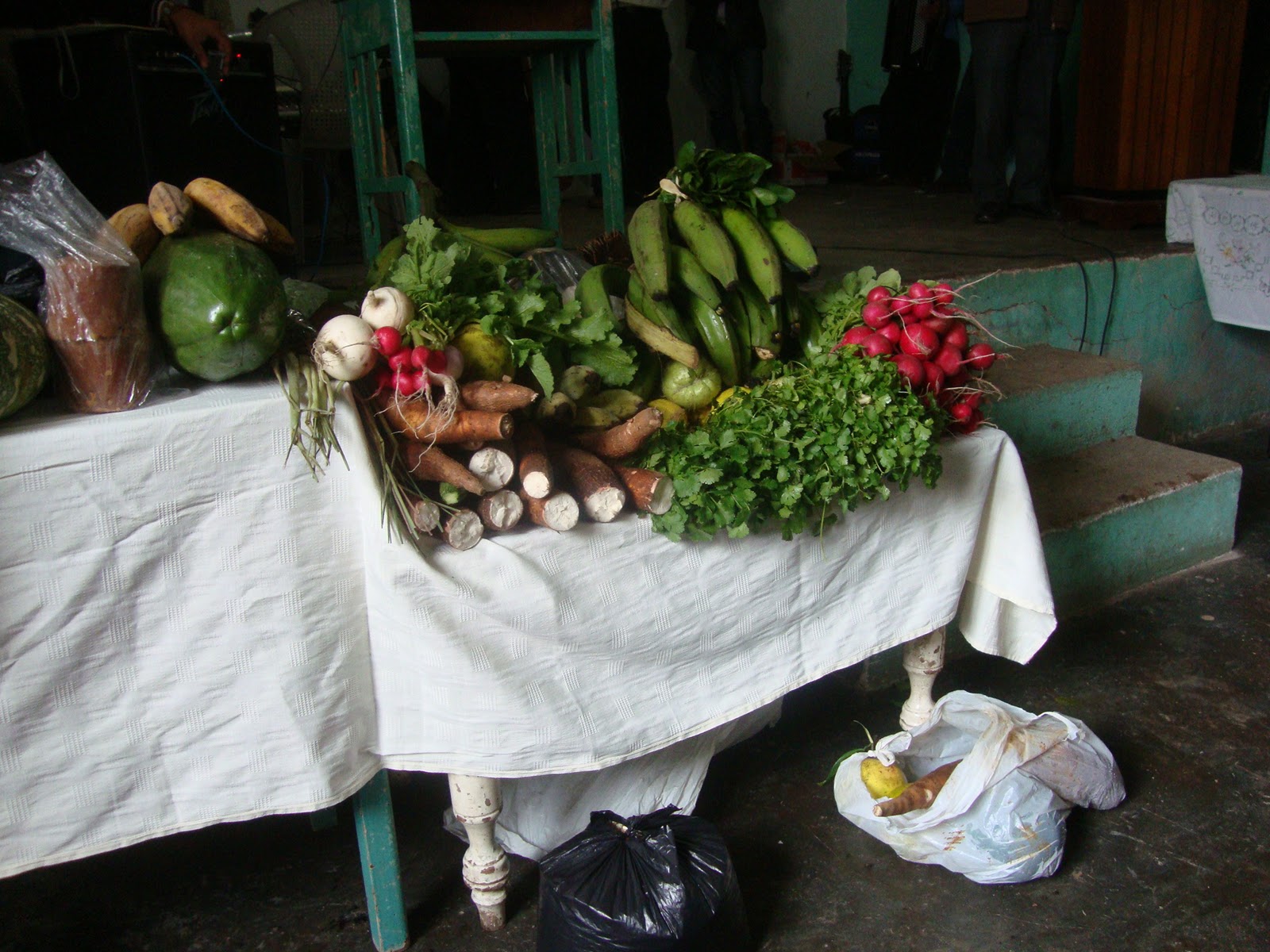
The parish hall was jammed with people. At the front was a table filled with some of the products they had produced. It was quite a diversity: plantains, yucca (cassava), papaya, squash, radishes, pataste, dulce de canela (raw sugar), oranges, tangerines, cilantro, mustard greens, green peppers, cabbage, and - what I never expected to find here – turnips. I’ll have to get some since one of the unusual dishes that my Aunt Mary used to serve at a post-Christmas meal my family often spent with them was mashed turnips.

How many of the products can you identify?

I left the parish before lunch because I’d been asked to show up as “San Nicolas/Santa Claus” at the Christmas party of the Santa Rosa campus of the Catholic University. For the past three years the university has invited poor kids from the city to their celebration and provided them with a meal and gifts.

San Nicolás also showed up at the parish meeting.

I arrived in the university parking lot in my muddy pickup wearing a red ISU hooded sweatshirt and a Santa Claus hat. I opened the door of the truck and at least twenty kids came running. “Santa, Santa,” they shouted, hugging and holding on to me.

There had been some miscommunication and there was already someone in a Santa costume, but that didn’t matter to the kids. A few asked me if I was Santa – I said I was his helper. That made sense.

I stayed around for a while as the kids broke open piñatas and dived for the candy. Then as they left the kids were given a small gift.

It’s good that something is done for these kids – at least once a year.

Saturday evening I had another surprise. Sister Nancy Meyerhofer. who ministers in Gracias with another Dubuque Franciscan, called. Returning from giving retreats in Guatemala she wouldn’t get to Santa Rosa in time for a bus to Gracias. So she came late and stayed until she got the 5:30 am bus on Sunday. We had a nice visit – a good ending to a full day.

I thought Sunday would not be a very busy day. I slept in till 8:15 (after getting up and taking Nancy to the 5:30 am bus). I washed clothes and did some grocery shopping.

In the afternoon I headed for Dolores where Bishop Santos consecrated the altar and installed the 17 extraordinary ministers of Communion for the parish and two who are now members of the parish of San Juan Bosco. It was a very important day for these men and women who’ve spent two years in the formation process.

The Mass was supposed to start at 5 pm, but people came early and music groups were playing in the church.

At about 5:00 pm most of the people went to  place about half a kilometer from the  church to greet the bishop when he entered town. 

Waiting for Monseñor Santos

The bishop arrived about 5:30 pm. He got out of the truck and walked with the people to the church led by a band from the local school. As he entered the church he was warmly greeted.

It is obvious that he is loved by the people. 

Monseñor Santos entering the church in Dolores

For a number of reasons the Mass didn’t begin until 7 pm.
The ministers were introduced before Mass: Padre Efraín introduces Gloria from Plan Grande

Mass was an incredible two and a half hour liturgy. Though my camera broke partway through the Mass, I did get two pictures of most of the communion ministers waiting for the opening procession.

five women extraordinary ministers of Communion

Thirteen of the men extraordinary ministers of Communion

The consecration of an altar is an impressive rite. The bishop anoints the altar with chrism and then lights a fire (in a pan) on top of the altar. Incense is liberally sprinkled over the coals. Candles for the communion ministers were lighted from the fire which was a very symbolic gesture - since they will be distributing the Eucharist, consecrated on altars such as this one.

Bishop Santos and Padre Efraín leading the Litany of the Saints during the consecration of the altar

After Mass I left, but not before Padre Efraín had asked me to drive one of the music groups – Los Lirios del Campo, the lilies of the field – to their distant village. It was late, about 10 pm,  and I don’t like to drive at night, because it would have been a very long walk for them.

But it ended up being a very long night for the four of them and me. Going up a hill about 25 minutes from Dulce Nombre the car stalled and wouldn’t start. I tried to back it down the hill but got the car stuck in a ditch. 

What did we end up doing? We tried to sleep in the car. I urged them to go home (about 45 minutes walking) but they insisted on staying and accompanying me. (The care these people take of crazy gringos like me is humbling.) It was not comfortable trying to sleep in the truck!

About 5:30 they ended up going on the way – and told me they’d send someone with breakfast. I told them I’d call my mechanic and see what he could do.

Well, several trucks passed by taking people to harvest coffee. One of them came back and tried to jump start the car. No luck. After talking with my mechanic in Santa Rosa I decided I’d try to contact a mechanic in Dulce Nombre and got a ride back to El Limon with Antonio, a coffee farmer with about 27 manzanas, about 45 acres. His wife gave me coffee and offered me breakfast as he and I tried to connect with a mechanic. No luck by phone, but a bus passed by and I took it to Dulce Nombre.

On the bus I sat next to a man and his son from El Limon. He tried to pay my bus fare – but I gave him the 20 lempiras (about $1.15).

I found a mechanic and we went to check out the car. The battery he brought ended up being not as powerful as needed and so, after a passing group helped push the car to turn it around, we push started the car. And what did he charge? 100 lempiras, a little more than five dollars. I couldn’t believe how cheap it was for his time and his fuel and gave him an over-generous tip.

Finally I got to Santa Rosa and went to the mechanic who works on vehicle electric systems. Sure enough, a major problem – a short circuit burnt out the alternator. Another expense.

In all this, I do feel somewhat jinxed in terms of the car. But above all, I feel a deep gratitude for the care of the people, which for me is the sign of God’s love.

I felt really awful trying to sleep in the car, but a prayer came to my heart that consoled me and gave me strength: “Me amas, Señor Jesús – You love me, Lord Jesus.”

As I reflect, the Lord was shown to me this weekend by many people – people with love for God and others, people willing to go out of the way to help, people who have made deep commitments to God and to the community.

Singing at Mass in Dolores

Thanks, God. This is what Advent is about – waiting in hope, being awake for the signs of God’s breaking into our lives in so many ways.


Saturday, April 09, 2011

Life from below - a glimpse into rural reality

Father Julio César Galdámez, who has been the associate pastor at Dulce Nombre, has had some serious health setbacks and will no longer serve in the parish. It’s a loss that the people feel deeply. The pastor, Padre Efraín Romero, has two other major responsibilities in the diocese – Caritas and the diocesan radio station – and so had to cut back a bit in the parish. He’ll be doing more now that Padre Julio has had to move and he’s asked me to do more in the parish.

This weekend I planned to attend two zone meetings. The parish is divided into three zones which have monthly meetings which representatives of the 11 sectors of the parish attend.
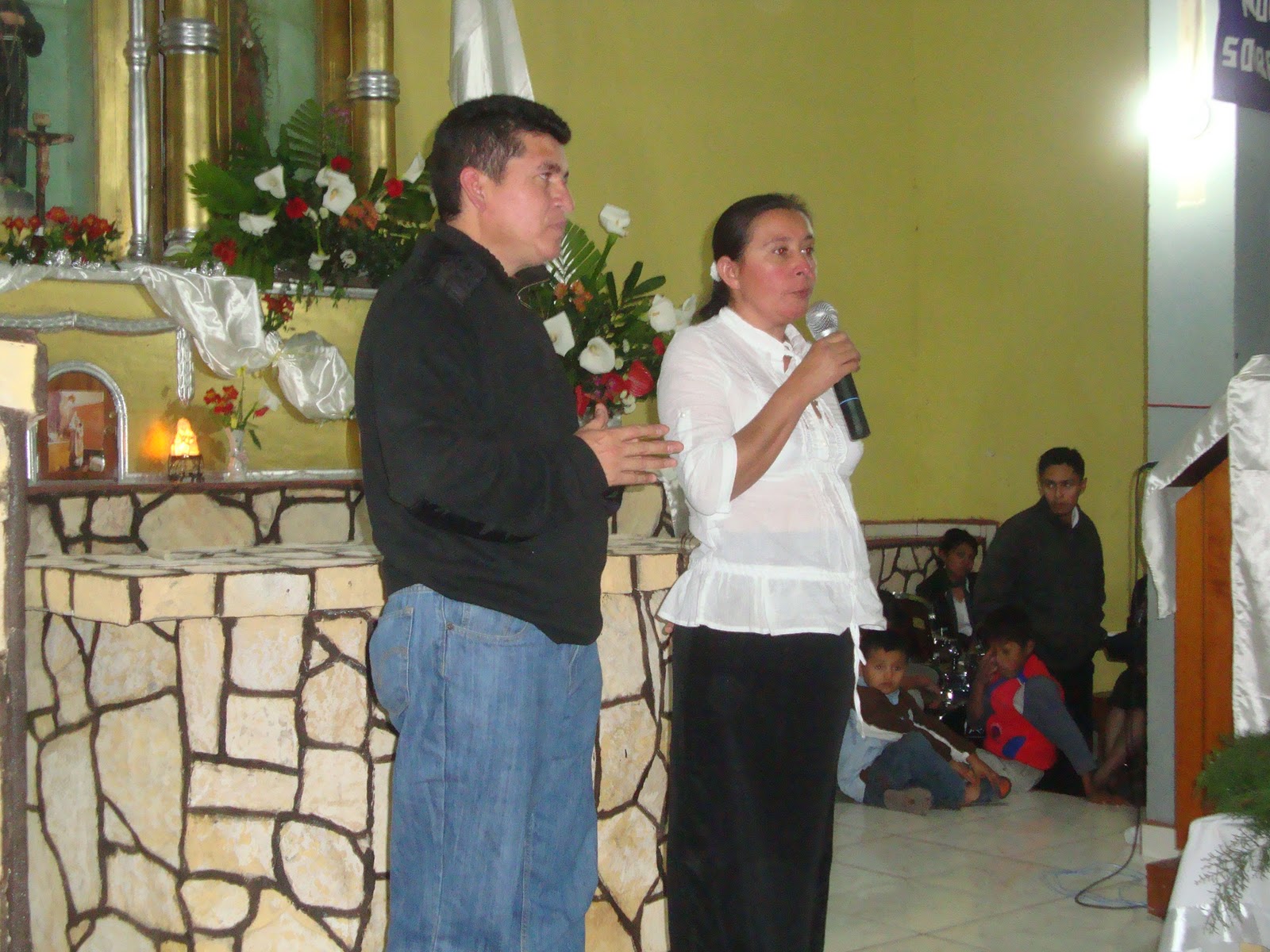
Friday there were about twenty-four people in El Limón for the meeting of Zone 2. Four guys came on horseback but the rest walked – or hitched a ride. (I gave several a ride when I met them on the rode.)

The El Limon church of Saint Michael with my car up front.

The meeting covered a lot of issues, some of which seemed to go on forever. But the seriousness of the people impressed me. Franklin who works on an agricultural project in the parish financed by Manos Unidas was there to talk about the project and to pressure for speedy loan repayments. He noted that one community has completely paid up its loans, but five out of the 23 villages in the projects will be dropped for any number of reasons, including lack of interest or cooperation. The project will probably get two more years funding.

For those who speak Spanish, there is a Spanish television program on the web  here - the first seventeen minutes detail the project in the Dulce Nombre Parish.

Franklin passed around a form for folks to fill out to help in an external evaluation which is being made of the project. Four people did not participate in the census because they could not read or write. Though pastoral workers, they were still illiterate.

Saturday I had planned to go out to El Zapote for the Zone 3 meeting. But I got into the truck at 7:15 am and something seemed wrong with the brakes. (And I don’t want to go out there with poor breaks – there are hills and precarious turns.) I eventually got someone to come and repair them, but one part we bought was the wrong size and so the mechanic had to go to find the right size washer. Yuk!

But it was interesting to talk with the mechanic. A young guy who spent two and a half years in Mexico. He was on the way to the US but got into an accident and had to stay in San Luís Potosí before returning to Honduras. He has very little education. His mother was killed a few years ago in San Pedro Sula during a robbery. But he’s working now in a mechanic’s workshop, learning the trade.

After the brakes were fixed I headed out to El Zapote, knowing I’d be a little late. I arrived as they were eating lunch. They had a few items on the agenda, including an economic report (including how much they were sending to the parish and my report). One young man asked for help for his sister who, because of pulmonary and larynx problems, can only whisper. She has a medical debt of about 7,000 lempiras and needs another 4,000 for medicine (about $670 in all). The group decided to give her 1,000 lempiras (about $53) of the 11,000 they had saved and promised to take up collections in the villages. The generosity of the poor.

After the meeting I went to Piedras Coloradas where we are beginning a project to help the community. We had a meeting with about 12 people attending. After a short shared reflection on the passage on the early Christian communities in the fourth chapter of Acts, I asked the community to share their successes. I had never tried this with a group here and was expecting that I’d have to drag examples out of them. However they chimed in with a list of about ten successes – from their base community to the work they are doing to try to get electricity to the town to the water project. I then asked them how they had done this and they shared about the groups that the community that had helped get many of these projects started. I was amazed, though they told me that they still had problems, such as not enough water.

I then asked them to dream about what they would want in their communities in 2015. I was again amazed –an improved school, a new roof and paint job for the church, fruit trees and vegetable gardens, a soccer team, a fish pond, better housing, and more. The most fascinating was a swimming pool and maybe even a water park! I asked them to get the kids in religious education to do the same time of dreaming as well as any other groups in the community. Next month we’ll examine them and begin to see what we can do.

I told them I came without money or projects and that we would work together for the community. I did, though, promise to bring them one of the soccer balls that the St. Thomas spring break group brought down.

I drove home tired, but reflecting on how privileged I am to be able to work with these people and to recognize what good they do and what good they can accomplish. Several of the people were illiterate. One young man had six years of school but the majority had four or less, but they had a great wisdom. I spent a few minutes talking with a 75 year old man who at first said he knew nothing. But I insisted that he had a lot of wisdom. I told he that he knew how to feed himself, growing corn and beans, but I couldn’t.

There are many who look down on these people and lament how Honduras has so many illiterate people who, these commentators seem to think, cannot be critical thinkers or good citizens because of their lack of education. I beg to differ. Formal education does not necessarily bring forth people with wisdom.

And so I returned to Santa Rosa with a deep sense of peace and I look forward to my next visit to piedras Coloradas in May. I have much to learn from them.

Today is the anniversary of the execution of Lutheran pastor Dietrich Bonhoeffer in Nazi Germany in 1945. There’s one quote from a 1942 Christmas letter of his that reflects my vision of life and of ministry:
“There remains an experience of incomparable value. We have for once learnt to see the great events of world history from below, from the perspective of the outcast, the suspects, the maltreated, the powerless, the oppressed, the reviled — in short, from the perspective of those who suffer....We have to learn that personal suffering is a more effective key, a more rewarding principle for exploring the world in thought and action than personal good fortune.”

Thursday, January 07, 2010

Cold, rain, and mud

The last few days have been cold (50s and low 60s) and rainy – typical rainy season weather. Tim Malone, who had been a student peer minister at St. Thomas in Ames, has been here for a short visit. (See him at right warming himself in Quebrada Grande.)

Tuesday we went out to Dulce Nombre so he could see one of my areas of ministry. But first we got up early – I was going to say bright and early, but it wasn’t bright – to get to the 6:00 am Mass at the Catholic radio station here in Santa Rosa. After Mass Padre Efraín Romero invited us to be with him on the 7 am program, “Cafecito con Pan” – “Coffee with [sweet] bread.” (There was coffee, but no one had bought pan!)

After Mass we went out to Dulce Nombre where we went around with Padre Julio Cesar Galdámez, the associate pastor, and four young people who are directing the agricultural project. They were going out to check on the results of the project in Quebrada Grande. It was cold but seven of us jammed ourselves into the pickup.

We visited an extended family in Quebrada Grande who have a large family garden. There are fourteen children in the family, their father told me. I knew three of them already because they are pastoral workers in the parish and two of them had been pestering me to come and visit.

After they shared with us some of the music they had written, we set out to see the garden and walked through coffee fields, getting quite wet and muddy in the process.. It was quite an impressive garden – one of several hundred being promoted throughout the parish by a project funded by the Spanish organization Manos Unidas (and also helped a bit by donations from St. Thomas Aquinas’s Vacation Bible School). The project benefits some of the poorest families in 23 villages in the parish as well as pastoral workers.

There were carrots, beets, cabbage, onions, peppers, and more. On the way back we stopped at a field where we harvested a few potatoes.

When we got back they were milling sugar cane in the trapiche to get jugo de caña – sugar cane juice for lunch. After lunch, wet and muddy, we left for a quick visit to another village, even further up in the mountains, Granadillal, where we picked up some firewood the people there were donating to the parish.

The road was muddy and slippery and so Padre Julio asked me to do some of the driving. Despite four wheel drive it was still slippery and several times I wondered if we would make the steep incline. But all came out well.

Tim got a good chance to see the countryside – and I got a chance to see where some friends live and work as well as to see some of the results of a project in the Dulce Nombre parish.

This gives me even more impetus to try to see what Caritas can do to implement more agricultural and development projects in the diocese.

This will become more important as the poverty has increased in the past few months and may well increase more. As I was told last week, the poor in the countryside had been receiving government grants under President Zelaya, but the coup regime has cut back or eliminated some of these. In addition, just this week the cost of gasoline has risen. These affect the poor and thus major private sector and church efforts will be needed to help the people attain some type of food security - preferably being able to produce much of the food they need.

-----

More photos from the visit to Quebrada Grande can be found at http://www.flickr.com/photos/johndonaghy/sets/72157623162616654/