Tuesday, June 29, 2021

Back HOME in Honduras

I got back home from a visit to the US on Wednesday, June 16. 


I had gone, primarily, to renew my Iowa driver’s license but I took advantage of the trip to get the Pfizer COVID-19 vaccine and to do an eight-day retreat. About the end of the second week, I was homesick for Honduras. 

I’ve been back now for almost two weeks days and so it would be good to reflect on what is happening here. 

Vaccines

I took advantage of my trip to the US to get vaccinated against COVID-19. I got both doses of the Pfizer vaccine. It was so easy to do and I had almost no reactions, except for a little soreness where the needle was.

I decided to do this since I had no idea when the vaccines would arrive where I could take advantage of them. So far, only 80,000 Hondurans have been fully vaccinated (with 2 doses). Some people I know have been vaccinated, but only with one dose. They have to wait two or three months for the second dose.

According to one news source, “Pfizer highlights the importance of applying the second dose 21 days after the first one. The JOH regime recently announced that they intend to wait three months.” 

According to other sources, “The 1.5 million vaccine doses donated by the Biden administration arrived in Honduras [in the last few days]. Even before that donation, the JOH regime had only purchased 4.11% of all the vaccine doses arriving in Honduras, even though it received millions to do so.”

It is hard to know when people in the countryside will have access to full vaccinations. But COVID-19 continues to plague the country.

The medical system is stretched thin and there are reports of some new strains here. It strikes home a bit because some people I know, including three priests have tested positive in the last two weeks.

Despite this, many people in the countryside are not using masks and are taking few precautions. I fear this will lead to further degradation of the health of the people. In the meantime, though vaccinated, I will continue to wear a mask – most of all to give a good example to people.

Pastoral Work 

I have assisted as deacon at a few Masses and have begun again to go to rural communities on Sunday mornings to preside at Celebrations of the Word with Communion.

Two Sundays ago, I baptized nine children under seven at a Mass in Plan Grande.

Last Sunday, I went to El Bálsamo and, after the celebration, I spoke with ten young people beginning confirmation preparation, encouraging them to continue with this step to deepen their faith commitments.

I also shared several photos that I had taken at the marriage of five couples there last year. 

Parish work

This past Monday a group came to work on the parish coffee fields. I got up early to bring them in from a village an hour away.

The original idea was to do two tasks, to apply fertilizer after dehijando, which can be translated as “removing the suckers from the plants.” The fertilizing was put off because it has been raining a lot and there is concern that the fertilizer would be washed away. But we worked several hours on the other task.

Deshijando is a specific and rather easy process of removing shoots which come put under the branches and would take a lot of energy and nutrition away from the coffee berries. Here are a few photos.
The main church

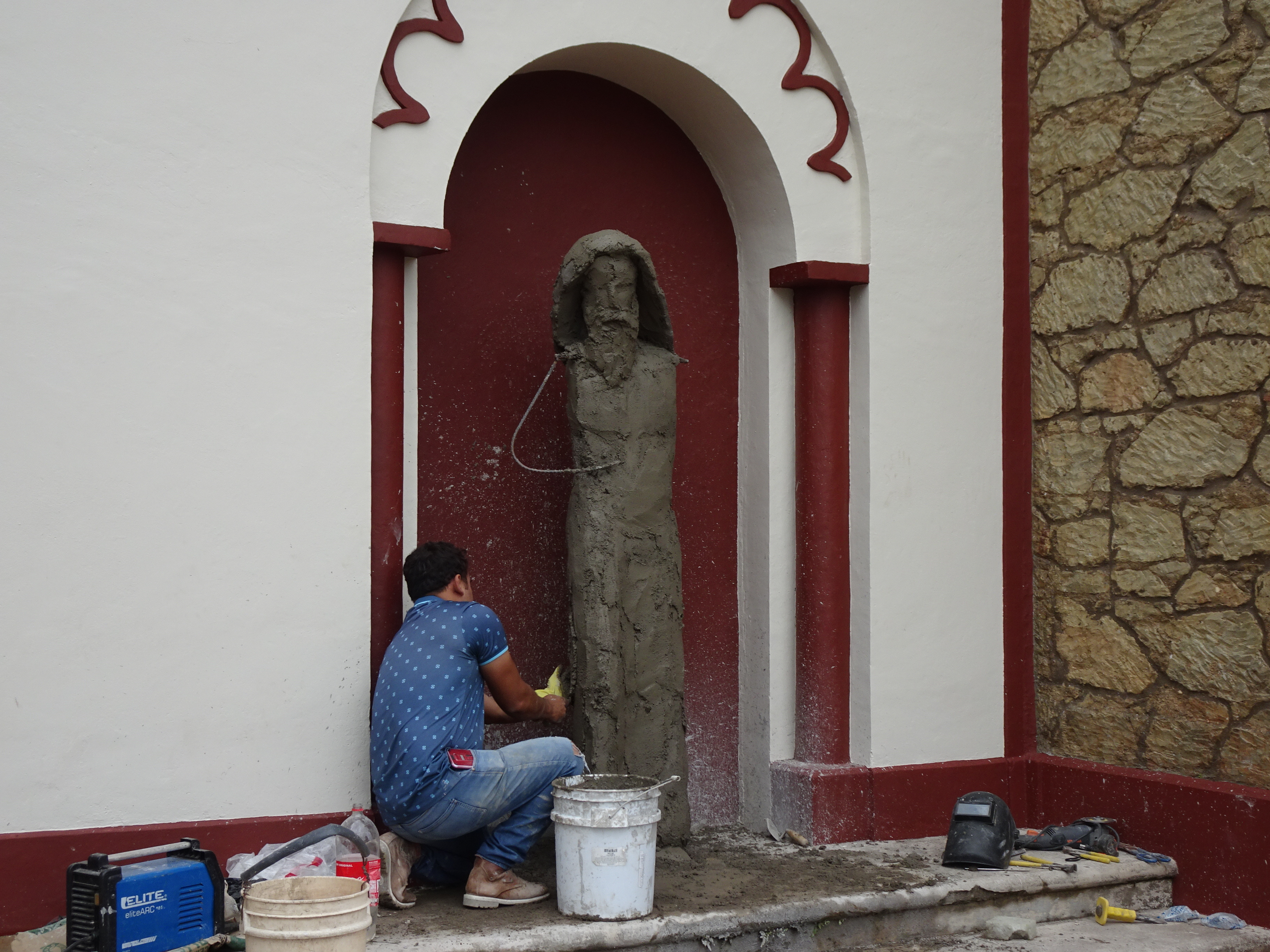
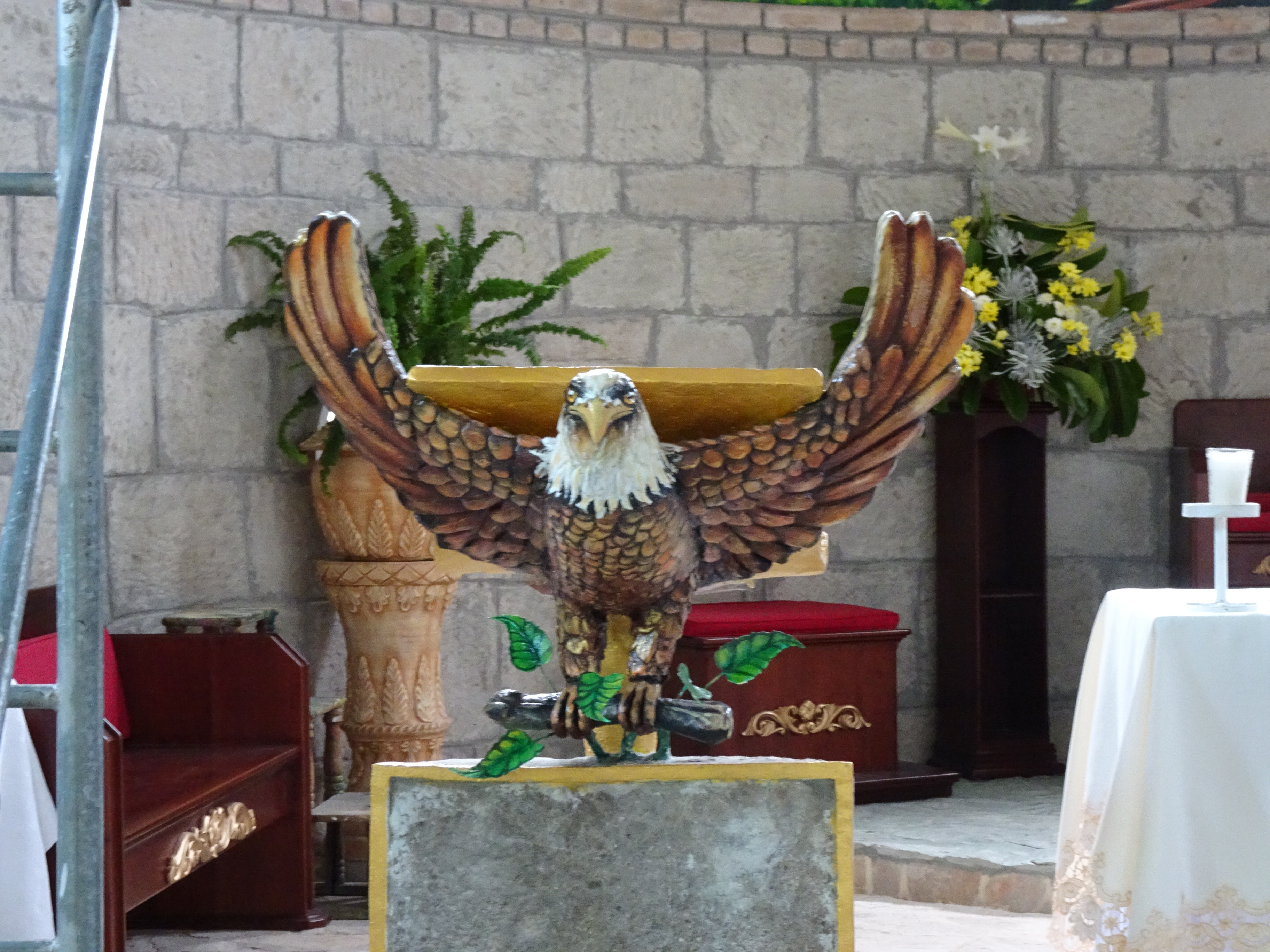
Since more than a year ago, we have been working on the renovation of the main church in Dulce Nombre. It has been painted inside, including a grand mural. The outside has also been painted. 


Now there are a few details being worked on, including the possibility of having some stained-glass windows installed in the sanctuary.

We hope to have all finished for the parish feast day, September 12, when the bishop will come to consecrate the church. (It was blessed but has never been consecrated.) That should be a great day.

The new space for assemblies and formation meetings

Several years ago, we were talking about having a place for formation activities in Plan Grande but the people suggested that it would be better to have a space in Dulce Nombre, where those who come for a meeting could also take advantage of the trip for shopping, going to the bank, and so on. So, the pastor decided to turn the former soccer field into a large auditorium. 
Some photos of the work follow. 


The new space will be named “Auditorio Santo Tomás de Aquino,” “St. Thomas Aquinas Auditorium,” to express our parish’s gratitude to our sister parish, St. Thomas Aquinas in Ames, Iowa. We hope to dedicate it on the same day as the consecration of the church. 

Latin American Church Assembly

Later this year, in November in Mexico City, the church of Latin America and the Caribbean will hold an assembly, which will include more than bishops – priests, deacons, religious, and – most important of all – lay members of the church. 

The assembly will be the culmination of a process which is beginning throughout the continent in local listening sessions. 

The Latin American bishops’ conference, CELAM, prepared materials for these sessions which were adapted for our diocese. Last week we had sessions in nine places in the parish, with participation of 10 of the parish’s eleven sectors. (The only area not involved, so far, is the city of Dulce Nombre de Copán.) I was pulled into helping lead the sessions in three parts of the parish. We had over thirty people in each location and there was good participation. 


I felt that the material was a little too complicated and not always written in ways that could be easily understood by people who do not have a lot of formal education. There was even mention of a challenge – “La incorporación de lenguajes pastorales actualizados o significativos para los destinarios” [incorporating pastural languages which are up-to-date or significant for the audience] – which was written in a way that was hard for people to understand.

But it was worthwhile to offer all people the opportunity to share their concerns. I felt a bit rushed, trying to do all this in five or six hours. I also wonder if there were some questions that were not asked, including access to the Eucharist and other sacraments.

My concern now is that the syntheses of the inputs are respected and not manipulated by those who report all this to diocesan, nation, and area groups.

An educational challenge

The issue of education came up in several areas, but in one part of the parish the situation is extremely grave.

According to what I have heard, teachers in three communities are not willing to return to even a few classes a week in person. But, even before the pandemic, some of these were not present for classes five days a week. As a result, the students suffer. People are concerned about fifth graders who cannot read. There are also a few allegations about the way some students have been treated by at least one of these teachers.

At a later meeting of church leaders of that sector of the parish, they discussed the situation and ways to go forward in obtaining quality education for their children. They emphasized that they are not seeking to replace the teachers but will go forward trying to remedy the situation, talking with education leaders in the district. 

Challenges of life 

On June 20, after Mass, we had a thunderstorm and one of the lightning bolts struck close to my house. As a result, the electricity was off for almost a day and, because the fiber optic converter was burnt out and I was not able to be at home because of commitments, I had no internet in the house until Friday morning. Just a small, somewhat first-world inconvenience.

This morning, while doing some laundry, I realized that the water from the faucet was not clear. This happens any number of times, especially after heavy rains. I think this is sometimes because the rains at times stir up the mud in the springs that are the water source and sometimes because one of the pipes has cracked or broken. The water for most of our communities in this area come from mountain springs, sometimes several miles from the villages.

The next few weeks

This Thursday we plan to visit the jail in Santa Rosa de Copán, bringing about tamales, other food, and about 4000 tortillas. This is in response to a request from a prisoner who leads the pastoral work inside the jail. I’ll be helping to transport the food. We will be a small group and will all have to be tested to avoid the spread of COVID inside the prison.

Next week Caritas will send two psychologists to provide attention to members of the parish. Father Fernando, the recently ordained young priest in the parish, and I will be trying to coordinate this, bringing them to various locations in the parish.

This is critically important – not only because of the trauma of the pandemic and the two hurricanes that hit our communities, but also continuing problems of domestic abuse and violence. One visit won’t be enough, but we can begin to see what the needs are and think of how to respond in the future.

I am also hoping to have more meetings with catechists in the zones of the parish to discuss how to begin again the religious formation of the young. I also plan to meet with the coordinators of social ministry in the zones to continue to respond to the needs of the people as well as to prepare for any possible emergencies during the hurricane season, around the month of October.

There is no lack of pastoral work. I am hoping that we can motivate and animate the people in this important ministry and do it in a way that is safe for the health of the people.


Back in the US of A

I realized today that I had published this in the wrong blog. It was written a month ago, on May 28, before going on retreat. I have been back in Honduras since June 16. 

I've been in Iowa for a little more than eight days.

My Iowa driver’s license was about to expire, on my birthday, June 1. I have a Honduran driver’s license, but I think it might be helpful to have a US license so that I’d have fewer hassles when I get back to the US, especially if I want to drive or rent a car.
So, I decided to take a trip back to Iowa, especially since the prices were the lowest I’ve seen in ages – some as low as $500 for a round trip.

Once I made the decision, I pondered getting the COVID-19 vaccine while in the US. I have no idea when there will be vaccines available generally in Honduras. According to a May 22 online report in Contra Corriente,
"According to data from the Ministry of Health (Sesal), Honduras has vaccinated only 1% of its population. Only 5687 frontline health personnel have been vaccinated with the two doses, and 108,538 people, including health personnel and older adults, have been vaccinated with the first dose."
According to the online Proceso.hn:
The second batch of vaccine doses bought by the IHSS arrived yesterday in Honduras, another 81,600 doses.
There are about 8 million people in Honduras. 

There are promises of vaccines by the government, but they were promising vaccines way back in February. So, I decided to take advantage of my visit to get vaccinated. It is extremely easy to get vaccinated in the US and so I am, in a way, leaving a place open for a dose of vaccine for Hondurans by getting my shots in the US. I managed to arrange an appointment by internet and received my first dose of the Pfizer vaccine on Friday May 21. My second dose is schedule for June 11. 

I am staying with friends who even offered me use of a car – which makes life even easier. From their house I was able to see the gorgeous sunset above as well as this photo of deer in a neighbor's yard.
I’ve been taking it easy for a few days, though I’ve gone out to get somethings I need as well as to visit a few people.

I discovered, trying to make a purchase, that my debit card had expired a year ago – and so I managed to arrange that fairly easily. Another good reason for the visit.

Sunday morning, I served as deacon at two Masses at St. Thomas Aquinas Church in Ames, where I had served for almost twenty-years before leaving for Honduras in 2007. It was very different – with all the bio-security measures, but I did see a few friends from the past. The twin daughters of two friends were baptized at the 8:30 am Mass and I was overjoyed to see them and their other three daughters, as well as members of their extended families.

I’m also visiting with a few people, including Fr. Kyle, the pastor of St. Thomas Aquinas in Ames. St. Thomas is the sister parish of Dulce Nombre de María and has helped us greatly. It was good to share with him some of the stories and photos of what is going on. After the visit I got to the noon Mass and then went to the Department of Transportation office to renew my license – which will be in the mail shortly.

I have also been able to visit or arrange visits with other friends, including with one of the donors for the mural project in the church of Dulce Nombre.

There's also the culinary aspects of this trip. In May you can find two of my favorite foods - rhubarb and asparagus. I got asparagus once in Honduras from a roadside stand near La Esperanza, Intibucá, but rhubarb cannot be found. I ate asparagus three times already and I made a sauce from rhubarb which has graced both yogurt and ice cream. Yum. And today I found a food truck in Ames what has Salvadoran pupusas. Even though it was not on the menu I asked if they had pupusas with cheese and lorroco - and they did. 

I’m also trying to tie up some loose ends of my life.

I have a lot of books stored with friends in Ames and am slowly going through them. I also have a good number of these books that I want to give away and I’m slowly finding ways to do that. I sent a list to a friend to share and I have been able to share more than four boxes of books, sending packages all around the US.

I’m also going through photos and files, throwing out what I really don’t need and trying to find ways of storing the many photos – some from my parents and uncles. But I found a large number of photos that I didn’t realize I had and am going through them. In the course of this, yesterday I came across an interesting document from about 1954 – a notice from the Pennsylvania Department of Health that I was eligible for the second Salk Poliomyelitis Vaccine! Now I am eligible for the second Corona-19 vaccine!

I got a chance to visit the new Catholic Worker in Ames, the Romero House. I brought them an image of Romero; it’s the least I can do to support this effort to serve the poor. It is amazing to see this work, initiated by a young Iowa State University graduate. I hope it flourishes. 

I had originally pondered going back to Honduras after the first dose and then coming back for the second, but a friend suggested that I look for a retreat for some of the time. Looking around the internet I found an eight-day Ignatian retreat at the Creighton University Retreat Center in Griswold, Iowa; I head there today, Friday.

But life is full of surprises. Wednesday I got an e-mail telling me that I had to get a PCR COVID test to go on the retreat, if I wasn't fully vaccinated. A quick run to a MercyOne in Des Moines and, by yesterday morning, I had the proof that I was negative.

When I booked my travel, I decided to return to Honduras on June 22, leaving enough time to assure I could get the second dose of the vaccine. But I got a June 11 appointment and so I’ll be returning home earlier. 

I was reluctant to leave and I'm anxious to return. I’m a homebody and travel gets a little harder as you get older. But I’m guessing that this will be a good opportunity to rest, to see some friends, to get somethings done that I’ve put off, and to have a retreat. I hope and pray that I can return renewed and invigorated for the years ahead.

Tuesday, May 18, 2021

Breaking ground in the theology of the permanent diaconate.

Review of Tim O’Donnell on the Diaconate 

Tim O’ Donnell, The Deacon: Icon of Christ the Servant, Minister of the Threshold. New York: Paulist Press, 2020. 

This is a most welcome book, clarifying the nature of the permanent diaconate and bringing to the fore much of what have not been at the center of most of the discussions I have read. As a permanent deacon in rural Honduras, I am glad to read someone articulating a deeper vision than some other writers. (I must exclude the great work of Deacon Greg Kandra, Deacon Bill Ditewig, Deacon James Keating, Monsignor Paul McPartland, Bishop W/ Shawn McKnight, and Michael J. Tkacik – among others.)

BASIC APPROACH 

 O’Donnell’s approach, emphasizing the deacon as the Icon of Christ the Servant and the Minister of the Threshold, analyses each model in terms of Christ, the Church, the disciple, and the deacon, as well as in terms of the functional, relational, and sacramental aspects of diaconal ministry. This is a very rich approach. As he explains:
“Each model begins with a metaphor (servant or threshold) that offers a perspective on the person and activity of Christ, and then extends to a parallel dimension of the Church and of Christian discipleship. Only from this broad perspective is it possible to see how the office of deacon is uniquely structured to represent and to put into action each model of ministry.” (p. 131)
This approach roots the diaconate in Christ, the Church, and the role of the baptized as disciples. The diaconate is not an isolated ministry, nor is his ordination separated from his baptism. The ordained deacon has his roots first of all in Chris, and thus in his service to the People of God, and in the deacon’s baptismal identity. But what I found most refreshing is what I believe is central to his reflection. He seeks an integral vision of the identity of the permanent deacon, not content with a reductionist approach nor denying the centrality of the diakonia of charity. AS he writes:
“the foundational understanding of the diaconal tasks as integrating word, liturgy, and charity, with a center of gravity in charity.” (p. 134)
I am also very grateful for his critique of the work of Collins. I have long felt that Collins has become an alternate magisterium on the permanent diaconate, undermining the servant aspect of the diaconate ministry. 

 CHRIST THE SERVANT 

Living the three-part ministry of baptism is central in my understanding and practice of the diaconate. For this, I am indebted to the theology of the base communities here in Honduras. Our pastoral work and the identity of the disciple are founded in our baptismal anointing in Christ – prophet, priest, and king – and are expressed in the prophetic, liturgical, and social ministries of the diocese, the parish, and the base communities. 

Defining the deacon in terms of the diakonia of Word, Liturgy, and Charity, with its center in charity, reflects the importance of seeing the diaconate in terms of its foundation in baptism.

The deacon’s ministry of service is also connected with the call to the church to be servant of humankind, as noted by Pope Saint Paul VI. O’Donnell notes the relational aspect of the diaconate. No deacon can be the servant alone but is servant with the whole church.

I would have liked some in-depth discussion of the deacon as the animator, driving force of the diakonia of the church, as noted by Pope Saint Paul VI and Pope Saint John Paul II. I’ll reflect on this later in this review. 

MINISTER OF THE THRESHOLD 

In reflection on my diaconate, I have seen that it includes serving as a bridge or being at the crossroads of the church and the world. O’Donnell’s emphasis on the deacon as a minister of the threshold is one of the most significant parts of this work, clarifying aspects of the diaconate that have not been fully developed.

Many have written about the diaconate as “a bridge or mediating ministry.” But the concept of threshold provides a richer understanding of our ministry. 


As O’Donnell notes, “A threshold, as a place of meeting and passage between different places or realities, suggests the ideas of bridge, borderland, and mediation…” (p. 113). Thus, the deacon is “…an ordained minister embedded in the world outside the Church.” (p. 122). 

Being ‘between,” in one sense, identifies us sociologically and theologically. But our ministry is more. 

As O’Donnell writes, “It is in crossing the Church threshold into the broader world that diaconal ministry is at its most characteristic.” (p. 122). 

For me, the permanent deacon who has his employment outside the church is in a unique and important place. In his life he can be a sign of the intersection of faith and work. He can bring his experiences in the workplace and the family, into the life of the church, formally and institutionally. In addition, he can bring the values of the Kingdom of God into the workplace. 

As I see it, the permanent deacon is one who ought to be able to see the reality of the world around him, the joys and the hopes, the griefs and the anxieties” of our age (Gaudium et Spes, 1). He can then bring them to the attention of the church. 

The image of the deacon as” the eyes and ears of the bishop” might be developed to reflect this aspect of being a minister of the threshold. I will make several comments on this below. 

Margins 

I would further develop O’Donnell’s portrait of the deacon as minister of the threshold in several ways.

First of all, I would suggest that the description the Seven in Acts 6-8 can be read partly in terms of being ministers of the threshold. 

The Seven are chosen to respond to the needs of those who have been neglected, those who have been, in a sense, marginalized, outside of the attention of the whole church, especially the apostles.

It is also important to note the ministry of Philip the deacon. He opens the faith to the outsiders – the Samaritans and the Ethiopian eunuch are beyond the community, but Philip evangelizes them, welcoming them into communion with the community.

I also think it might be helpful to think of the diaconate call as a pull or a push toward the edges, to those who are beyond the church, the alienated, the marginalized, the abandoned members of our world. Pope Francis’s call to go to the peripheries is a diaconal calling all disciples to be ministers of the threshold. 

This call has been taken up in a monthly on-line publication of Latin American deacons entitled, appropriately, Servir en las peripherias – Serve in the margins. 


It might be helpful to look at the Latin American emphasis on mission and discipleship, which can be found in the document of the Latin American Bishops Conference of 2007 in Aparecida, Brazil. 

This is reflected in much of the teaching of Pope Francis. 

Furthermore, looking at the deacon as a minister of the threshold, I would have liked a discussion of the deacon as the eyes and ears of the bishop – especially in relation to the discussions in the priest barracks at Dachau on the failure of the Church to respond to Nazism. 

The deacon can be, by being involved in the world, not just the eyes and ears of the bishop but as one who can make the connection with the world and the needs of the world for the whole church. I will offer a few initial thoughts below. 

 AREAS FOR FURTHER REFLECTION: 

Deacon Tim O’Donnell has opened a space for a deeper understanding of the deacon’s identity. I would suggest that there are at least four aspects of the diaconate that merit further discussion. 

1) The deacon as animator of diakonia:

The deacon is, as several popes have mentioned, an animator, a driving force for diakonia of the whole church. This opens a space for the deacon that is more than the one who does diaconal ministry.

As animator, the deacon is a leader, but a leader who promotes the baptismal ministry of every disciple. O’Donnell mentions the deacon as animator. “The task of ministers is not to take on this goal of full discipleship as a specialized one for themselves. Their task, rather, is to support and animate the people of God in stretching toward it.” (p. 120). 

This model has several advantages. 

First of all, it recognizes that the deacon has a mission to promote the baptismal mission of every believer. As Deacon James Keating has written in “The Spiritual Apex of Diaconal Formation” in Forming Deacons:
“The deacon possesses no unique power by virtue of ordination but possesses a mission in being sent by the bishop; he evokes from others the power that is theirs by baptism.” (Kindle location 2366)
In a work not specifically related to the diaconate, Yves Congar, OP, points to ordained ministry as animating the Body of Christ:
“St. Paul expressly says that ordained ministers organize the ministry of the saints, that is, of Christians (Eph 4:12). They organize it, but they also invigorate and animate it and drive it forward. They are the drivers and the governors of the Body in that condition of responsibility and universal service that is the Christian condition itself.” (Power and Poverty in the Church, p. 45)
Second, viewing the deacon as the animator of diakonia can help us see how the deacon leads in the diakonia of charity. This may help flesh out the role of leadership of the deacon that O’Donnell notes in chapter seven. 

Personally, this image of being a driving force has been central to my pastoral style. I wrote about this is a blog post a year ago, just before the pandemic hit.

2) The deacon at the threshold of work and the church 

There is an element of the deacon as bridge which O’Donnell mentions but could be further explored – the deacons involved in the world in "secular" professions. 

I work full time in the parish where I serve. Before I was ordained, I served in the diocese as a volunteer. This is one way of serving as a deacon.

But I think that the deacon with outside employment can really be at the threshold of the world and the church, bringing his experience to the Church and bringing the faith to his work experience. He also can bring his understanding of the reality of the world, as experienced in work, in politics, and in family life to the church.

I find it very interesting that the promotion of the diaconate in the mid-twentieth century occurred about the same time as the worker-priest movement which sought to connect with the working class, which was considered “lost” to the church, especially in France. 

3) The Deacon as the eyes and ears of the bishop 

O’Donnell mentions the ancient description of the deacon as “the eyes and ears of the bishop” in a footnote, but I think reflection on this image can help us understand better what the deacon as “minister of the threshold” could be. Take note of this passage from Pseudo-Clement, from his letter to James, chapter 12:
“Moreover, let the deacons of the Church, going about with intelligence, be as eyes to the bishop, carefully inquiring into the doings of each member of the Church, ascertaining who is about to sin, in order that, being arrested with admonition by the president, he may happily not accomplish the sin. Let them check the disorderly, that they may not desist from assembling to hear the discourses, so that they may be able to counteract by the word of truth those anxieties that fall upon the heart from every side, by means of worldly casualties and evil communications; for if they long remain fallow, they become fuel for the fire. And let them learn those who are suffering under bodily disease, and let them bring them to the notice of the multitude who do not know of them, that they may visit them and supply their wants according to the judgment of the president. Yea, though they do this without his knowledge, they do nothing amiss. These things, then, and things like to this, let the deacons attend to.” (Found in the Compendium of the Diaconate: Kindle Location 1849 ff.)
Some might find this description problematic, evoking the image of a spy, reporting to the bishop. But that is to misunderstand the scope of the deacon as the bishops’ eyes and ears. Cardinal Walter Kasper notes that “the deacons served as “the bishop’s eyes and ears” — informing the community about the concerns and desires of the bishop and reporting to the bishop the needs and situation of his people.” (p. 185, The Deacon Reader In another place Cardinal Kasper wrote:
“I am thinking here of hospitals, homes for the elderly, spiritual care in places of work, in prisons, in refugee shelters, etc. I also include co-operation in the leadership of a diocese in those regions, where the main question is that of diaconal leadership. In this context, I would like to point out that for the bishop the community of deacons of a diocese can be a welcome panel of advisors. The deacons can act as the eyes and ears of the bishop in identifying areas of need and can help him in his task of being father to the poor.” (pp. 274-275).
At an International Diaconate Center conference in 1997, he noted: 
“The deacons can act as the eyes and ears of the bishop in identifying areas of need and can help him in his task of being father to the poor.”
The deacon could also serve as the eyes and ears of the church, not just the bishops, making real the first paragraph of Gaudium et Spes, by opening the eyes and ears of all the baptized to the reality of the world around them: 
The joys and the hopes, the griefs and the anxieties of the men of this age, especially those who are poor or in any way afflicted, these are the joys and hopes, the griefs and anxieties of the followers of Christ. Indeed, nothing genuinely human fails to raise an echo in their hearts. 
I think it is important to note that part of the discussions that arose in the priests’ block at Dachau addressed a concern that the Church had not responded adequately to Nazism. As William Ditewig noted in a June 2014 article in US Catholic, the priests were, in effect, asking: “why wasn’t the church able to somehow influence society to prevent all of this from happening? What can we do in the future, so this doesn’t happen again?”

One of those imprisoned, Father Wilhelm Schamoni, later wrote in his advocacy of a permanent diaconate:
3. The preaching of these deacons, who would be involved in the work-a-day world, would be particularly persuasive and down-to-earth. One perceives in current preaching that it is being done by individuals who are “segregate a populo” [“separated from the people”]. 
4. The Church has largely become a Church of authorities and officials. The feudal state and the civil servant state have rubbed off on her. The diaconate would be an effective means to return Holy Mother the Church to a Church of the people. 
5. The Church has not succeeded in holding its ground among either the leading intellectual classes nor among those classes most easily led astray, the proletariat. In their own milieu, deacons from these classes for these classes could gain influence incomparably deeper than could any priest, since priests would never develop within this milieu the kind of rapport that deacons would have already established. One could develop the diaconate into a means to win back the de-Christianized milieu. An intelligent deacon from the working-class would, without any special theological training, be able to touch the heart of his worker colleagues with just the right words.
In addition to this dimension, the deacon can be one who lets the voice of the faithful be heard by bishops and pastors. As Deacon Greg Kandra notes in ”The Catholic Deacon Today”:
“He can serve as the eyes and ears for the bishop or pastor—and as a voice for the people.”
I believe that this aspect of the diaconate needs to be developed.

First of all, are deacons sharing what they see and hear with the bishop and with their pastors? In particular, are they sharing the injustices they see around them, the racism, the injustice, the poverty? Are there deacons bold enough to denounce the racism and clericalism that they may see around them? Are there deacons who advocate for the victims of abuse – in the church and in the world? Are there bishops and pastors who welcome such advocacy?

Secondly, are deacons being prepared to listen to the cries of the poor? Are they being prepared for critical social analysis of the social reality they encounter?

Thirdly, are we deacons speaking in our homilies of the reality of this world, reflecting an incarnational spirituality that opens the Church to the presence of Christ not only in the Eucharist but in the poor, as well as in the daily life of families? 

4) The deacon at the intersection of Eucharist and the poor

There are as many the dangers of reducing the diaconate to the liturgy as of reducing its mission to social service. O’Donnell’s work opens a way to address this, but I would suggest that we need profound reflection on the intersection of the three aspects of diaconal ministry in the Eucharist.

In July 2020, the Vatican Council on the Clergy released an instruction on parish life, "The pastoral conversion of the Parish community in the service of the evangelizing mission of the Church", which included significant paragraphs on the deacon. It notes that, in Canon Law, “there is no indication of any particular office in which the deacon's ministry can find specific expression” (81). But it begins to probe this. In paragraph 82, the instruction offers one way to look at the relation of the three ministries of the deacon:
… the history of the diaconate recalls that it was established within the framework of a ministerial vision of the Church, as an ordained ministry at the service of the Word and of charity; this latter context includes the administration of goods. The twofold mission of the deacon is expressed in the liturgical sphere, where he is called to proclaim the Gospel and to serve at the Eucharistic table. These references can help identify the specific tasks of a deacon, adding value to that which is proper to the diaconate, with a view to promoting the diaconal ministry.
In this document, the deacon’s ministry is considered largely in terms of “evangelization and charity” (81), but these, according to the Instruction, as “expressed” in the liturgical dimension of his ministry. I think this needs to be explored to further the work that O’Donnell has begun. 


We can also explore the relation between charity and the Eucharist in many ways. It might be helpful to begin with what Monsignor Paul Mc Partland wrote in an article on “The Deacon and Gaudium et Spes”:
“The deacon stands at the altar and prepares the gifts with clean hands, but he stands also where the practical need is greatest, getting his hands very dirty.”
We might also begin to reflect on the responsibilities of the deacon at the Eucharist and how these bring together some aspects of the other dimensions of the diaconal ministry. I offer my blog post on cleansing the sacred vessels as a starting point for this. It can be found here.

CONCLUSION 

I hope that all deacons (as well as priests and bishops) will read this important work on the diaconate and use it as the basis of discussions and further theological reflection on the ministry of the deacon. 

I am grateful to Deacon Tim O’Donnell for this important work.

Friday, May 14, 2021

Learning from the catechists

This year, as the pandemic appears to be coming under a bit of control and we are able to have more meetings, I have tried to meet with the catechists in the parish. 

This is not as easy as it might appear. I am trying to meet with them in small groups, by sectors.

The parish has about fifty towns, villages, and hamlets; it is divided into four zones and eleven sectors. So far I have had nine meetings.

 I was meeting with the catechists in one of the sectors of the parish. As part of our discussion on the sacraments, I shared the advice of Pope Francis, “The sacraments are not rewards for the justified but are medicine for the sick.” 

One catechist, reflecting on this, noted that in the public schools the teachers give prizes for the students who do really well, as rewards. In our religious education, we should not be doing the same, she said. We should pay attention to all, especially those who are most in need. What a great insight. 

She realizes that our work with children in faith formation is not the same as classes in the schools.
catechists' training in 2017 in Delicias Concepción

Saturday, May 08, 2021

Come over to Honduras and help us.

Fifteen years ago, after a moving experience volunteering in New Orleans after Hurricane Katrina, I visited Sister Nancy Meyerhofer in Honduras as part of a discernment process. 

After working in New Orleans, I felt that God was calling me to do something different, moving from my work in campus ministry and social ministry at St. Thomas Aquinas Church in Ames. 

Nancy and I were going to meet the bishop to talk about possibilities. Before that, I spent a few days with Nancy, observing her work and going with her to some of the communities where she served.
Saturday, as is my daily custom, I read the lectionary readings. The first reading, which this year is read today, is from the Acts of the Apostles 16: 1-10. This verse stood out for me: A Macedonian stood before him and implored him with these words, 
“Come over to Macedonia and help us.”
Paul had been planning to go to Bithynia but “the Spirit of Jesus did not allow them.” 
At this time, I was also considering a paid position in El Salvador. 
I had my first Latin American pastoral experiences in El Salvador and the people still have an important place in my heart. It is a holy land, graced with the blood of many martyrs. 
But, reading this passage from the experience of St. Paul, I began to wonder if my call was to Honduras. 
When I had crossed the border from El Salvador into Honduras, I noted a difference – most notably the infrastructure. The roads were terrible. (They still are in many places, though there have been improvements in the last fifteen years.) 
The next week I went with Nancy and met with the bishop. He was willing to accept my offer of help but warned me that they have no money.
I returned to the US with a greater sense that my call was probably to Honduras. There was greater poverty in Honduras than in El Salvador and there was less international solidarity with the people of Honduras.
In June 2007, I arrived and began serving here. I do not regret my decision. It’s where God has opened many paths for me to serve God’s people. And, God willing, it’s where I will be able to serve God and the people of God until I die.