Wednesday, May 30, 2012

A small victory - for now


Tuesday, May 29, more than 600 people closed the international highway between Santa Rosa de Copán and Ocotepeque in the town of La Labor, Ocotepeque. At the same time, a delegation from the area, including the mayor of La Labor, was in Tegucigalpa meeting with members of congress.

This is not the first time that people in the area have taken the highway. A number of years ago the people fought successfully against a threatened mining operation in the area.

The issue is related.

Near the town of La Labor is a National Biological Reserve called Guisayote. It is a major source of water for the region.

A local congressman has proposed changing the status of the area to a National Park. That sounds innocent, especially when advocates are claiming that this will help the area by allowing for ecological tourism or will help them buy more land to protect.

But many local people fear that the change will allow parts of the area to be opened for mining concessions.

And so the people are struggling for their lands and their natural resources.

The highway blockade (toma de carretera, in Spanish) began at 3 am with about 75 people. More arrived as the day progressed; I have heard between 300 and 600 came. All seems to have been peaceful. 

A reporter challenged the 300 or so police who arrived not to use violence against the people, since there were old people and students among the demonstrators. He noted that the wife and children of one of the policemen were among the many who were blocking the highway.

Two diocesan priests accompanied the action.

The blockade was ended when the news came that Congress will not proceed with the law to change the status of Guisayote.

A small victory for the people. Hopefully the politicians will be true to their word, but that is to be seen.

Sunday, May 27, 2012

When the Spirit stirs


Today is Pentecost, the celebration of the outpouring of the Spirit on the followers of Jesus who were gathered, anxious and perhaps fearful.

The last two days I have been moved by the outpouring of the Holy Spirit in the parish of Dulce Nombre.

Friday: communion ministers and social ministry

Friday the parish had scheduled two events – a meeting of the representatives of the Social Ministry from the villages of the parish and a meeting of the extraordinary ministers of Communion.

I went to Dulce Nombre, planning to help where needed.

At first I went to the Social Ministry Assembly and was amazed at the number of new young participants in the ministry, especially from Zone 3 of the parish, which has some of the remotest villages. 

Social Ministry lunch break included a game of "futbol" (aka soccer)
 
I spoke with a young man from San Marcos Pavas, who left home about 4:30 am to walk to the village of Delicias to catch a bus to Dulce Nombre. We talked about his village that has had some real problems – a pastoral worker left because of threats due to inter-family quarrels. But they have reorganized the ministry in the village and he is the representative of the social ministry.

Padre Efraín worked with the Social Ministry representatives and, since the other priest hadn’t shown up, I went with the Communion ministers to meet.

Since I hadn’t known I’d be working with them, I had to improvise. We reflected on the Pentecost reading from the Acts of the Apostles and then I had them share their experiences in their ministry.

In many of the villages, but not all,  the presence of the Eucharist has actually renewed the life of the church. People come out, usually on Thursdays, for a Holy Hour.  In their visits to the sick, the ministers have seen some people recover their  spirits – if not, at least in some cases, their health.

We talked about what they might need for their ministry. A retreat was a top priority, though a visit to the Aguas Termales – the hot springs – in Gracias was also mentioned.

But they also talked of needing good written materials to help with planning Holy Hours and to help their visits to the sick.

We had to cut off the discussion for lunch, but they and I were glad that they had a chance to share, something they had not yet done as a group.

After lunch I gave a short introduction to the methodology of the Social Teaching booklet they are using in the base communities, emphasizing the participative nature that the booklet hopes to nurture.

I was about to end when Fernando spoke up. It’s time to let us go home, he said, since there’s a storm coming. We ended with a prayer and they went on their way, though I’m sure that some of them got soaked.

Saturday – to three corners of the parish - and five sacraments

Saturday, in El Zapote de Santa Rosa, one sector of the parish was having a gathering for the children and youth in religious education. More than 100 young people – with some catechists and parents squeezed into the meeting hall for songs, talks, and skits – one for each of the four villages on the zone.

Several of the skits were quite entertaining. Sadly, I missed what some of them were about since they went so fast and the amplification was poor. One was a marriage skit. 

Marriage skit in El Zapote

But the wildest skit featured a religious ed meeting that encountered six young people into “sex, drugs, and rock and roll.” Well, not exactly that, but it was drugs (marijuana and cocaine), alcohol, smoking, rap music, and dancing hip to hip. The young people played their parts well and, in the skit,  the religious ed class ended up converting the druggies. It was, of course, a little too facile, but entertaining. The real surprise was that the religious ed teachers – actually one of their real teachers, was a guy dressed up in a skirt with  a bra under the blouse.I never expected to see this here - especially since it was not done in a mocking way.

It was good to be there, but I had to leave before Mass started (an hour late) since I had to do a presentation on the Social Teaching booklet for the sector meeting in Dolores.

After that I went to Dulce Nombre to meet Padre Efraín to go with him to San Agustín.

I had not been there for some time and was surprised, first of all, at the good state of the dirt road. Later I found out that the mayor has also been doing a lot to try to improve the lot of the people, including taking over the costs of the Maestro en Casa, an alternative education program.

We met with Agüeda, an older woman who with her husband Horacio had moved to San Agustín a few ears ago after living in San Pedro Sula. These two Communion ministers have been active in preparing couples for matrimony, as well as encouraging couples living together to get married in the church. They also have an extensive ministry of bringing Communion to he sick – about 19 houses in San Agustín.

We met Agüeda near her house and visited five houses. The first three had women confined to their beds. The first was very poor. As we entered a granddaughter was mopping the floor because of the rain that had entered the house. Padre Efraín heard the woman’s confession and then, with us present, he anointed the old woman. Agüeda will later bring her communion.

The second house was even poorer – with an unconscious older woman, confined to bed. When we arrived there were at least six people gathered and several more joined us as the woman was anointed. As we prayed I noted that even the small children knew their prayers.

Seeing the poverty, I was near tears.

At the fourth house we expected to find a couple in their eighties confined to their beds. But they were up, even though very frail. Padre Efraín learned that they had not been married in the church! What to do? He asked them if they wanted to be married. It took quite a while for him to get through to them, but finally they agreed. Padre Efraín heard their confessions and then married them in a very simple ceremony, before anointing them with the anointing of the sick.

The marriage ceremony was touching. The old man sort of made up his own version of the marriage vows. “Yeah, I want to marry you.” Padre proceeded with the official marriage vows. A grandson present looked on, with a big smile.

Padre Efráin with the newly weds, with Agüeda looking on.

These signs of God’s love and grace touched my heart.

I was also moved by Agüeda’s ministry. As we drove and walked to the various houses, she mentioned how she had ministered in San Pedro Sula,  even going to ministering to a dying gang member, going where a priest was reluctant to go, out of fear.

After our visits, we had dinner with Horacio and Agüeda and the family of one of their sons who had come from San Pedro Sula for the Vigil. We ate in the fairly nice home of a coffee farmer whose three sons would be baptized that night.

The vigil was supposed to start at 7:00 pm and we started just a little bit late, mostly because the people were slow in arriving at the church, perhaps due to the rain.

The Mass was good – though the singing could have been better. The two women leading the songs at times started the songs without waiting for the musicians and so they sang in one key and the musicians played in another.

For me, the highlight was the baptismal ceremony, especially the reaction of the youngest boy, probably no more than five years old. He was so full of joy. It was a delight to see his enthusiasm at the prospect of being baptized. After he was baptized he was beaming. It’s amazing what the sacraments can do with people, including children, who are open to the Spirit. 

What joy - after being baptized.

After Mass ended about 9:15 pm, Padre Efraín and I returned to Dulce Nombre in rain and fog.

I tried to sleep but there were lots of mosquitoes and bugs. So, when I woke up about 5:30 I decided to head back to Santa Rosa early.

The Spirit stirred among these people and touched even me. 

Thursday, May 24, 2012

An amazing event


Amid the turmoil and violence in Honduras, amid the continuing controversy over the role of the US military and Drug Enforcement Agency in the "drug war" in Honduras, amid the continuing killings in the Bajo Aguán, here's a story that shows what Hondurans can do.

The church of San Marcos Ocotepeque, Honduras

This week people in the parish of San Marcos Ocotepeque worked to put in a water line for the parish’s formation center. Over 800 people showed up to dig the four kilometer long trenches and finished that work in one day. They had only expected 350 and so ran short of food for lunch.  

Another day was needed for the more complicated work. The center now was water.

What an amazing act of solidarity and cooperation.

José Romero, the director of Caritas of the diocese of Santa Rosa de Copán, played a central role in the project since he has had years of experience in water projects, mostly with the Honduran office of Catholic Relief Services.

Thursday, May 17, 2012

What is the US doing in Honduras?


Today I’m venturing into a topic that I perhaps should treat more cautiously, but recent events – specifically the killing of at least four civilians (including 2 pregnant women) by Honduran drug agents who were accompanied by US Drug Enforcement Agency (DEA) persons – lead me to offer a few thoughts.

I offer these musings knowing that I am not writing from personal experiences, but my life here for almost five years in the poorest diocese in Honduras does give me a distinct perspective.

A few weeks ago a priest whom I trust asked me about US AID, the US Agency for International Development, and its work here in Honduras. US AID does some good working in agriculture, and health. But US aid is conditioned on the policy behind it.

If the agriculture policy is supporting use of chemical fertilizers and genetically manipulated seed, is this really helpful for the small farmers who are seeking to eke out a subsistence on the little land they own or have to rent? If the emphasis is on export agriculture, will this really help José and Cruz feed their family in a remote village?

But also US aid should be seen in the context of US policy in the region which is, I believe, very questionable, at the very least. The roots of this policy go back more than a hundred years when US supported the US banana companies that controlled agriculture in the northern coast.

The continuing presence of more than 500 US military personnel in the Soto Cano Air Force base near Comayagua is a thorn in the side of many Hondurans. The base was established in the 1980s, when repression was severe here. It served, together with a training base in northern Honduras, to support the Contra war against the Nicaraguan government and the US-backed repressive Salvadoran government in the civil war against the FMLN.

But the US military presence has increased in the few years. More bases have been built throughout the country, especially on the northern coast; the reason given is to control the transit of drugs, especially cocaine, through Honduras.

The US is providing the Honduran government with radar installations in the Moskitia, a very unpopulated region in the northeast which is said to be a major transit point for drugs from South America.

There are also more civic operations which include US troops (often National Guard) with Honduran military and Honduran government agencies. These go out into remote areas and provide one-time medical care. Why there are troops from both the US and Honduras there seems strange. In at least some cases my guess is that they are there as part of intelligence operations, supposedly looking for drug trafficking.

But these remind me of the Salvadoran military practice, endorsed by the US, to provide civilian services by the military in contested areas as a way to, supposedly, “win the hearts and minds” of the people who had many reasons to be suspicious of the repressive policies of the government and the brutality of the military.

Excuse my cynicism, but these “Medical Readiness Training Exercises” make me nervous, remembering the history of like programs in El Salvador and Guatemala – and Vietnam.

But the presence of DEA in collaboration with Honduran drug enforcement personnel is especially problematic as I see it.

Not only does it mean a militarization of what should be police work, but it ignores some very real deficiencies in Honduras. Specifically I refer to the massive corruption of police and government personnel – sometimes at high levels of authority. The drug lords can easily pay off police, mayors and others to ignore what they are doing. There are stories of a mayor who is tied to drug trafficking paying off the police in the region with $100 a month.

The human costs of the DEA presence can be seeing in recent events.

An event in the Moskitia last week reveals part of the problem. At least four people, including two pregnant women, were killed when a Honduras drug enforcement helicopter fired on them. According to some reports, in the pre-dawn hours, the helicopter was following some boats which were believed to be transporting cocaine. Some sources claim that there was a firefight, initiated by the drug-trafficking boats.

But why were the civilians attacked? Their boat had a light while the other boat didn’t.

But some reports from unnamed sources make it look as if the civilians were killed during a firefight. The way some reports are phrased make it appear that initial fire came from the civilian boat, which is highly unlikely.

But what is the word out of the US Embassy and the Honduran government?

I may not be finding the right sources but it looks as if they have not yet apologized or lamented the loss of life.

This is in stark contrast to the reaction to the brutal killing of a HRN radio journalist who was kidnapped and then killed. HRN is a mainstream – some would say conservative – news source in Honduras.

President Lobo is offering 3 million lempira (about $150,000) for information about the journalist’s abduction and killing. The US Embassy and the ambassador have expressed outrage at the killing – which is fitting.

But what outrage has been shown by the US Embassy about the other 20 some journalists killed since early 2010 or the more than 50 killed in Bajo Aguan (many at the hands of security forces of large landowners)?

This killing grieves me – as do the many other deaths throughout the country that are never investigated.

But the US usually seeks to put this all in the framework of a drug war, or blames "gangs". 

The drug trafficking situation has worsened here in the last three years. But I believe that it is closely connected with the continuing breakdown of law, in part due to widespread corruption and bribing of police and officials by drug lords and the ongoing failure of the government to respond to the needs of the poor. At times it appears that the government doesn’t really care about the poor but serves the interests of the elites.

What is also disturbing is the failure of the Honduran government to investigate human rights abuses, even abuses by police and military, and the failure of the US government, esepcially the State Department,  to pressure Honduras in this respect. There are efforts in the US Congress to place human rights condition on police and military aid to Honduras, but what chance is there of this really happening?

In the midst of all this I am still convinced that this is where God wants me to be. There is much to be done, mostly accompanying the people in their faith lives and in their struggles for a decent life.

There are signs of hope here, but they mostly come from the people at the base, not from institutions, especially not from government institutions, whether Honduran or US.

And so, today I pray for the people here – a people who are suffering but with the hope of resurrection.

Jesuit father Ignacio Ellacuría, martyred by Salvadoran government forces in 1989, talked about the “crucified peoples of the world.” I run across them almost every day but I see some of them trying to live the hope of resurrection. These are the persons I hope I can support and accompany as we work and pray together for the Reign of God.

Wednesday, May 16, 2012

Musings and controversies in Honduras


San Isidro Labrador in Oromilaca

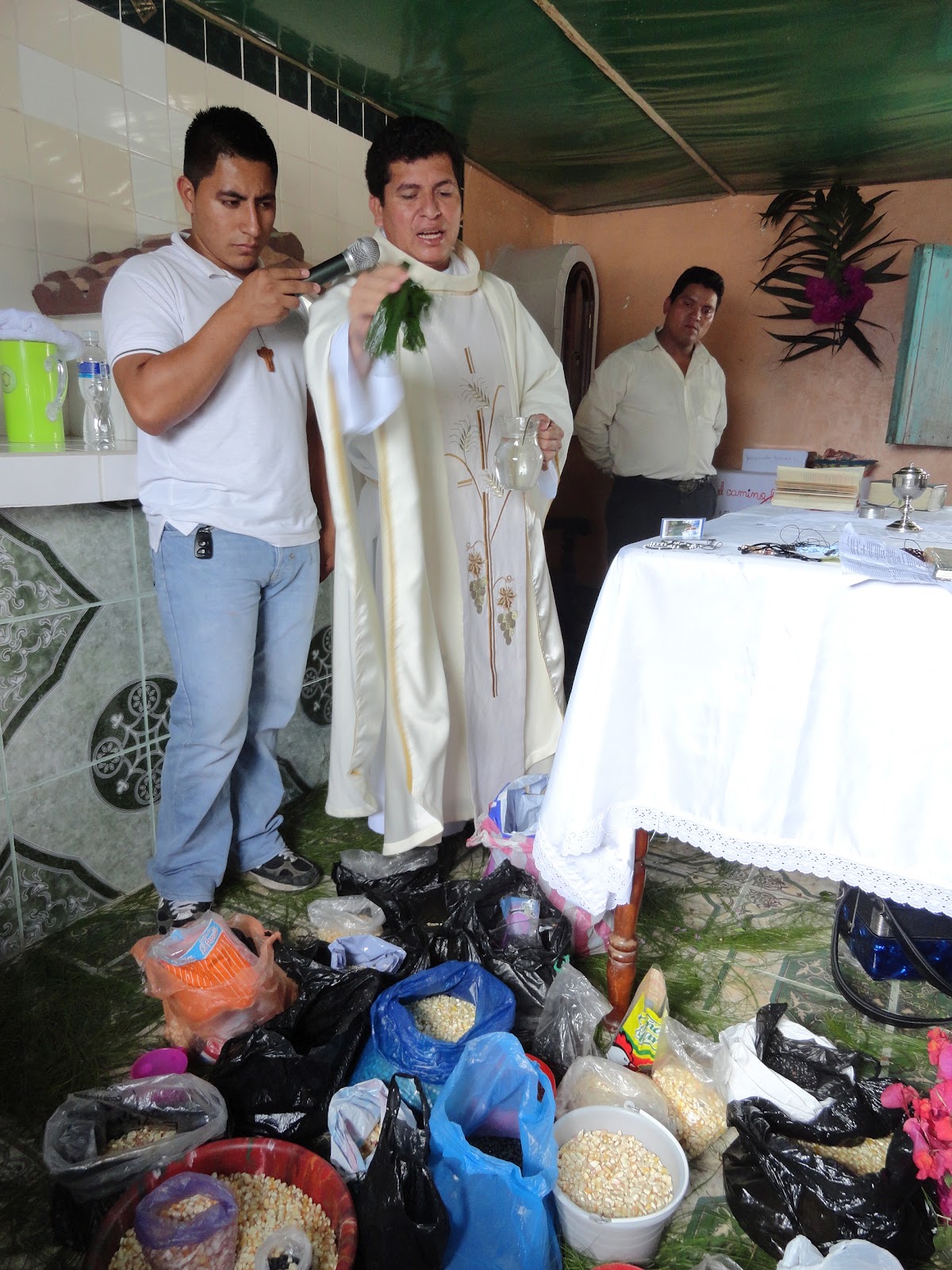
Tuesday was the feast of St. Isidore, the patron of farmers and farmworkers.  The sector San Isidro of the parish of Dulce Nombre had a celebration which included Mass and blessing of seeds.

The celebration also included blessing a new ambo and tabernacle for the church. The village, which has two extraordinary ministers of communion, will now have the Eucharist reserved in their church. Interestingly the tabernacle is shaped like a house with white walls and red roof tiles.

Alfredo and Efraín distributing Communion

Padre Efraín gave a spirited homily, speaking first about the devotion of San Isidro who went to Mass every morning before going to work in the landlord’s field. 

Then he went to talk about the importance of using better agricultural practices, in particular, avoiding the use of chemicals.

The parish has a program to help farmers and though part of the program is buying chemical fertilizers in bulk, the program does try to promote other practices, including teaching people how to make organic fertilizers.

It’s an uphill struggle. There have been some advances in some parts of the country. Though here in Copán some still prepare the land by burning, in the south of Lempira the municipal governments, with the support of the church, have effectively banned burning.

May San Isidro help us find better ways to feed the people. 

Blessing of seeds

If you want some more information on San Isidro/Saint Isidore, I wrote a little about him yesterday here.

There are more pictures of the event on my Flickr set here.

Deaths in the country

This past week two more reporters were killed – one from a gay alliance supporting the Resistance, the other from a mainstream radio station. Whether there will be any investigation remains to be seen. These are just two of the more than 20 journalists killed since the June 2009 coup.

I also just read that another person has been killed in the Bajo Aguan region in northeast Honduras. That makes more than fifty killed in relation to land controversies there.

A major problem is the lack of police and judicial follow up of crimes. To the people involved it appears that the government just doesn’t care – or, at the very least, is incapable of responding to the problems. This is especially so when the poor and involved as victims or the perpetrators are members of the elites or police or governmental authorities.

Addendum: President Lobo is offering 3 million lempiras (about $150,000) for information about the death of the journalist from the mainstream radio station. As far as I know, nothing has been offered about the other 20 journalists.

US involvement in Honduras

In the last year there has been much talk of US support of Honduran anti-drug-trafficking measures. The US Drug Enforcement Agency (DEA) has sent five US “commando style squads” to Central America and the Caribbean, including Honduras.

The results here – the recent killing of four to six civilians (plus the two unborn children of the two pregnant women) who were travelling in a boat on a river in the Moskitia, in the northeast of the country.

According to a report in  El Tiempo,  a Honduran daily, they were “being pursued by helicopter by agents of the National Police and the Drug Enforcement Agency of the United States (DEA).” (A translation can be found in the Quota blog, here. )

This is not the way to deal with drug-trafficking.

Any effort to deal with this needs to deal with the involvement of politicians of both major parties in drug trafficking, as well as with the corruption and involvement of the police and the military.  There are reports of a drug lord in western Honduras giving 100 dollars a month to police – but only four refused the “gift”.

The militarization of a country where the authorities do not investigate crimes and human rights abuses and where authorities are involved in serious human rights abuses will only put more power in the hands of those who refuse to deal with underlying causes of injustice and corruption.

I don’t know the way to deal with this. But the efforts of people at the local level need to be encouraged and supported. That will help begin to solve the problem, if is accompanied by some structural changes that take power away from those who profit from drug-trafficking.