Sunday, May 30, 2010

OF MANY THINGS, revised

A lot has been happening in the last week - and so here's a disjointed blog entry.

RAIN, RAIN, GO AWAY…

It’s been raining here almost continually since Thursday – Tropical Storm Agatha. It’s been a personal inconvenience for me. From May 14 to 26 I was hosting people and on May 27 I went to Esquipulas, Guatemala, with an excursion of the staff of Caritas Santa Rosa. On May 28 I managed to wash a few clothes and hang them up to dry. But it poured and many of them are still wet, even though I’ve now hung them in a place protected from the rain.

But enough whining. The situation is serious throughout the Central American region with landslides, flooding and threats of dams breaking - as well as several deaths. A friend had to walk around a landslide to get through to a bus on the other side to get from Guatemala to El Salvador.

I saw a small indication of this yesterday on the way to Dulce Nombre to do a section of a workshop that morning. There was a tiny landslide at the place where the road to Dolores breaks off from the road to Dulce Nombre.


That afternoon I headed with Padre Efraín and Padre Julio to a celebration in El Progresso, Yoro, in the north of the country. As we passed over the Democracy Bridge over the River Ulua we noted how high the water was. (By the way, one lane of this bridge fell last May as result of an earthquake that hit the country.)

As we passed into town we could see streets flooded a few blocks from the river.


The situation is serious and there may be some emergency work that Caritas will need to do this week.


VIOLENCE AND CRIME


This area of the country is relatively safe, though I experienced a break in and robbery over a year ago.

But this week I heard a few disturbing reports.

The bishop’s secretary and her husband have a corner store (literally) in Santa Rosa, near the center of town. This week they suffered an armed robbery at about 6:30 Tuesday evening.

Monday, two of the St. Thomas visitors and I helped the Dulce Nombre parish agriculture project deliver about 19 sacks of fertilizer to the community of San Antonio, Dolores. The project bought them in quantity at a lower cost and is providing the fertilizer on simple and fair credit terms to help small farmers. I found out that five sacks of fertilizer were stolen from the church where they were stored.


The theft was reported to the police but I doubt they will make any serious efforts to investigate the crime. Some people in the village are investigating to see what happened but people are afraid to report crimes if they see them or to intervene in any way, since the justice system really doesn’t do much and people are afraid of reprisals from the criminals. This combination of the lack of a responsible judicial system and of a sense of responsibility to report crime is a major problem here.

I also heard that one of the motorcycles being used by the health promoters in the Caritas maternal and infant health program was stolen. The promoter was on the motorcycle when it was intercepted by a car who forced him off the vehicle and took it. Who did it? It’s hard to say. It’s in a zone where there is drug-trafficking but someone who had worked in that area with another aid agency knows of a case where the police were responsible for stealing a motorcycle nearby.

Which brings up another problem that plagues Honduras – drug-trafficking. Honduras is a transit point between Colombia and the US and a road in the department of Copán is one of the conduits for drugs to Guatemala and Mexico and eventually to the US. I’ve heard of involvement of political leaders and the presence of drug lords in some of the towns and villages there. But I have also heard recently that drug traffickers are moving into areas like Santa Rosa, buying some businesses as a way to launder drug money.
This could get very serious.

But in other parts of the country it’s worse. Thursday night eight people were killed in a brutal murder in Choloma, near San Pedro Sula. And there have been killings of at least six journalists here this year as well as threats and killing of some people involved in the Resistance to the coup and to the current government. International human rights groups are deeply concerned about these acts.


CELEBRATION in EL PROGRESO

But in the midst of this several groups from the diocese went on Saturday to El Progreso, Yoro, east of San Pedro Sula in the north of Honduras. ERIC-SJ, a research, reflection, and communication project founded by the Jesuits was celebrating its thirtieth year.

The celebration started with a Mass, with the local bishop concelebrating with about twelve other priests. It was a moving Mass, not least of all because almost all the Mass parts were from the Salvadoran Campesino Mass, a Mass with extraordinary lyrics written in the late 1970s and early 1980s. It is a real example of liberation theology and spirituality.

I was especially moved receiving Communion as we sang:

Hoy, Señor, tenemos hambre
de trabajo, techo y pan.
Danos ya tu cuerpo y sangre,
danos combatividad.

Today, Lord, we are hungry
for work, for a roof over our heads, for bread.
Give us now your Body and Blood,
Give us combativeness!

During the offertory of the Mass, many symbolic gifts were brought up with the bread and wine for the Eucharist. To remember those who have been killed since the coup, a group of women presented a banner of a young woman with the Resistance who had been killed.
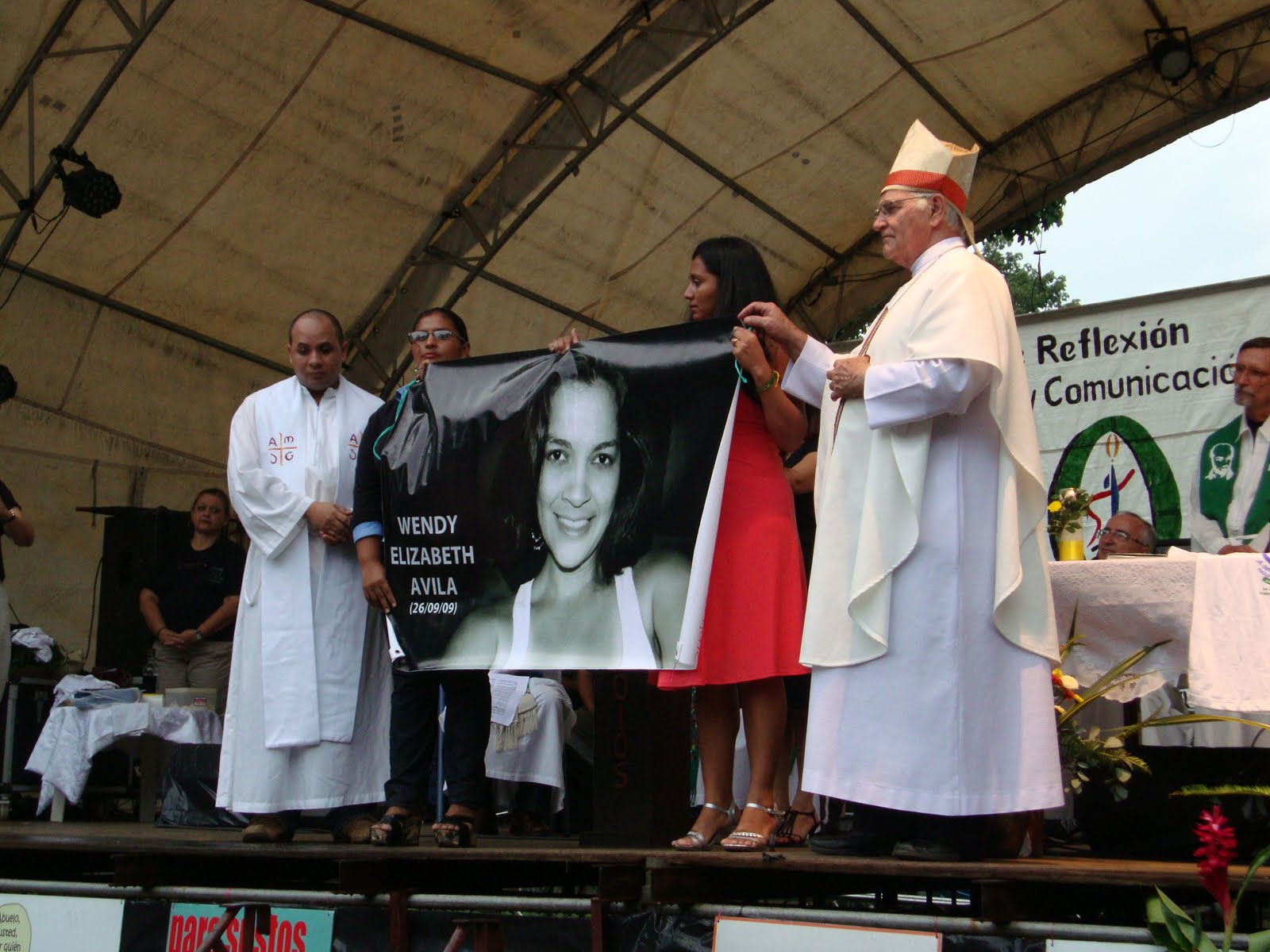

After Mass, the celebration began – with six music groups. But before they started one of the MCs noted that Father Ignacio Ellacuría, the rector of the Salvadoran Jesuit university who was killed in 1989, said that while, we suffer, we must celebrate. Suffering should not define people as victims but, in the midst of this, they must (and they do) celebrate life and hope.

And this was a celebration of hope.

Father Melo Moreno, the Jesuit director of ERIC-SJ and Radio Progreso, who has been the target of death threats, spoke. He talked about the importance now of a continuing peaceful struggle.


The first group was Café Guancasco, a group of young Tegucigalpa guys, who played quite loud and rhythmic music, combing jazz and rock and who knows what else. The crowd responded spiritedly – wildly and rhythmically jumping up and down as they joined in the chorus of a song called “El club de los idiotas.” I couldn’t get the words, but I’m sure it was very critical of the coup and the current government! (I later found the words of this song: it's a biting critique of bourgeois society and the "high life style" of the rich and powerful!)

Between the acts the MCs talked about ERIC’s work and also warmed up the crowd by doing types of “call and response”interchanges with the crowd that is common here (and in other parts of the world). The most common one is “El pueblo unido, jamas sera vencida” – the people united will never be defeated.

But the one I found fascinating was, in my translation, “When we listen with the ears of the poor, we become a people – el pueblo.” The word used is not “la gente” which seems to me to mean something like a group of individuals, but “el pueblo,” a people with an identity (and therefore a common purpose and a mission.) Listening from the standpoint of the poor can give us deep insights into the reality of the world and lead us to solidarity, becoming a real people who care for each other and work together for a world of love, freedom, and justice.

I ran into all sorts of people there - a Spanish Passionist priest from the department of Santa Barbara and a young man I'd met at a Caritas workshop, the brother of my neighbor across the road, a teacher at the school next to the kindergarten where I go, a worker with Caritas in Yoro, and Adrienne Pine whose blog Quotha has lots of great information on Honduras. Her most recent blog entry tells a little more about the celebration in El Progreso.

I left about 11:45 pm with Padre Efraín and Padre Julio; we got back to Santa Rosa about 2:30. Though I was exhausted it was for me an energizing experience.

The Mass was a highlight for me which was extended into the evening by the music. I was particularly moved when Carlos Mejia Godoy led the group in singing a song from the Nicaraguan Campesino Mass, “Vos Sos el Dios de los Pobres” – You are the God of the Poor. (The Mass was written by his brother.) It is a song that emphasizes the identification of Jesus with the poorest, with the folks who sweat in the streets, sell lottery tickets, or work changing tires. Jesus identifies with the worker!

As I looked around I saw men and women, young and old, singing the song which they knew by heart.

I was especially impressed by the presence of young people – late teens and early twenties – who were obviously part of the resistance. In our area the Resistance is a lot less militant than in Tegucigalpa, San Pedro Sula, and other places and I have not seen many young people here connecting with it. And so it was inspiring to see them there – many of them quite involved in the first song, but also some of them singing with gusto “Vos Sos el Dios de los Pobres.”

What signs of hope!

Incidentally, as the concert began the rain stopped. The rains resumed about 15 minutes before the concert ended. It rained all the way home to Santa Rosa and throughout the night. Today it's only been raining lightly on and off.

Tuesday, May 25, 2010

What's real here in Honduras, part 2

I had tried to upload and format the previous post with photos but slow modem dial up and lack of computer savvy led to a blog entry with only a video, which does happen to be a first for me. But here are some photos from the immersion. The four participants are members of St. Thomas Aquinas Church and Catholic Student Center in Ames, Iowa.


Bernardo playing with some kids in the kindergarten in Colonia Divina Providencia in Santa Rosa de Copán.


Kevin and Allyson moving rocks for the retaining wall for a futbol field on the parish ground in Dulce Nombre.


A music group in Las Delicias serenading us while we ate, with Bernardo joining in.


Padre Julio Galdámez encouraging the congregation at the Pentecost Vigil Mass in Dulce Nombre.


Children going up to greet Padre Efraín Romero during the Greeting of Peace in the town of Dolores on Pentecost.


Volunteer monitors in San Antonio, Dolores, Copán, weighing children as part of a program coordinated by Caritas of Santa Rosa de Copán and Catholic Relief Services.


Suyapa, a single mother of four, is a volunteer monitor in the AIN-C program coordinated by Caritas of Santa Rosa de Copán and Catholic Relief Services (CRS). Note the CRS logo on her hat.


House made out of bajareque (mud and sticks) in San Antonio, Dolores, Copán


Monseñor Luis Alfonso Santos, bishop of the diocese of Santa Rosa de Copán, gives a lesson on agricultural practices to the group visiting from St. Thomas.


What's real here in Honduras

The past 8 days I have been hosting a group from St. Thomas Aquinas in Ames. During that time we’ve spent four days in the parish of Dulce Nombre.

One day we did some work on a retaining wall the parish is building for a small cancha, a futbol [soccer] field on the parish grounds as well for a wall of a kitchen and dining room the parish will be building to serve the parishioners who come in from the countryside for retreats and training sessions.

On Monday some of us helped in the distribution of fertilizer for the parish’s program for promoting family gardens and increasing production of basic grains.

My theology (I originally wrote philosophy) for visiting groups is that they come not so much to do something as to be here with the people. It is good that people have a chance to do something but I believe it should be doing something with Hondurans in one of their projects. I have some strong opinions on this which I’ll share in a later post.

This group spent Saturday morning visiting the rural village of Las Delicias, high up in the mountains of the parish, for a Mass with the villages of that sector of the parish. Padre Julio César Gáldamez took us out in the parish pickup and celebrated the Mass. After Mass, one of the families of Las Delicias gave us lunch. While we ate a conjunto, a music group, from town played. The hospitality of these people was,as customary, wonderful.

PENTECOST VIGIL MASS

In the evening the group joined the people in Dulce Nombre for the celebration of the Vigil of Pentecost. People came in from several other towns and villages – 40 people from Vera Cruz in two cars (at least that’s what they told me), 60 from Dolores in a bus, and others from Candelaria and Plan Grande. We gathered at about 7:00 pm at a water tank up from the church and after prayer around a fire we walked in procession to the church.

The Mass, which lasted until almost 11 pm, was extremely spirited – with much singing led by a musical group from Dolores (which is influenced by the charismatic movement) and La Gran Familia, an extraordinary group of brothers and cousins from Plan Grande.

Here, especially in the countryside, the people often clap while singing. So the Mass was very spirited, especially since many of the hymns sang of the gifts of the Holy Spirit. Father Julio was particularly animated as he led the people in song (and motivated the people listening to the Mass over the diocesan radio station.)


The Mass proved to be for many in the group a highlight, since it showed the deep faith and profound religiosity of the people, expressed in a very enthusiastic way.

PENTECOST SUNDAY

Sunday the group went with the pastor, Father Efraín Romero, to Mass in Vega Redonda, a poor village in the midst of extensive grazing lands held mostly by five landowners. The group was welcomed warmly and, again, given a fine lunch by one of the families in the village.

In the evening we went to the nearby town of Dolores for a most spirited Mass, celebrated by Padre Efraín. This community has been influenced by the charismatic movement and has very spirited singing. But what surprised me was that as the sharing of the Peace of Christ began more than 40 kids ran – yes, ran – up the center aisle to greet the priest.

OUT IN THE COUNTRYSIDE

Monday two of the group stayed in Dulce Nombre for the morning since Carl Bern, a professor of agricultural engineering at Iowa State, wanted to spend time with Marcos who has been making silos and teaching others how to do it.

The three others of us went out to distribute fertilizer for corn production to various rural villages that are taking part in the parish’s agricultural program.

We delivered about 23 sacks of fertilizer to the town of San Antonio, Dolores, and the two students with me waited for the pick up to go back and get 17 sacks for a town up the hill.

SAN ANTONIO, DOLORES, COPÁN

For a while we sat on the steps of the church and I talked with Jaime, who is working with the project there. WE talked of many things, including coffee production. He has about a manzana and a half (about two acres) but only part of it is in production this year since he pruned some trees recently. This past year he got about 32 cargas (a carga is 200 pounds) from that manzana – but in good years he can get about 49. He proudly noted that he uses very little chemical fertilizer; he mentioned that those who use chemical fertilizer can get a little more than 50 cargas but the effects on the soil are disastrous.

Jaime sells his coffee to an intermediary for about $180 for a carga; the intermediary transports it to a nearby collection point in Dolores where the intermediary is paid about $185 to $195 per carga.

In August or July he can get $9 per carga from IHCAFE, the Honduran government coffee institute. if he presents the invoices. He called it a retención, a sort of retainer, possibly given after the coffee has been sold internationally.

What struck me is that he sells his coffee in the form of “café oro” – which means he has removed the pulp, he has dried the beans in the sun, and has removed the thin film around the coffee bean. If he had not taken the time and effort to do this he would have gotten a lower price.

After the Dolores plant receives the coffee, it is taken to a regional beneficio and then prepared to distribution.

As often in agriculture, even in the US, so many intermediaries get their share of the profits and little makes it back to the producer. Small niche coffee markets – such a s fair trade – make it possible for the small producers to get a good price, but that’s quite a long-term process.

After a while we walked around town with Belsi, one of the workers in the parish’s agriculture project.

We walked down to the school and spoke with one of the two teachers in the two classroom school, as the kids were having a mid-morning meal of soy milk, rice, and ticucos (a local corn and bean variant on tamales), provided with the aid of the World Food Program. Here there are two teachers for six grades with 83 students. But I was impressed that the classes are for about five and a half hours a day – in both the morning and the evening.

I asked about students going beyond sixth grade. Eight students walk about 40 minutes each way to the Centro Básico in Dolores for the equivalent of middle school. If they can go beyond that they have to go to Dulce Nombre or Santa Rosa.

This is the situation throughout much of the country, especially in the countryside. Usually no more than one-third of those who could go past sixth grade actually do so. The reasons are varied, including some failure to place value on education in some families. But access is also a real issue.

After leaving the school we walked down toward the cancha, the futbol field. On the way we met Suyapa. I noticed that she wore a shirt of one of the volunteer monitors for the maternal and infant health program Caritas is running. I talked to her about that and found that she was also involved in the parish’s agriculture project and teaches in the pre-kindergarten, as a volunteer. The municipal authorities, though, have recently been giving her a small stipend for this.) She’s a single mother with four kids but is involved in her community. I found out later that her husband was killed four months ago, as a result of one of the squabbles that often leads to violence here.

But she still struggles along – and supports her community.

When we got to the cancha we saw two other monitors of the program weighing babies in the porch of a house across the road. I dropped by and found that the three monitors in the village were attending 38 children! I took a few pictures of kids being weighed who were crying like made. (I don’t know if we three gringos scared them or what.)

I noticed that the monitors were wearing shirts of the program and noted that the shirts had the logo of Caritas as well as CRS (Catholic Relief Services, the US bishops’ international aid agency) which is supporting the program with its own funds and funds of the World Monetary Fund.

It’s good to see this work in progress in the rural communities, a small way to assist people in need.

In the afternoon we went out to two other places to distribute more fertilizer.

FAREWELL

The group heads out to San Pedro Sula to leave early Wednesday morning to return to Iowa – to continue and deepen the solidarity between the parish of St. Thomas Aquinas in Ames, Iowa, with the Dulce Nombre Parish.

Recently St. Thomas sent the parish of Dulce Nombre an invitation to establish a relationship of partnership in solidarity. At the May 15 Dulce Nombre parish council meeting the approved the following statement to send to St. Thomas Aquinas.

A PARTNERSHIP IN SOLIDARITY

Letter agreeing to form a partnership in solidarity

Brothers and sisters in Christ our Lord in the parish of St. Thomas Aquinas,

We, the faithful of the parish “Dulce Nombre de Maria” [“Sweet Name of Mary”], in response to your letter of invitation, are pleased to form part of a partnership in solidarity, whose purpose is to strengthen the bonds of unity, partnership and the mission to extend the Kingdom of God, walking together as brothers and sisters to encounter the Lord through the interchange of culture and faith in the two sister/partner parishes, without borders that might separate us.

In our parish, we are organized in groups of brothers and sisters called church base communities led by coordinators, village council, pastoral workers trained to preach the Word of God, catechists for the religious education and sacramental instruction of children and adults.

We are organized in the Three-fold Ministry
  • a) liturgical: this includes celebration of Mass, celebrations of the Word, religious education, retreats, gatherings, sacraments , etc. [This also includes music.]
  • b) prophetic: planning of pastoral work. [This actually includes religious education.]
  • c) social: visiting the sick, helping those in need, attending to the material needs of the church, community projects, construction and repair of houses of prayer (churches). [This also includes a major agricultural project to improve production of basic grains – corn and beans – as well as to promote small family gardens.]
The territory of the church is very large. The work of evangelization is entrusted to men and women volunteers who, as committed lay persons, help our pastor [Padre Efraín Romero] and associate pastor [Padre Julio César Galdámez].

We thank St. Thomas parish for their material, economic, and human assistance, and the presence of a missionary, brother John [Donaghy] who carries out a full time work in our parish.

[We thank] the Catholic students of the university of Ames, Iowa, USA [Iowa State University] some of whom when visiting us have come to know about the work of our parish, our culture, and the religious life [of our people]. Joining us in our social work in their recent visits and their travel in the village of our parish. Thanks for their contribution.

We reaffirm our ongoing commitment to pray from our villages just as you pray for us in order that we may find strength around the Lord.

We share your thought that together we will achieve great things to strengthen our Catholic Church - a universal church without borders- and [to strengthen[ our cultures.

Our fervent desire is that it might become a reality what the apostle Paul expressed in his letter to the Romans 1: 8-15:
First, I give thanks to my God through Jesus Christ for all of you, because your faith is heralded throughout the world. God is my witness, whom I serve with my spirit in proclaiming the gospel of his Son, that I remember you constantly, always asking in my prayers that somehow by God's will I may at last find my way clear to come to you.

For I long to see you, that I may share with you some spiritual gift so that you may be strengthened, that is, that you and I may be mutually encouraged by one another's faith, yours and mine.

I do not want you to be unaware, brothers, that I often planned to come to you, though I was prevented until now, that I might harvest some fruit among you, too, as among the rest of the Gentiles.

To Greeks and non-Greeks alike, to the wise and the ignorant, I am under obligation; that is why I am eager to preach the gospel also to you in Rome.
Greetings to your parish, thanks and greetings to the young students of the University of Ames, Iowa [Iowa State University] for having St. Thomas Aquinas as patron of students. He was the composer [author] of hymns and praise songs that we sing during the exposition of the Most Blessed Sacrament and which show that “To have Jesus is to have everything.”

Separated by distance, united in faith and prayer, we will make real the partnership of solidarity in the Communion of Saints.

Let it be so.

Parish of Dulce Nombre de Maria


-----

Photos from the May 2010 immersion can be found in a Flickr set of mine.

Saturday, May 22, 2010

What are you looking for?


Yesterday, visiting the incredible farm of Moises in Mejocote, outside Gracias, Lempira, I saw again this incredible flower. I asked Carmela, Moises' wife, what it was called.

"Busca novio" or "Busca novia" - Looking for a fiancé(e).

Lovely.

PS - I'm NOT looking for a novia!

PPS - I need to do a post on Moises' farm which is a marvel; I'll try to write one and include photos before the end of May.

Wednesday, May 19, 2010

Understanding Honduras?

A small group from St. Thomas Aquinas Church in Ames is visiting here for about about ten days. It’s different from some other groups since it includes two undergraduates, a graduate student in agricultural and bio-systems engineering who is from Uruguay, and a professor of agricultural engineering from Iowa State University.

Last night we sat down over a dinner of bread, cheese, and fruit to talk about the day and our experiences. I invited a young Honduran just finishing his industrial engineering degree at the Catholic University who is also very involved in his parish here in Santa Rosa de Copán.

After a bit of talking about everything – including soccer, of course, as well as his hopes to sometime study for a masters degree outside Honduras – he suggested we talk about politics. Great, I thought. Then he proceeded to ask the group about the recent British elections. Whoa! He revealed that he is very well read on international politics and recent news.

After a bit, I asked him to talk about Honduras. He expressed his concerns about corruption, the problems of the two main parties, his opposition to the coup, his analysis of former president Zelaya (He’s not very smart – but we don’t get smart people elected here. But at least he was trying to do something for the poor.)

But then he spoke of his concerns about the Lobo government, especially concerns that many have that the government will privatize Hondutel, the public phone company, and other publicly-owned enterprises.

That was, I think, a surprise to the professor and the grad student. The professor spoke of the commonly held belief in the US that competition will lower prices. The grad student, more knowledgeable of the state of “capitalism” in Latin American countries, mentioned that the private sphere is generally more efficient that the public sphere.

The discussion went in many directions at that point. I pointed out that in Honduras it’s not capitalism as in the US – it’s feudal capitalism, in a sense. The Honduran student spoke of the ten or fifteen families who own most of Honduras. I found an article by Leticia Salomon where she listed the coup supporters who own most of the private enterprises and communications media and read a few of the companies or franchises owned by the ruling elite.

But one thing the Honduran student said was critical and easily missed. One of his main concerns about the privatization of Hondutel as well the mining industry is that they take so much and give so little to Honduras. He expressed it in terms of not giving much to the Honduras government, but his concern was that these people and these companies do not contribute to the common good.

Whether they are efficient is another question, but questions of mere efficiency miss the critical point he was trying to make. Honduras is largely being used for personal and corporate profit – not for its good.

I need to return and reflect more on that conversation in the next few weeks, but the Honduran student’s remarks helped me analyze Honduras a little differently and how hard it sometimes is to see what is behind the anti-privatization thinking here.

The concern is that the common good – and the needs of the poorest – are being sacrificed for the enrichment of a few.

But as Pope John Paul II once said, “The needs of the poor take priority over the desires of the rich.”