Showing posts with label deacon. Show all posts

Wednesday, August 10, 2022

The roasted deacon - food for the People of God

THE DIACONAL MISSION – GIVING ONE’S BODY AS FOOD
Last week I went with Father German, my pastor, to the diocesan Day for the Sanctification of the Clergy, which is celebrated on the feast of Saint John Vianney, the patron of priests. On the way back, Father German shared an interesting take on Saint Lawrence and the diaconate. 
 
I have been blessed to work with Father German for more than nine years. We’ve had our conflicts and I get frustrated with his long homilies (and I have been caught sleeping during at least one of them). But he has a unique perspective on the importance of the diaconate. He was for some years a Franciscan friar and was ordained a deacon, with the expectation that he would be ordained a priest shortly thereafter. But he remained a deacon for three years, despite requests from his Franciscan superiors. The diaconal ministry and the diakonia of the People of God are important for him.

We spoke of many things, and he shared his unique understanding of Saint Lawrence. Lawrence was one of the seven deacons of Rome, with responsability for the goods of the church and for the care of the poor. Pope Sixtus and the other deacons were arrested and martyred by the Romans. Lawrence was spared since the Roman authorities thought the church had a storehouse of treasures and ordered him to hand over those treasures in three days.

Lawrence gathered the treasures of the church and sold them, even, according to reports, the sacred vessels of the church. He then distributed the money to the poor, the widows and orphans, the outcasts of society. When he appeared before the Roman authorities, he brought the poor, the outcasts, the lepers, the widows and orphans and told the Roman prefect, “These are the treasure of the Church!”
Woodcut of Ade Bethune
Mural in the church of Dulce Nombre de María

The prefect was not impressed and sentenced Lawrence to death, roasted on a gridiron, probably hoping that the torture would make Lawrence reveal the location of the Church’s gold and silver. In the midst of his suffering, Lawrence told his torturers “Turn me over. I’m done on this side!”
Stained glass in The Cloisters Museum

Father German’s take on this was unique. Lawrence was saying that he was ready to be served as food, as nourishment.

Aren’t we called to be food for others, to offer ourselves as nourishment for others?

This is the diaconal call – of the diaconal People of God as well as the ordained deacon. We are to be the food, the nourishment – giving ourselves for God and the People of God (and, I would add, for the whole world).

I didn’t fully comprehend Father German's thoughts on Lawrence at the time. But last night, I was reading the reflection on Saint Lawrence by the German Benedictine Anselm Grün, in his book Cincuenta testigos de confianza.
The second image of Saint Lawrence which has always fascinated people is the image of the red-hot grill. Generally, the grill is an image of life: in its fire we are roasted to convert us into food for other people. This is represented in a graphic image: our life has to be penetrated by the fire of love. It could be said that only then will we be nourishment for other persons, only then will others to able to live from us and through us. (My translation)
La segunda imagen de San Lorenzo que siempre ha fascinado al pueblo es la de la parrilla incandescente. Por regla general, la parrilla es una imagen de la vida, en cuyo fuego somos asados para convertirnos en alimento de otras personas. Dicho con una imagen gráfica: nuestra vida tiene que ser penetrada por el fuego de amor. Se podría decir que sólo entonces seremos nutritivos para otras personas, que sólo entonces podrían otros vivir de nosotros y a través de nosotros. (p. 109)
As ministers of the cup of the Blood of Christ, we deacons are called to pour ourselves out for God and for others, to shed our blood as Christ shed his Blood for us.

Few of us will be called to shed our blood in the style of Lawrence and other deacon martyrs, but each of us is called to put our hearts into our call for service, to sweat, to shed our blood and tears, to give ourselves for and with others.

We do this because our ministry flows from our baptism, our dying and rising in Christ. For us deacons, it especially flows from the altar and calls us to nourish the People of God, first of all, with our lives, the way we live in our families, in our jobs, in our social and civic duties. Then, bringing our lives, our needs and the needs and lives of all, especially the poor, to the altar, we ask God to transform our lives and the world by the fire of His love – to become a People who are living images of Christ the servant who came “to serve and not to be served, to give us life as a ransom for many.” (Matthew 20:28)

This is not easy. It means a daily dying. It means, recalling today’s Gospel (John 12: 24-26), being like the grain of wheat which has to die to bear fruit.

I close with these words from Saint Óscar Romero, martyred archbishop of San Salvador, to whom I dedicated my diaconate. Preaching on this Gospel text on April 1, 1979, he said:
To each one of us Christ is saying: If you want your life and mission to be fruitful like mine, do as I. Be converted into a seed that lets itself be buried. Let yourself be killed. Do not be afraid. Those who shun suffering will remain alone. No one is more alone than the selfish. But if you give your life out of love for others, as I give mine for all, you will reap a great harvest. You will have the deepest satisfactions. Do not fear death or threats; the Lord goes with you.
Romero's tomb in the cathedral crypt, San Salvador

Friday, July 15, 2022

Six years an ordained deacon

Today is the anniversary of my ordination as a deacon in the diocese of Santa Rosa de Copán, Honduras. I am the first permanent deacon in the diocese, one of only six in the country, and the only celibate deacon here.

During my ordination, I was especially moved by the presence of the saints with us as I lay prostrate during the Litany of the Saints – surrounded by a great cloud of witnesses. I shook as we called on Charles de Foucauld and Monseñor Oscar Romero – both of whom are models of diakonia for me.
I also shook when I heard in the consecratory prayer that the apostles chose seven men and dedicate them to the service of the poor [los dedicaron al servicio de los pobres]. 

This morning, during my Skype call with my spiritual director, she asked me what I was going to do to celebrate. I’ve been out and about much this week and I had decided to clean the house, wash clothes, and be domestic.

I got up early – about 5:08 am, washed and prayed, and then had spiritual direction at 6:30 am. I’ve washed clothes and I’m cleaning the house. 

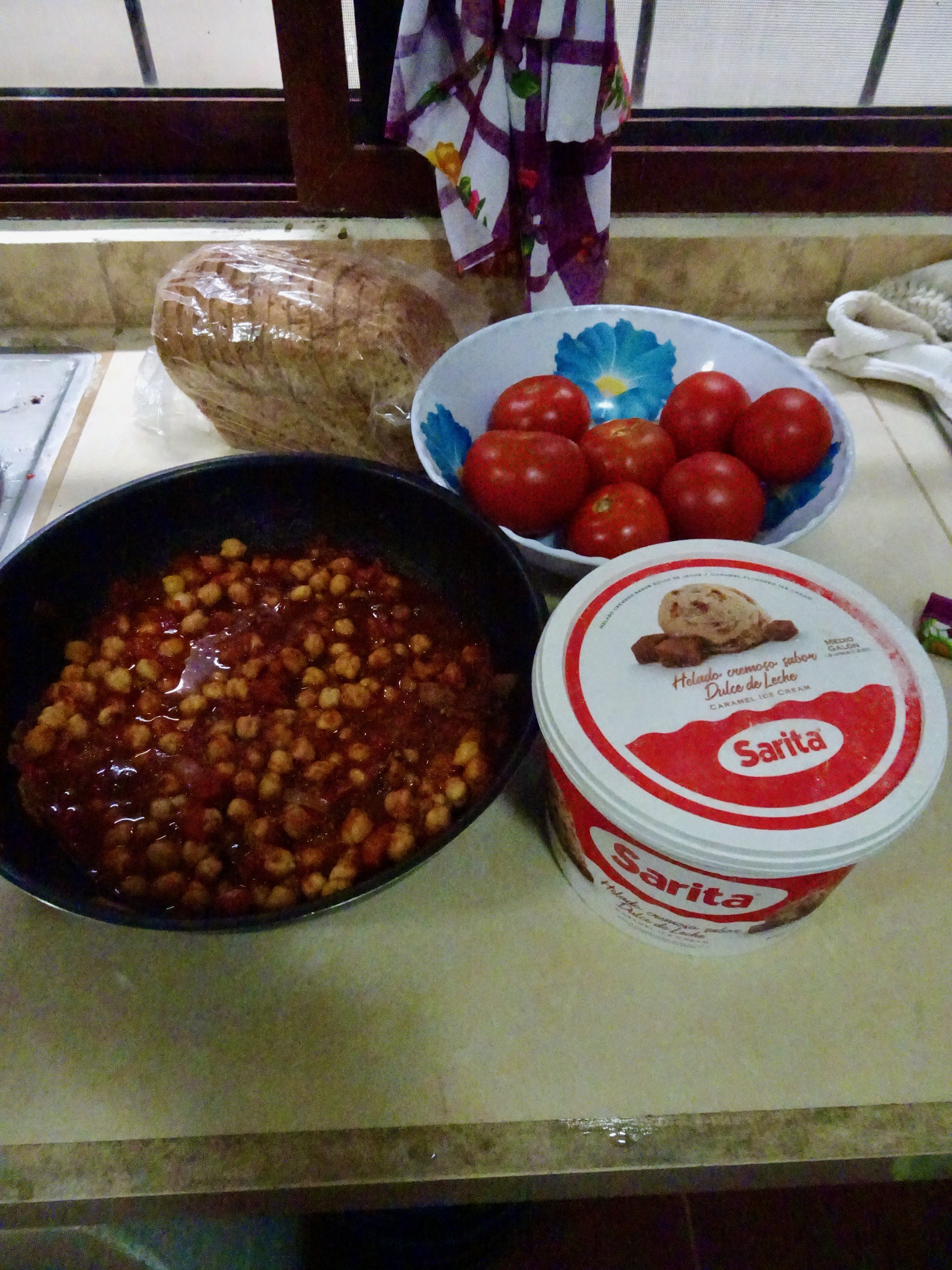
I also made a chickpea and tomato dish for lunch today (and for a few more days). The chickpeas were canned but the tomatoes are fresh from a neighbor’s tomato project. I had some whole grain bread I bought yesterday in Santa Rosa. I also finished off some ice cream.
In the course of the morning I managed to break two coffee cups (but they were extras) as well as a large bowl that I often used for soups.

This evening there is a Mass of Thanksgiving in the parish. That is quite thoughtful But what really touched me was the announcement:

"Mass of Thanksgiving for one more anniversary of the ministry of deacon of our brother Juancito"

I was touched that the note referred to me as “nuestro hermano Juancito.” 

One of my concerns about becoming a deacon was a concern that this would create a greater distance between me and the people in the parish. Though this still happens at times, being called “our brother Jack” gives me hope.

I am probably a little more sensitive to this this week since I read a very provocative article in America about calling priests “Father.” 

By chance, the reading for the feast of Saint Bonaventure is Matthew 23: 8-12. – “Don’t call anyone ‘father’.” 

I am grateful for being ordained a deacon – and for the ministry of deacon I had been able to live for many years before my ordination. Diakonia is part of our baptismal charism – for all of the church. 

Now, I am called to be a sign of Christ the Servant, motivating others to live our baptismal commitment.

How will I celebrate six years as a permanent deacon? Continuing and deepening my call. 

Tomorrow I hope to go to the distant community of Debajiados with the pastor to celebrate the feast of the Virgin of Carmen.

Sunday I’ll go to another rural village and then head for an afternoon Mass in another part of the parish.

This week I have a meeting with the catechists.

I also want to get to a large town here that has a lot of sick and bed-ridden and only one communion minister.

The next week there are more meetings, including one with parishioners involved in Social Ministry. 

But I really need to get to some other rural communities. 

Please pray for us – and for me, that we may offer our people signs of the love of God and open with them spaces for grace.

Saturday, June 11, 2022

Deacons, the sick, and communion ministers

In our parish of Dulce Nombre de María, we have about 28 extraordinary ministers of Communion. They meet once a month, for planning and for continuing spiritual formation. I have accompanied them for several years, even before being ordained a permanent deacon. 

This morning we met. 

Our pastor, Father German, was with us for about an hour helping us plan for the celebration of Corpus Christi. Though there are many villages in our parish without communion ministers, we want to have all the parish the opportunity of Eucharistic adoration for some time during the week leading up to next Sunday’s celebration of Corpus Christi. 

In some places there will be the traditional Forty Hours celebration, forty continuos hours of adoration before the exposed Eucharist. In other places, there will be shorter times for adoration.

The ministers had already made provisional plans in their sectors to have adoration in most places for at least ten hours. They’ll have to make some changes because there will be Masses with Father German or another priest in most of the sectors of the parish to close the Forty Hours devotion. 

 After this, the pastor left for some pastoral visits to the countryside. 

During the course of the meeting, concern arose about one minister, not just because of his absence at many meetings but also for other reasons including his failure to visit the sick and elderly in his village. 

Our parish’s understanding of communion ministers is very clear. They serve at Masses; they lead Holy Hours and other Eucharistic devotion. But key to their ministry is visiting the sick and bringing them Communion. They are expected to visit all the sick, even those who do not receive Communion. If they don’t do this, their ministry in not complete. 

This is not the case in many parishes, even here in Honduras.

A young priest, who spent almost two years in our parish in a pastoral experience, then as a deacon, and finally for a few months after his priestly ordination, has shared how the communion ministers in his parish just serve at the altar.

As we discussed this, one of the communion ministers remarked that they are doing what a deacon does. 

I was pleased, even flabbergasted, that they see that the role of an ordained deacon is to serve at the table of the Lord and the bedside of the sick and the poor. And they identify their service with the order of deacons.

Central to my understanding of the diaconate is that the permanent deacon is called to be “the driving force” for the diakonia of the entire People of God, a phrase used by Both Pope Saint Paul VI and Pope Saint John Paul II. 

 In my service and in my accompanying these ministers and others, I hope to arouse in them and all the faithful a deeper desire to live out their baptismal call to diakonia, as servants. 

When I can do this, I do not feel threatened by what they do. I do not try to do everything and thus displace their living out their call. I serve in building up the Body of Christ by helping People of God see their place in the Body of Christ and live it more fully.

For all this, I am grateful to God, to the Church that called me to this ministry, and to these extraordinary minister of Communion who show me how blessed and “extra-ordinary” is the call to serve the sick.

Part of the mural on the front of the church office, by El Indio Rivera.

Sunday, January 02, 2022

A spirituality of a missionary deacon 1: critique of two recent books

In the past year and a half I have read two books on the diaconate which I found very inadequate. Perhaps my criticisms arise from my unique experience – a deacon living and working in rural Honduras, in a large parish with only one priest. I won’t mention the works but I want to share what caused me concern.

Christmas Vigil Mass - procession to the crib 

I found these problems with the most recent book. 

  • The author ties the permanent diaconate too closely to the sacrament of matrimony and, in this way, he does not get to the core of the vocation of the deacon. At one point he writes, “The evangelizing witness of the deacon is rooted in sacramental marriage, through which he strives to sanctify his family.” 
  • The same book does not mention the importance of Catholic Social Teaching, especially for the deacon. 
  • Speaking of prayer, the author seems to place more emphasis on adoration than on the Mass. 
  • I did not see the author connecting the diakonia of charity with the Eucharist 
  • When dealing with racism, he seems to look almost exclusively at only promoting concord, not addressing the issues of racial justice.  
  • Ministry with the poor is considered more in terms of service to them or for them. Where is the reference to Pope Francis’ culture of encounter? 

The other book proposes a diaconal spirituality which I find limited. 

  • It seems to be a privatized, individualistic spirituality. Where is the ecclesial dimension of the spirituality of a deacon? 
  • The spirituality that seems to be “churchy.” Where is the dimension of the diakonia of Charity? 
  • Where are the poor in the spirituality of the deacon? 
  • Whereas the other book referred to the deacon in the workplace, this book does not pay enough attention to the deacon’s workplace. 
  • I found the spirituality was not very incarnational, pespeically in terms of  recognizing the presence of God in the daily life. Though he refers to De Caussaude’s “sacrament of the present moment,” I felt as if he treated it rather fatalistically. He also did not refer to Pope Francis’ “sacrament of the poor,” which I believe should be central to a diaconal spirituality 
  • There seems to be a dualism in his spirituality. He wrote, “The deacon’s service is first and foremost to God rather than to the people; only in God and with His grace can he truly serve the people.” I believe that this sets up a false dichotomy between God and God’s creation. 
  •  When dealing with service to the poor he relies on the virtue of “empathy.” But what about compassionate accompaniment of the poor? 
  • I also found an overreliance on Collins’ emphasis on the deacon as herald. 

I found both books seem to promote an individualistic spirituality and that Pope Francis’s call to ministry in the margins is minimally addressed. 

Perhaps I am overly critical but both these books, as well as other writings on the diaconate, seem to miss much of what could serve us deacons in our diakonia

 Rather than write an extended critique, I think it is important to begin to elaborate my spirituality of the diaconate, which I will do in a subsequent post.


Saturday, November 06, 2021

The deacon embedded in the secular world: witnessing and listening

In an interview in the virtual Deacon Conference on November 5, 2021, Deacon James Keating spoke of deacons as “clerics embedded in the secular world.”

I think this is a very useful way to speak of the vocation of the diaconate as a permanent state. But this needs to be unpacked, not in terms of the status of clerics versus laity, but in terms of the vocation of the deacon.

Keating and others are pointing to the unique place in the church of the deacon who also has a vocation, including employment, outside the church. The worker-deacon can be in places where a priest usually cannot be found – in the factory, in the courtroom, in the hospital emergency room, in the halls of government.

I am somewhat reluctant to use the word “secular” since it is all too often used in contrast to the sacred. I believe that our role as deacons should reflect an incarnational spirituality.

Jesus is God made flesh, God-Human, Son of God and Son of Mary. He is both. He manifests the presence of God in the midst of human life and living. God reveals Himself in the flesh. As the early fathers (and St. Thomas Aquinas) affirmed. God became humans so that humans may become God – revealing the presence of God in the world.

Thus, the deacon can reveal the presence of God in the daily world – in Spanish, lo cotidiano. His is, as Deacon Tim O’Donnell writes, the ministry of the threshold. I heartily recommend his book, The Deacon: Icon of Christ the Servant, Minister of the Threshold.

But it is, sometimes, useful to note that the world of the church and the secular world often seem to be proposed as not only distinct, but even opposed, realities. But, as “clerics embedded in the secular world,” the deacon can see his call to be a presence in the world and to be one who hears “the joys and hopes, the griefs and anxieties” of the world (Second Vatican Council, Gaudium et Spes, 1). 

PRESENCE IN THE WORLD 

In France, in the middle of last century, the worker priest movement was an experiment by the Church in France to reach the working class which seemed so far away from the message of the Gospel. Priests worked in the factories, without identifying themselves to the other workers. They saw the importance of the presence of the church in the "secular" world. 

Also, one can also look at the example of the Little Brothers and Little Sisters of Jesus who live and work among the poor as a silent witness of the love of God in the world of the poor.

I believe that it extremely important to remember that the restored diaconate has several roots, including the Priest Cell block at Dachau. There, the priests noted the failure of the church to be attentive to the rise of Nazism. They saw the need to have persons, including clerics, who were immersed in the world so that they could share with the church what they were seeing and experiencing.

After the Second World War, one of the priests, Wilhelm Schamoni, noted:
The Church has not succeeded in holding its ground among either the leading intellectual classes nor among those classes most easily led astray, the proletariat. In their own milieu, deacons from these classes for these classes could gain influence incomparably deeper than could any priest, since priests would never develop within this milieu the kind of rapport that deacons would have already established. One could develop the diaconate into a means to win back the de-Christianized milieu. An intelligent deacon from the working-class would, without any special theological training, be able to touch the heart of his worker colleagues with just the right words.
However, Deacon James Keating, speaking of the role of the deacon as bringing the Word to the world, seems more intent on role of the deacon as one who shows the faith to the people he is around. In the interview, Keating mentions a deacon being present at social events and responding to the needs of the people. 

True, but is this the most significant aspect of this description of the deacon's call to de present to the world? 


LISTENING TO THE WORLD

As a cleric living and working in the world outside the institutional church, the deacon might be able to hear more than a priest would. 

This role of listening – and helping make it heard within the Christian assembly – is unique for the deacon working outside the institutional church. (I should note that I work full-time in a rural parish and thus don't show forth this aspect of the diaconate.)

As noted above, the priests in Dachau’s Priest Block saw the need to have persons, including clerics, who were immersed in the world so that they could share with the church what they were seeing and experiencing. They could hear and see what was happening and what one could miss if he were totally immersed in the affairs of the church.

Cardinal Walter Kasper has spoken of the deacon as “the listening post.” Referring to an ancient document, he noted that the deacon “is depicted as ‘the ears, mouth, heart and soul of the bishop’ (Didasc. II, 44).“ Thus, “The deacons can act as the eyes and ears of the bishop in identifying areas of need and can help him in his task of being father to the poor.”

The deacon thus can become the advocate of the poor and oppressed, amplifying their voices, which he has heard.

Saint Oscar Romero, martyr-archbishop of San Salvador, was called “La voz de los sin voz” – the voice of the voiceless. His homilies – which were extremely long – were a combination of reflection on the scriptures and sharing the news of the week, including the names of people killed or disappeared. These homilies were broadcast on the archdiocesan radio as an alternative source of news, as well as a call for justice.

What Monseñor Romero did, the deacon can do – listening to the Word of God in the scriptures and listening to the word of God in the cries of the poor. We can do this, I believe, when we are present to the world – especially with those at the margins of society.

A few weeks before I was ordained, I was in El Salvador and visited the tomb of Romero and dedicated my diaconal ministry to him. As I look back, I see how fitting this has been.


-------------

Marshall Gibbs, “The Deacon as Preacher,” Forming Deacons: Ministers of Soul and Leaven.
Walter Kasper, “The Deacon offers an ecclesiological view of the present day challenges in the Church and Society,” Paper given at IDC Study-Conference, Brixen, Italy, October 1997. 

Tuesday, November 02, 2021

The deacon, laity, and mission in the world

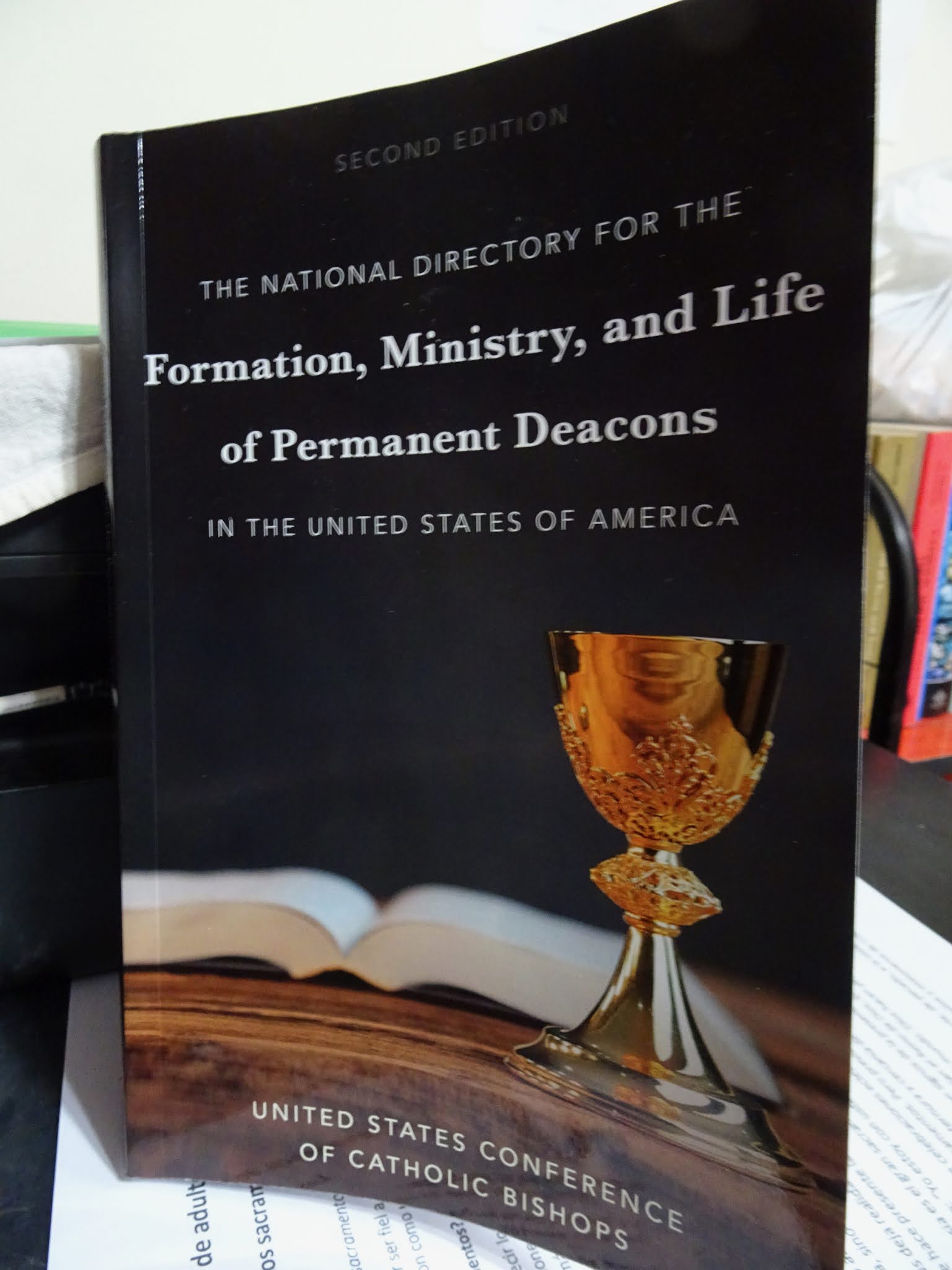
While in the US I purchased a copy of The National Directory for the Formation, Ministry, and Life of Permanent Deacons in the United States of America and started reading it. Chapter One is entitled “Doctrinal Understanding of the Diaconate.”
Paragraph 31 struck me. Citing Pope Saint John Paul II, the Directory notes that “the deacon’s ministry is defined as a ‘service to the bishop.’” This may sound to some as a type of subservience to the person of the bishop, but it is explained as service to the ministry of the bishop for the whole church. “St. John Paul II has clearly in view, therefore, the reasons for not only the diaconate but also the whole apostolic ministry: serving the discipleship of God’s people.” 

The diaconate is oriented toward the whole People of God. 

Guiding force of the diakonia of the church 

Citing Pope St. John Paul II again, the Directory notes that the deacon’s tasks, include ”promoting and sustaining the apostolic activities of the laity.” Thus, the deacon, as one “more present and more involved than priests in secular environments and structures” ought to ‘foster closeness between the ordained ministry and lay activities, in common service to the Kingdom of God.” 

I find this encouraging because it points to the common roots of our service in our Baptism and presents a way to understand the deacon’s intimate relation with the laity. He does not serve on his own but is called, as several popes have noted, to be “the animator, the driving force” of the diakonia of the whole Church. I have written on this in an earlier post, based on my experience. This is an interesting way to help understand the deacon – as clergy, but intimately related to the laity. 

The deacon at the threshold 

In the next section of Paragraph 31, the Directory, again citing Pope St. John Paul II, notes an important aspect of the deacon: the presence of the church in the “secular” world:
“…a deeply felt need in the decision to reestablish the permanent diaconate was and is that of a greater and more direct presence of Church ministers in the various spheres of family, work, school, etc.”
The deacon, involved every day in the world outside the church, “can relate the rich tradition of Catholic teaching to the practical problems experienced by people.” 

They can even, as envisioned by the priests discussing the diaconate in the Dachau concentration camp in Nazi Germany, provide a look into what is happening in the world, so that the Church is not caught off-guard in the face of the evils of Nazism and other oppressive regimes.

The deacon provides an entry for the institutional church, of the clergy, into the lived experience of the People of God – as well as all the people of the world. The deacon is thus a ”minister of the threshold,” as described in Tim O’ Donnell’s The Deacon: Icon of Christ the Servant, Minister of the Threshold. (I reviewed it here.) 

Being on the threshold can be important for a deacon – showing with his life, and not only his words, the intersect of faith and life. He can bring the world to the altar and the altar to the world.

In some ways, I don’t fit this dimension of the deacon – being a celibate who is a full time volunteer with the church. But I think it is an extremely important dimension of the diaconate.

It speaks to what I have promoted for decades – the dignity of work and the witness of the worker in her or his work environment, not by what one says but by how one lives.

When I was a campus minister, I often heard some students lamenting that they weren’t involved in the church, that is, in the activities based in the parish or student center. I still hear that here in Honduras where some people lament that they aren’t more involved in church activities. But I say: What you do in the church is important, but perhaps even more important is how you live as Church, as People of God, in the world, sanctifying the world with your presence, your daily work.

As the Directory notes, “In their secular employment, deacons also make evident the dignity of human work.” They can show in their professions the presence of the Incarnate God, who did not cringe from being called the son of a carpenter. 

What might change in our way of living faith and in our culture when we see a deacon on the altar with hands marked by calluses, signs of hard manual labor?

I have a priest friend who jokingly used to say of his vocation, “These hands are made for chalices, no calluses.” I think he would agree that the callused hands of a deacon might be signs of the God who works among us. The deacon, working outside the institution, can show the dignity of work and he also can see, in his work, “an opportunity and obligation… to bold proclaim and witness the Gospel of life,” not only in words but in his way of living.

This recalls one of my favorite quotes of Thomas Merton:
“The saint preaches sermons by the way he walks and talks, the way he picks up things, and holds them in his hand.”
Such can be the sermon of the deacon in his daily work. A marvelous vocation.

Thursday, July 15, 2021

Five years as an ordained deacon

On July 15, 2016, I was ordained a deacon for the diocese of Santa Rosa de Copán. 


Five years an ordained deacon but, when I look back at my life, much of my life has been spent in a diaconal ministry. Serving those in need has been part of my life since high school and so I see my ordination as confirming my vocation of being a servant, deepening it in Christ the Servant, and opening up new horizons.

A few months after I was ordained, my pastor asked me what was different.

Except for presiding at Baptisms and weddings, and more presiding at Celebrations of the Word, not much had outwardly changed. Before ordination, I had been taking communion to the sick, assisting and giving reflections at Celebrations of the Word with Communion in remote villages, training catechists and accompanying extraordinary ministers of Communion.


But there have been changes.

First of all, I find myself becoming more "present" to people who are sick or caring for the sick as well as to people grieving at the loss of a loved one or suffering in one way or another.

I don’t find myself doing more, but there is a different spirit in my ministry.

Visiting the sick, the elderly, and the homebound, bringing them Communion, and just praying with them is an important part of my ministry. For the most part, I try to go where there are no communion ministers or the needs are great.

I also find myself at more funerals, wakes, or prayers during the novenarios, the nine days of prayer after a person is buried.

Being present to a family that has lost a member, being present at a community suffering after a violent death, or just praying around a casket in a home have opened up depths of compassion and tenderness that I didn’t know I had.


During the early months of the pandemic, I did go out a few times, mostly for funerals and occasionally to help bring supplies to communities. After last November’s hurricanes, I found myself visiting the most affected areas, sometimes just to listen to the people explain what they are experiencing. I also have tried to accompany people in efforts to rebuild, especially encouraging community-based efforts to help families whose homes were destroyed or damaged.


I also, aside from the first few months of the pandemic, usually go to a rural village for Sunday morning Celebrations of the Word with Communion, especially where there is no communion minister. I often visit some of the sick in that village.

Sunday afternoons, I try to get to Mass in one of the towns or villages of the parish. Almost every week, the pastor or the associate has me preach at these Masses, mostly to give them a break (since they often have three or four Masses each Sunday). I thus preach much more than many deacons.

Another essential part of my diaconal ministry has been to accompany those who are doing pastoral work in their villages, mostly the catechists, the communion ministers, and those involved in social ministry.

I was doing some of this before, but now I look on this ministry in a different way. Pope St. Paul VI and Pope St. John Paul II both spoke of the permanent diaconate as the animator or driving force of the diakonia of the people of God.

I am not just training people to be catechists or communion ministers, or helping people respond to the needs of the people in social ministry, I am trying to help them live their baptism, as member of Jesus who is prophet, priest, and servant-king.

This is a challenge because it is trying to break down any notion that only a cleric lives out these ministries.

My role is not to do, though I need to be available to teach and preach, to preside as celebrations and distribute communion, as well as baptize and witness marriages, and to respond to the many needs of the parish which is very poor.

My role is to foster the participation of the people in their three-fold ministry, role, of being prophets, priests, and servants, to open spaces where they can exercise their ministry, their diaconia, and to help them develop the skills – and more importantly, the spirituality, to be active members of the Body of Christ.

I had some idea of this before but my experience as a deacon has helped me to understand this more as well as to incorporate this in my ministry. Accompanying the People of God also means, for me, learning from them, listening to them, being at their side.


I love this photo that someone took, several years ago, when I was accompanying the medical group, AMIGAS, in a rural village. The man from the village is showing me where we would be serving. He was my guide.

Finally, my ministry continues to stretch me – pulling me out of myself but also trying to let go of any desire for control. I’m slowly learning how to be more available, which is really important when calls come at 6:00 am, sometimes for a funeral.

I am also developing and trying to live out a spirituality of pastoral work which is much more open to all. I see my role as opening spaces where people can live their lives of faith, personally, in their families, and in their communities, or, perhaps better stated, opening spaces for grace.

May I continue to try to be faithful to my call – to be of service to those in need, reflecting the Icon of Christ the Servant, and opening up spaces where the People of God can live as true servants of God and be a Church of the Poor.

Friday, January 08, 2021

Prayer for purifying the sacred vessels

Our diocese had a special Mass to commemorate the canonization of Mother Teresa.

The Missionaries of Charity have a home for malnourished children, Hogar San José, under five, which I have sometimes visited. When I first came to Santa Rosa, I went several times a month but, since moving out of the city, I’ve visited only a few times.

A few years ago, I was asked by the directors of a home for children, Amigos de Jesús, to visit with their volunteers, mostly from the United States. I have continued to connect with them and their current chaplain is a good friend. Amigos de Jesús provides a real home for over 125 children and also provides them with education. They have a school as well as a bilingual program on site and several of those who finished high school there stay in a house in San Pedro Sula to go to the university. 

The Missionaries of Charity were at the Mass as well as staff, volunteers, and children from Amigos de Jesús I was blessed to assist at the Mass as deacon. 

One of the responsibilities of a deacon is to clean the vessels after Communion.

As I began to clean the vessels, I noted the people from Amigos de Jesús in the middle aisle of the auditorium where Mass was held. The ciboria were filled with particles from the consecrated hosts and so I took care to carefully clean them, seeking to consume even the tiniest particles. 

I looked down at the ciborium and looked up at the children in the aisle, some of whom are orphans, some have been abandoned, some have been maltreated. There were many small particles in the ciborium and small children in the aisle.

I realized that as just I took care for every particle of the Body of Christ in the ciboria, I am called to take care of the least of our sisters and brothers, the face of Christ in our midst. I often recall this as I clean the vessels.

Today I wrote this prayer
Lord, Jesus, you are present in the Eucharist, present in the tiniest and most fragile particle of the consecrated host. Help me treat your sacramental presence with care and devotion, seeing You in every fragment. You, Lord Jesus, are also present in the least of our sisters and brothers, especially children and the poor. Let me remember Your presence in them and treat them with as much care as I treat You present in the Host. Let me respond with care and love to the least of them, as I care for the least particle of the Host. Let me ever reverence You in the Host and in the poor and care for them as for You. Let Your presence in the Host and in the poor open me to Your great love for me, and for all. Amen.
Purifying the sacred vessels at the church in Debajiados, on the day after my diaconal ordination.

Monday, August 10, 2020

Saint Lawrence deacon

Today the Church celebrates the feast of Saint Lawrence, deacon and martyr, who was executed on August 10, 258.

Lawrence was one of the seven deacons of the city of Rome, entrusted with care of the goods of the church and serving the poor. He was not killed with his bishop, Pope Sixtus II, and the other six deacons, on August 6.

According to the tradition, he was called to bring the treasures of the church to the prefect of Rome. He sold the goods of the church and gave them to the poor, the widows, and the sick. Then he showed up with these outcasts before the prefect and proclaimed: “These are the treasures of the church.”

The prefect was not pleased and proceeded to have Lawrence killed.

What does this tell us deacons?

Where do we seek our treasure? Do we assist those at the margins of society? Are we identified with them? Do we know their names? Would we know where to find them if we were called upon to present the treasures of the church to the authorities?

The diaconate is not limited to the altar, to an exclusive sacramental ministry. We have a role in the liturgy, but we do not stay there. We are called to be signs of the Good News of Jesus to the world in our daily lives and to assist those who are neglected or despised by the powerful.

We bring the needs of the People of God to the altar and we go forth from the altar with Good News, bringing hope to the corners of the world where we love and work and assist those in need.

In this way, we can be servants of God, promoting the Baptismal call of all the People of God to be signs of the Reign of God in the world. We do not do this alone; God works with us through and with all the People of God.

We serve in the Church, with the Church, and through the Church – for the world.

print by Ade Bethune


Saturday, August 08, 2020

Deacon reflection 6

 What’s different, being a deacon?

A few months after I had been ordained, my pastor asked me what was different.


Not much, I told him.


I was continuing my work in visiting communities on Sundays for Celebrations of the Word with Communion as I had been doing for years. I was continuing to visit the sick and bringing them communion. I continued working with catechists and helping to organize the social ministry in the various communities.


There were some differences in the way I presided at Celebrations of the Word with Communion and in how I visited the sick. The most obvious difference was that I was giving a blessing to those I encountered.


There were a few new things. I baptized a few times and presided at funerals.


I was a member of the clergy.


As such, I had a position within the church. I was ordained for the order of the community, in my case to image Christ the Servant.


But a real difference for me was that I was no longer a “free agent.”


I had come to Honduras as a volunteer and offered myself to the bishop to serve as he saw fit. But I was a volunteer. I had no contract. I had no official commitment. I could leave when I wanted.


But ordination meant that I was no longer a volunteer. I had a role in the church as a deacon. I couldn’t, without permission, just get up and leave. I had been called and ordained for a specific service in this local church, the diocese of Santa Rosa de Copán, Honduras.


Now, I’m here as one with a particular ministry in the diocese. I’m no longer here on my own.


This isn’t a privilege, nor an honor. It’s a calling to live out.


Before my ordination, I had been serving in the church and the world. But now I’m expected to do this because of being called in a different way.


This doesn’t mean that all the baptized are not called to serve. That’s part of who we are as persons baptized into Christ who is prophet, priest, and king (servant), as the rite of anointing with chrism after Baptism notes.


This is who I am now, not above anyone, but commissioned, ordained, to serve the People of God in a special and visible way.


All of us who are baptized are also called to live as Christ, as member of His Body. Before we were baptized, if we were baptized as adults, we may have been living as Christians. But, by baptism, we are doing this publicly, commissioned to do this – not because we want to, but because of who we are.


And so, I am now called to serve, not because I want to, as a free agent, but as I am – called to be an Icon of Christ the Servant in the world, at the service of the People of God, especially the poor.


Monday, August 03, 2020

Deacon reflection 3

The Ordained Deacon and the Baptized

When the bishop asked me to consider the diaconate, I shared with him one of my concerns: Would this create a wider breach between me and the people I serve?

I am aware that there is a breach already between us. I am white, from the United States, I have bank accounts and an assured income (Social Security). I have many more years of education than most of the people I work with. I can leave whenever I want for the United States and don’t need a visa to visit there since I am a US citizen. I can take vacations, even to Europe (if I save enough money). I am from a different culture and prefer different foods (though I love baleadas and pupusas). Would becoming a deacon, a member of the clergy, create a further breach? I still struggle with this.

Some of my concern is with the clericalism I see here. Many people have a clericalist view of the clergy. Not only does Father know best, his word is law – for some lay people. It is not easy to find people with a critical consciousness, able to raise questions with priests and bishops. I have also seen aspects of clericalism among some priests, a sense of entitlement and superiority and an unwillingness to hand over responsibilities to lay people. I have also known priests who seek to empower the people.

Avoiding any type of clericalism or sense of entitlement or power over others is absolutely necessary. But I think there is also a need to rethink the sacrament of holy orders, especially in light of the sacrament of baptism.

For me, the sacrament of holy orders is a special way to some members of the community to live out their baptism in such a way as to “order” the life of the people of God.

The deacon serves in the church in evangelization, liturgy, and charity.

In our diocese the pastoral work is organized for the most part, in three areas, which we call the Triple Ministry – the prophetic, the liturgical, and the social.  In the rite of baptism in Spanish, the baptized person is anointed with chrism, “para que se incorpore a su pueblo y sea para siempre miembro de Cristo, Sacerdote, Profeta y Rey” – so that the baptized person may be incorporated to God’s people and be forever a member of Christ, Priest, Prophet, and King.

As I see it, the deacon is ordained to live this baptismal call in a special way, for the good of the whole Church. The deacon needs to place emphasis on servanthood – which is the way Christ see being a King. But he will also live out the other two aspects. And so, for me, the diaconate is trying to live as the evangelizer, the servant of the poor, and the minister at the altar.

I am there not to replace the non-ordained in the ministries but, in the words of Pope Saint Paul VI, to be a driving force, an animator of diaconía for the whole church.

The deacon is not above the baptized. He is called to live out his baptism in a unique way, serving God and the People of God.

There are my first thoughts on this important issue: How can is the ordained diaconate related to baptism? I plan to write more on this.


Saturday, August 01, 2020

Deacon reflection 1

To prepare to celebrate the feast of Saint Lawrence, deacon and martyr, on August 10, I will be writing a novena of reflections on the diaconate.

I never wanted to be a permanent deacon.

In my youth I wanted to be a Franciscan priest and in grad school I wanted to be a university professor, but I never became a professed Franciscan priest and I never taught in a university as a professor, only as an adjunct.

But I never wanted, or planned, to be ordained a deacon. Nevertheless,  now I am a deacon.

In October, 2014, at a dinner in Dulce Nombre with Padre German Navarro, the pastor, Monseñor Darwin Andino, our bishop, asked me to consider the permanent diaconate. Father German had asked me about this a few months before the dinner and I had explained to him why I did not think I was called to that vocation. I looked at him and his face told me that he had not mentioned this to the bishop.

I explained to the bishop some of the reasons why I did not feel called. After dinner was over, he urged me to consider this seriously. I told him I would and that night I began my discernment.

I read a lot; I write to friends, including a priest who had been director of the diaconate in his archdiocese; I spoke to friends here, asking them to help me discern whether this was God’s call; when I went on a visit to the US, I spoke to friends there.

I didn’t want to become a deacon and resisted it. But God kept calling through the months of discernment.

Resisting a call has been part of my life. If I had had my own way, I would never have left graduate school and served for almost 24 years in campus ministry and social ministry at St. Thomas Aquinas Church in Ames, Iowa. If I hadn’t spent a spring break in hurricane-devastated New Orleans in 2006, I never would have come to Honduras. If I hadn’t taken the bishop’s invitation seriously, I wouldn’t have been ordained a deacon.

Somehow God broke through my resistance. I think this happens to many of us.

But as I reflected on the diaconate in my process of discernment, I recognized that my life up to the day of my ordination was a preparation for the diaconate. God calls us from where we are and who we are.

When I was discerning if I should leave my work in Iowa and go as a lay missionary to Honduras, my spiritual director asked me why I would do this. Without a moment’s hesitation, I said, “To serve those most in need.”

I did not need to think through my response. Seeking to serve those most in need was who I am, or at least who I had been prepared to be – from my childhood, raised by two parents who had hearts open to those in need.

And so, as I think of my vocation, I realized that we are called to go beyond our self-imposed limits and respond from the very depths of who we are and who we had been prepared to be.

I did not want to be a deacon, but God – and family, teachers, friends, and others – had prepared me to respond. And so, by the grace of God, I was called to be an ordained deacon and I responded, weak and fragile as I am. 

Drawing of Ade Bethune
May God use this vulnerable man to serve.


Sunday, July 19, 2020

Update on my diaconal ministry

I haven't written for more than two weeks and so here's a long post on what's happening.

Last Wednesday was the fourth anniversary of my ordination to the diaconate in the diocese of Santa Rosa de Copán.

The last four months have been quite different than the previous years.

Since March 23 we have been quarantined, staying at home except for designated days to go out. As a result my diaconal activities were very limited.

I probably could have gotten away with going out to villages occasionally, since I know the mayors and, according to our pastor, the police recognize me. But I decided that I should not count on any privileges. Thus, I travelled only on the designated days, mostly recently only once every two weeks.

I did go out for several days during Holy Week and in early May to accompany the municipality’s program of providing some basic items, driving some of the workers as well as some of the bags. In a very real way, that was my diaconal service, accompanying the outreach to the poor.


 I also began walking several days a week here in Plan Grande, which provides a great opportunity to talk with folks.  I even brought Communion to two home bound persons.

A few weeks ago, at the suggestion of the pastor, I got letters from three of the mayors that would, hopefully, le me get around a little to do some pastoral work. Then I found out that the Catholic Church at the national level had obtained a salvo conducto for the clergy. Thus I could go out from Monday to Friday within the limits of the diocese.

About a month ago, the church at a national level released protocols for public Masses – masks, distancing, use of gel and disinfecting of persons on entering the church, communion in the hand, and disinfecting of the church before and after the Masses or services. Even though people were having celebrations in some villages, even here in Plan Grande, I did not feel comfortable presiding until the protocols were out. For the most part the protocols are being followed here in Plan Grande, as well as in the main church in Dulce Nombre. One of the problems is that though the government has been claiming to distribute several million masks, many people do not have them. Two weeks ago, I bought a hundred from a friend in Santa Rosa.

Other things are slowly resuming,

Just before the curfew began, I was planning to meet with several couples for their pre-marriage interviews. There were about 15 couples ready for the meetings which we had to postpone.

I finally met with one couple and then, at the pastor’s insistence, met them again to talk with the young man who was not baptized. We finally arranged his baptism last Wednesday and the couple’s wedding yesterday.

I baptized the young man in Dolores on Wednesday, a nearly perfect way to celebrate my diaconal ordination. It was a joy to be able to celebrate with him and with a small group of folks.


The celebration included a young couple who were presenting their forty-three day old child. Here there is a custom of presenting a child in church forty days after birth.


The pastor asked me to preach the day after, the feast of Our Lady of Mount Carmel, at the Mass in the neighboring town of Candelaria. It was the third Mass I’ve been to since March and the first I’ve preached at.

One very distant community in the parish, about an hour’s drive from where I live, has six couples ready for the sacrament of matrimony. I had decided to go there and meet with the couples and their witnesses since they cannot easily get out of their area. There is no public transportation. In addition, they are not supposed to go out except on the days designated by the last number of their id. Obviously, not every couple would be permitted to go out the same day. So it made sense for me to go. So I have gone out three times and had two interviews each day.

What is fascinating about these couples is that the initiative to seek the sacrament of matrimony came from them. They began meeting and discussing a number of things. At first, they had some resistance from some folks in their village since they were meeting without someone from the village’s church council. But finally they began receiving the preparation for the sacrament. Now they only have to wait a few details and would like to be married in August. Of course, they have to do this in a small ceremony, probably six separate wedding. Two of them women will also have to receive baptism before the wedding. I have encouraged them to wait for a bid celebration next year and I have promised to help buy a chancho hornado – a roasted pigfor the celebration next year.

What is encouraging about this group is that the initiative came from them; they didn’t wait for someone to say that they could start marriage preparation. They met and then asked for it. I am encouraging them to continue to meet after their weddings and form a base community among themselves.

I am waiting to hear from other couples in other villages for the interviews. I also have to look into how to prepare a few of them for baptism before their wedding. I am looking forward to this opportunity to serve.

Two weeks ago, the clergy of Honduras were supposed to have our national study week. Of course, we couldn’t get together but they managed to have online Zoom sessions for five mornings. I wand psychology. as looking forward to this because the theme was the protection in the church of children, minors, and person in situations of vulnerability. The study week was led by Father Daniel Portillo of CEPROME of the Pontifical University of Mexico. About two hundred clergy participated, including a few bishops. I was aware of most of the information since I had been at a meeting on the theme in November 2018 in Bogota, Colombia, sponsored by the Latin American Conference of Religious and I had also just finished a four week online study with CEPROME on Abuse in the Family. But it is so important that we in Latin America begin to face this openly and seriously.


This week there is supposed to be a four-morning online study for the diocesan clergy on COVID and Corruption in Honduras. There will be presentations on the theme from the perspectives of sociology, economic, medicine, the law, I am looking forward to this.

The situation continues with serious outbreaks in Tegucigalpa, San Pedro Sula, and several departments on the north coast. Here in our diocese, the situation is mixed. There were efforts to open up a bit, but they have been pulled back in Gracias Lempira and may be in La Entrada Copán.

The situation is difficult for many, especially those in the cities where people are not working and for those who depended on the informal economy, selling items in the streets. In our parish there are people who do not have enough to eat but many people in the countryside have some access to food. Yet, the situation could get more serious. A neighbor told me that in Dulce Nombre beans are about 28 lempiras a pound, though they are about 5 lempiras less here. (One lempira is about four cents of a dollar.) A few months ago, beans were 15 lempiras a pound.

One bright spot is that the 7000 of green coffee sent by the association of small coffee owners in El Zapote arrived in Ames and the money has been received by the association. They will therefore have some money to help with basic needs. Those is central Iowa can contact El Zapote Coffee which recently had a drive through sale of coffee in the parking lot of St. Thomas Aquinas Church.

Image may contain: plant and outdoor

What to expect?

I do not know. The medical system is severely threatened. And even though the government has received more than 100 million dollars worth of aid, corruption has been serious. Whether the system will be able to respond to the cases is unknown.

Yet people continue their lives.

What do I say to people? Don’t lose hope.

I also share with them what a friend who is a doctor working with COVID-19 patients has told his medical colleagues:
Don’t panic.
Be positive.
Kindness counts.
Wash your hands, wear protective gear, and stay home if you’re sick.

I think that’s good advice for all of us.

On a personal note, I have been able to be in contact with folks – Skype, Zoom, and a good phone calling plan have enabled me to talk with friends not only here in Honduras but also in the US and Palestine. I am also participating in some discussions with folks in the US and participated in some education events here and from Mexico. Reaching across borders, if only electronically, is important. I have spoken once with my spiritual director and have to arrange another session the end of this month.

I have been doing a lot of reading. I completed ten books in June – six of them novels! But I also have read two books by Henri Nouwen, Reaching Out and Clowning in Rome,  both of which have been very helpful. I am also in the middle of a monumental work of Gerald Schlabach, A Pilgrim People: Becoming a Catholic Peace Church.

What the next months hold is unpredictable. I won’t do my usual fall trip to the US since the situation of the pandemic is still up in the air. I do hope that I can do some more writing – mostly on the book on my path to the diaconate that I’ve been trying to put together for about a year.

In the meantime, be safe, stay sane, pray a lot, and wash your hands.