 |
| The church of Santiago Atitlan, photo taken in 2018 |
 |
| Interior, photo taken in the 1990s |
This week a shrine in his name will be dedicated in Oklahoma. The shrine, which will also be a parish for the area, cost about forty million dollars.
I have a devotion to Blessed Stanley and have been inspired by his life and ministry since I read several articles in the 1980s and then Henri Nouwen’s Love in a Fearful Land, first published in 1985.
I visited Santiago Atitlan a few times in the 1990s.
My devotion to him was deepened reading María Ruiz Scaperlanda’s The Shepherd Who Didn't Run: Father Stanley Rother, Martyr from Oklahoma, published in 2015.
More recently, in January 2018, my pastor and I made a pilgrimage to Santiago Atitlán. We prayed in the church and in the room where he was martyred.

Our pastor concelebrated Mass in the church, and I had the privilege of serving as deacon at the Mass, reading the Gospel from the site where Blessed Padre Apla’a preached.

When we first entered teh church that afternoon, the Eucharist was exposed on the main altar. But I noticed that under the altar is a vial containing the blood of Padre Aplas'.
While we in Santiago Atitlán, we had time to speak with a few people and got a vision of a priest who truly served with the people, who had “the smell of the sheep” about him. I’m sure his upbringing in rural Oklahoma made him at home with the campesinos in the parish.
He also had a deep sense of the dignity of the campesinos. One of his quotes that continues to move me: “To shake the hand of an Indian is a political act.”
The body of Padre Apla´s was returned to Oklahoma, but, at the request of the people of the parish, his heart was entombed in the church.

When I heard this story and stopped at the site of his heart, I could not help but remember the words of Jesus: “Where your treasure is, there also will your heart be.”
Our pastor, Padre German Navarro, also has a great devotion to Padre Apla’s and often mentions him by name in the Eucharistic Prayer.
But a forty- or fifty-million-dollar shrine?
I have a number of questions.
Is this shrine a case of US triumphalism? Or will this be an opportunity to awaken the US church to the church of the martyrs in Latin America and to the commitment of the church to accompany the poor in their struggles for life and justice?
Is this shrine a case of promotion of an other-worldly vision of holiness?
Pope Francis speaks of an incarnate holiness.
Note the letter that Padre Apla's wrote the Christmas before he was martyred. This is no disincarnate holiness.
“A nice compliment was given to me recently when a supposed leader in the Church and town was complaining that ‘Father is defending the people.’ He wants me deported for my sin.Is this shrine a case of a de-politization of martyrdom?
“This is one of the reasons I have for staying in the face of physical harm. The shepherd cannot run at the first sign of danger. Pray for us that we may be a sign of the love of Christ for our people, that our presence among them will fortify them to endure these sufferings in preparation for the coming of the Kingdom.”
How many martyrs in Latin America were killed by dictatorial regimes, many of them supported by the US government?
How many will learn of the repression in Guatemala during the 1970s and 1980s and 1990s that resulted in thousands of church people killed.
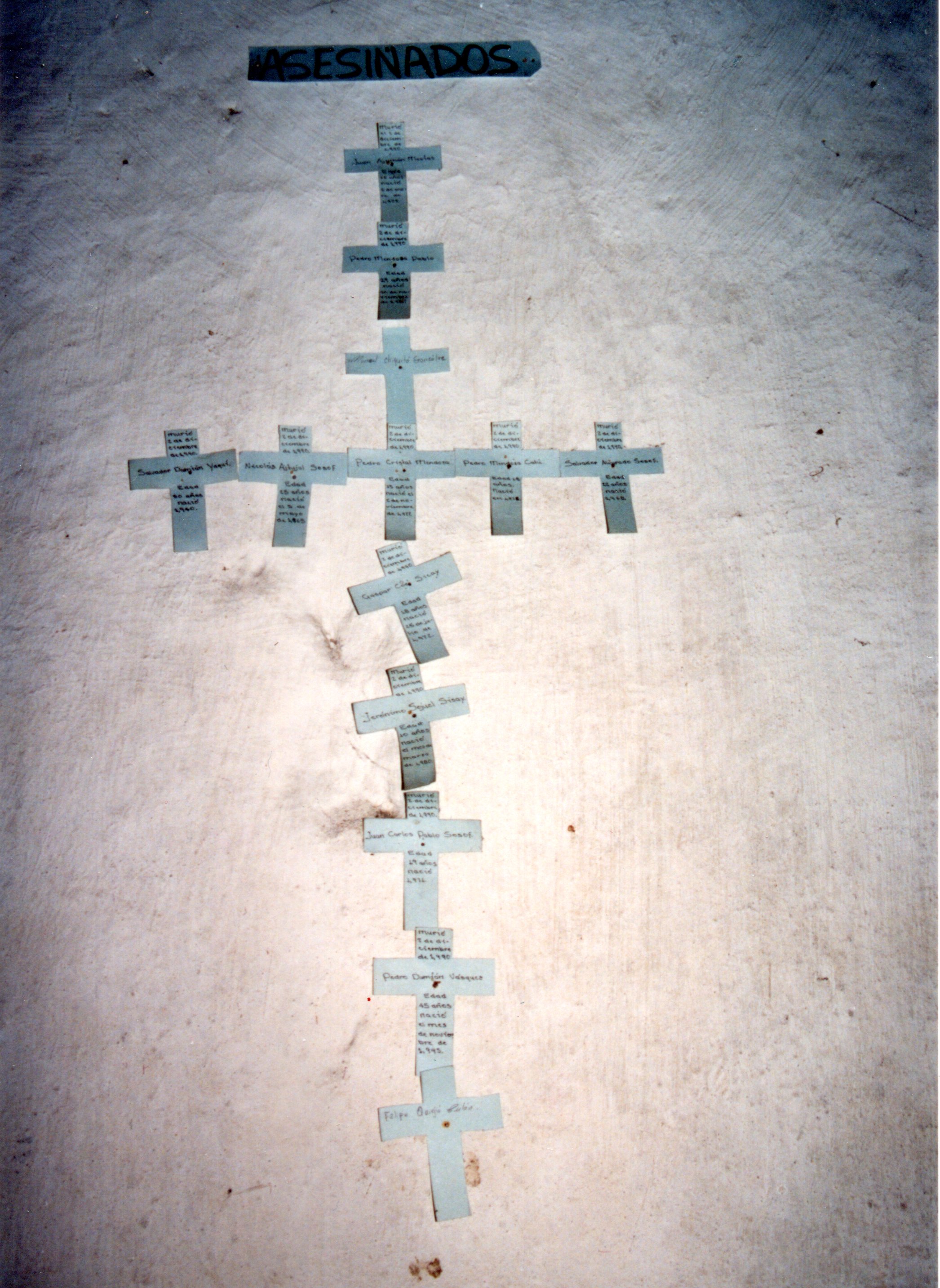
Padre Apla’s is one of scores who were killed in his parish. Near the room where he was martyred there are several metal frames with scores of crosses of those who were killed in Santiago Attilán.

Where I visited in the early 1990s, there were crosses by his shrine of those killed and wounded in a December 2, 1990 massacre by the military of campesinos who had come out to protest for their rights.

I have come across the names of two lay church workers in Santiago Atitlán who were martyred:
- Diego Quic Apuchan, Mayan Indian catechist, was disappeared and killed, Santiago Atitlán, Guatemala, January 3, 1981. He had earlier written this to Padre Apla´s:
“I have never stolen, have never hurt anyone, have never eaten someone else’s food. Why, then, do they want to hurt me and kill me?”
-Juan Sisay, painter, president of Catholic Action, was martyred in his home, Santiago Atitlán, Guatemala, April 21, 1989.
It is also important to realize that Padre Apla’s is only one of 15 martyrs in Guatemala who have been beatified. Will their names and faces be visible at the shrine? I hope so.- Brother James Miller, A US Christian Brother
- Father Tulio Marruzo, ofm, an Italian Franciscan missionary
- Lay Franciscan Luis Obdulio Arroyo Navarro.
- The Martyrs of Quiche:
- Juan Barrera Méndez, Juanito, 12 year old catechist in Zacualpa
- Rosalío Benito Ixchop, leader of Acción Católica in Chinique
- Reyes Us Hernández, catequist in Uspantán
- Domingo del Barrio Batz, sacristan and catechist in Ilom
- Chajul Nicolás Castor, catechist and extraordianry minister of Communion in Uspantán
- Tomás Ramírex Caba, mmember of Acción Católica in Chajul
- Miguel Tiu Imul, catechist in Sacapulas
- and three Spanish priest of the missionaries of the Sacred Heart: Padre José María Gran Cirera msc, Padre Faustino Villanueva msc, and Padre Juan Alonso msc.
And then there are those church leaders, martyrs who have not been beatified:
- Bishop Juan Gerardi
- Father Bill Woods, MM
- Brother Moises Cisneros Rodríguez, Marist
- Sister Victoria de la Roca
- Fr. Conrado de la Cruz, CICM, Philippines
- Servant of God Fr. Hermógenes López
- Rick Julio Medrano, Franciscan
- Fr. Carlos Pérez Alonso, S.J.,
- Fr. Augusto Rafael Ramírez Monasterio, OFM,
- Fr. Alfonso Stessel, CICM
In addition, a number of evangelical pastors and church workers -including one US Mennonite missionary, John Troyer.
Will the shrine recognize these martyrs of the faith, martyrs of justice? Will they make any reference to the work of the commission of martyred Bishop Juan Gerardi, Recovery of Historical Memory Project. Will the bookstore stock “Guatemala: Never Again! by the Recovery of Historical Memory Project (REMHI) Human Rights Office, Archdiocese of Guatemala, published in English by Orbis Books?
But at what cost do we evangelize?
I don’t know all the details of the costs of the shrine. It may be a way to evangelize. But will it be an evangelization rooted in the vision of a Church incarnated in the world of the poor, which dares to shake the hands of the poor without drawing back because they don’t speak English or don’t have official papers. (One must remember how in the 1980s Guatemalans fleeing from the violence had almost no chance to obtain political asylum in the US, even if they had proof of persecution.)
I don’t; have the answers, even though my heart is full of questions.
I want to close this reflection with a quote from the Guatemalan Bishops on August 6, 1981, a few weeks after the martyrdom of Padre Apla´s.
“The Church is suffering persecution as an historical verification of its fidelity in fulfilling its mission that Christ confided it — to save humanity from sin and from all its consequences, to announce redemption, and to denounce with vigor all that opposes its full realization.
“The faith causes us to understand that the Church in Guatemala is living an hour of grace and of certain hope. Persecution has always been a clear sign of faithfulness to Christ and to his gospel. The blood of our martyrs will be a seed of new and numerous Christians and the proof comforts us who are bearing our part of the suffering ‘which was lacking in the suffering of Christ’ for the redemption of the world."Will the US church become a martyrial church, witnessing to the God of life, the God of justice, the God of peace?
May the example of Blessed Padre Apla´s and the thousands of martyrs of the faith from Latin American move us to live the radical message of the Gospel, that calls us to lay down our lives for our sisters and brothers as we seek to live the Reign of God that Jesus preached and lived.

Blessed Padre Apla’s, pray for us.
On a very personal note, I have prayed to God, under the intercession of Padre Apla’s, as I face treatment of my prostate cancer.




 Posts
Posts

