Sunday, August 03, 2014

Signs of hope in the youth

Sunday afternoon I went to the village of Yaruconte to meet with the young people.

I had met some of them at the meeting they had with the youth of El Limon. I told them I’d drop by. I wanted to get them to share what they’d like to discuss in their meetings

I got to the church and found a good number of them waiting. I talked to two of the leaders, Kevin and Edin, and told them what I planned to do. They also expected me to do something.

When I was in El Limon, Kevin and I had talked and one issue was the problem o relations between young men and women and early pregnancies. He wanted me to do something about the issue of relations between young woman and men.

I hadn’t planned on this and wasn’t ready. I first told him that this was a bigger issue and I’d only do something to introduce this.

Well, God inspired me. That’s the only way I can explain what we did.

I divided them into young men and young women on different sides of the church.

My first surprise was that there was almost an equal number of guys and young women – about 15 of each. So often the guys just stand at the back door of the church and listen from afar – but here there were many young guys.

I asked the women to make a list of qualities of a good young woman. I then asked the guys to make a list of the qualities they’d expect of a good young woman.


After they had done this for about 10 minutes, I asked the guys to list the qualities of a good young man; the women had to list what they expected from good young men.


The sharing went really well with a general agreement on most points. But when I opened it up people began to speak their mind – especially a few young women and men. There was disagreement and some challenging of stereotypes. It became heated but respectful.

What I found most encouraging was their openness as well as their respectfulness. They could disagree without getting all that defensive. They could challenge each other without attacking the other person.

I plan to write up the activity so that other communities of young people can use it. But I think it will only work if there is already a sense of trust in the community.

I’ll get back to Yaruconte later this year.

But our dream now is to form youth leaders from each community so that they can work with their peers.

Today left me very hopeful.


Learning more about coffee and exporting

I mentioned in a previous post - here - that I am accompanying a cooperative of 15 coffee farmers from El Zapote de Santa Rosa in their efforts to produce high quality coffee for direct exporting to the US.

As part of that effort, I arranged to have four of them go with me to La Unión, Lempira, to see and hear what they are doing there. You can read more about the work of La Union Microfinanza [UMF] on their website here. 

We were there for about 48 hours – well spent, I believe.

We spoke with the team of Hondurans and the US director, Patrick Hughes, when we got there. Our coffee producers had lots of questions. It was great to see such enthusiasm.

The first afternoon we went out to the beneficio, the coffee processing facility that UMF has, partly as a training and experimental center – since it is only used by 4 producers.

Patrick (left) explaining the beneficio

Betio (left) explaining the fermentation tanks
Fermentation tanks
Patrick and Betio explained their facility and emphasized the importance of good processing, clean facilities, and much more.

a solar dryer
After we examined their solar dryers, they showed us their biogestor experiment to process and use the coffee pulp and the residual water (called aguas mieles) without contaminating the environment.

Biogestor
 Patrick, Betio, and others from UMF also emphasized the importance of careful coffee harvesting, emphasizing quality over quantity.

If you want high quality coffee, you pick the mature coffee berries.

Often in harvesting coffee, the harvesters are paid by quantity and therefore they pick green, ripe, over-ripe, and almost ripe berries. These all get processed together and are sold for Honduras consumption. But mixing these together won’t give you good coffee for export.

The second day we visited two producers in their fincas (coffee fields) and talked about a lot of different themes related to quality coffee production. I was very pleased to hear the guys I brought with me asking good questions as well as sharing their experiences.

with Bernardo (left)
A homemade trap for coffee berry borer beetles
The "road" back from one of the fincas
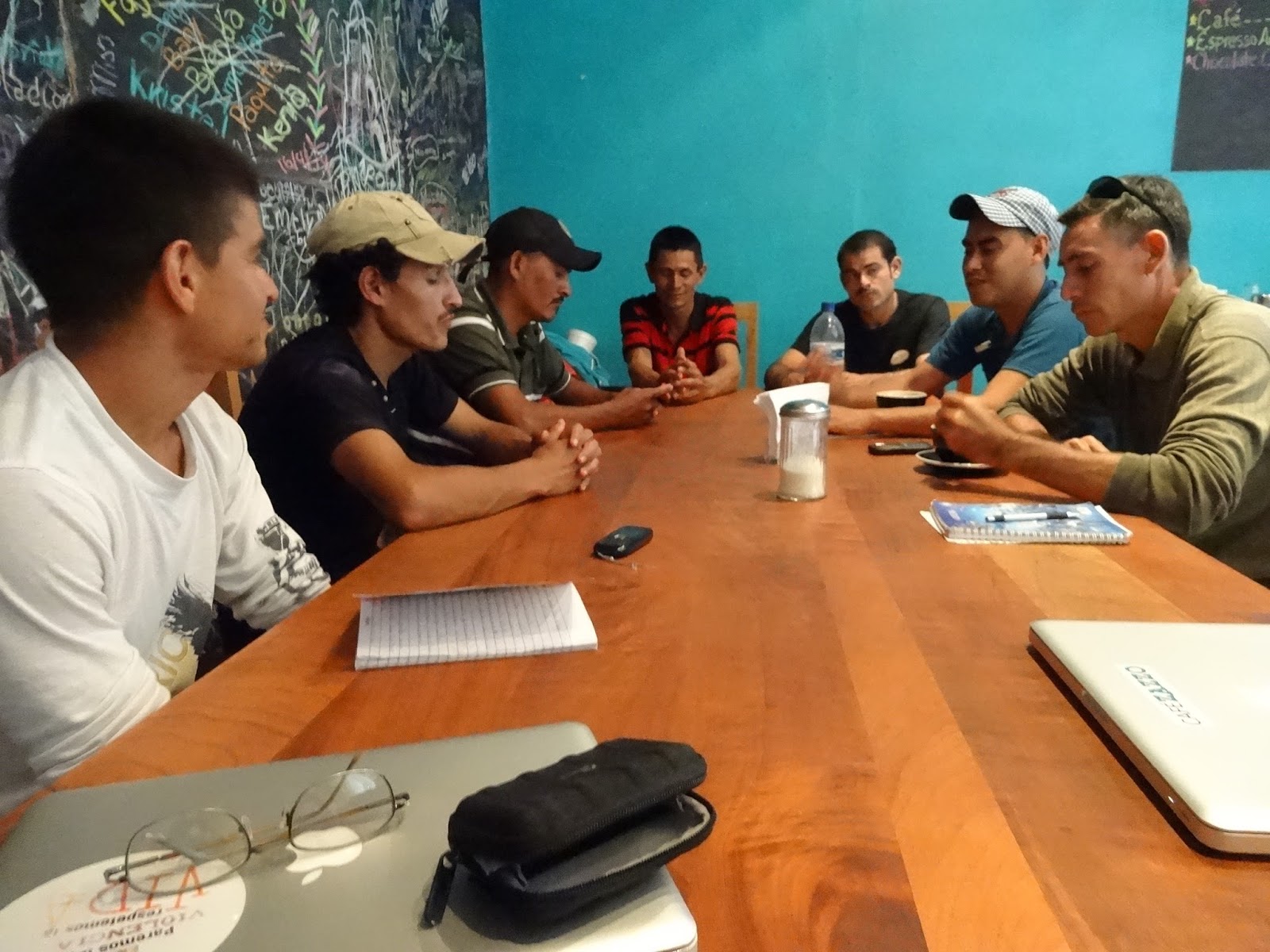
The final day the guys from El Zapote sat at a coffee shop talking about the process of exporting coffee with the staff of Unión Microfinanza.


Lots of information was shared – and many questions were raised. It was a good step to helping advance what could become an important way for these and other small coffee farmers to work together for a better life for their families and their communities.


Monday, July 28, 2014

Weekend ministry with missionaries

Saturday morning I went out to Plan Grande to facilitate a workshop with the base community leaders of that sector of the parish. 38 people came from five different communities.

We spent time talking about base communities and the new process Padre German has started -  a process that, I believe, tries to help the communities deepen their relationships with Christ and with each other.

Each week of the month the base communities have a different type of meeting. The first week is study of a theme from a booklet. The second week is a time to celebrate birthdays, anniversaries, and more. The third week is a meditative reading of scripture. The last week, the group looks at their village and sees what might need to be done to make it better; they then decide what to do.

In the third week the community does a short of Ignatian imaginative contemplation of a story from scripture. To help them experience what this is I used the story of the multiplication of the loaves and fishes in John’s Gospel (6: 1-11).

We start with rhythmic breathing which creates an incredible silence in the room. Then I read the passage and asked them to picture themselves there and pay attention to what they are seeing and feeling and hearing – their personal experience. After a few minutes of silence, I ask them to share with the persons next to them and then share to the whole group.

From what they shared I can see that this has been, for at least some people, a way to encounter Christ in a different way. It has also been a way to open up the Bible for them.  I tell them that they are not looking for a message, but opening themselves for a meeting with Christ.

I emphasize that this is only one way to read the Scriptures. Maybe next year we can have them learn how to do lectio divina.

The workshop also included sharing some ice breakers - dinamicas – to break the monotony of sitting.


After the workshop, some sisters I know drove out to Plan Grande to see the work on the house we’re building there.

Then I went to San Agustín (about 30 minutes away) for a meeting with the youth there. I had prepared a theme – trust – but they had something already prepared. Next time I’ll call the young leader a week or two before.

There were 28 young people meeting, which is great. But I think they need a bit of help since they don’t have a real sense of their common identity as members of a community. They are more like a gathering of 6 different groups of young people. But that is not uncommon here – or anywhere. We tend to stick with those we know.

On Sunday morning I was back in Plan Grande. (Yes, I need to live there as soon as possible.) A group from Plan Grande was going to the village of La Torera to lead a Sunday Celebration of the Word.

The people of La Torera had been going to San Agustín for celebrations but one leader from the nearby village of Descombros had come to visit them and they have decided to try to organize themselves. To assist this, each Sunday a team from one of the villages of the sector goes to lead a Celebration of the Word and to prepare parents and godparents for the baptism of nine children.

I took the Plan Grande group in my truck – at least 15 of them.


Two delegates of the Word from Plan Grande led the celebration in a house and they asked me to do the reflection. I managed to make it participative and under 13 minutes!


It was marvelous to see this small group of people who really want to live their faith. I can see some real leadership emerging among them and I do hope that they can reach out to the young people in their families. (As usual there was a small group of single young men just outside the house where we were meeting. As usual I made an effort to talk with them a bit.)

The people there are also hoping to build a little church. There are only about eight Catholic families in the village. Most people there are evangelicals and there are two evangelical churches there. The Catholics would like to have a small church. So they are collecting donations as well as seeking other ways to raise money.

Going to La Torera with the people from Plan Grande, it was also marvelous to see and hear of the sense of mission that people in this sector have. If I hadn’t been there, they may have tried to find someone to take them there, but I think they would have walked about an hour to get there,

I feel blessed to be a part of their missionary work.


Wednesday, July 23, 2014

In the works

There are several possible projects in the works in the parish of Dulce Nombre.

The first is going along rather swiftly.

In January when Fr. Jon Seda came from St. Thomas Aquinas in Ames, he was accompanied by a young man who had graduated from Iowa State a few years ago and had visited Dulce Nombre in 2011.He had interest in initiating a direct marketing of coffee from some small coffee producers in the parish.

He spoke with two producers from different villages who provided samples. I insisted that what I considered important was that the producers organize themselves and that some investment be made in their work. I think this is the best way to proceed since it does not make the US partner a mere buyer and helps the local coffee producers work together.

A month later one of the men told me that he had 15 small coffee producers interested. They later met and formed themselves into a cooperative, with officers – though only with 14 members, since one had gone to the US.

A few months later I sent samples from three of the coop members to the US contact. He had them toasted and taste-tested by a small organization that toasts and distributes coffee. The quality of the samples was very good and there is interest in buying from the coop.

There are many steps to be taken to get this really going, but they are meeting and I am helping them with some contacts to help them get official recognition as well as put together a plan of action to maintain and improve the quality of the coffee.

Next week four of them and I are going to visit La UniónMicrofinanza which does direct marketing of coffee.

The second possibility is in process.

A few months ago someone donated a manzana (1.68 acres) of land planted with coffee to the parish. The coffee, of the newly-developed OBATA variety, had been planted in August of last year. It thus won’t give a decent yield until the 2016 or 2017 harvest.  The parish also has the opportunity of buying a contiguous manzana planted with OBATA and is hoping for some financing.

Coffee obata

Padre German’s idea is to use the yields of the coffee to finance the parish’s formation process, as a way to become a little self-sustaining.

Each month a sector from the parish is going out to weed or fertilize the fields or to enclosed the land with barbed wire (to prevent cattle from entering the field.) This year corn has been planted in the field and so this should help generate some funds or, at least, provide corn for the parish’s meetings.

Corn and coffee 
The third possible project is still in the discussion phase.

A US non-profit is interested in starting a medical clinic in the Dulce Nombre area and is seeking the cooperation of the parish. They propose to assist funding for a number of years with the plan of helping the clinic become self-sustaining. I think they also see this as a way to help local medical professionals, many of whom are unemployed.

I hope this comes to fruition since I think this might be a good way to involve some of my friends and acquaintances who are in the medical professions.

There are probably other possibilities which I’ll see when I’m living out in the parish, but that will have to wait a few months.