Tuesday, October 30, 2012

Jesus in the storm


As the east coast of the United States faces the fury of Hurricane Sandy and as Honduras faces the ongoing fury of violence and corruption, I recall an image of Jesus calming the waters (Mark 4:35-40).

Years ago a Belgian priest friend of mine sent me a card with a photo of this scene from a miniature in a medieval manuscript.


It came at a good time in my life, helping me to navigate troubled waters.

What surprised me about the miniature was that Jesus is depicted twice. On the left he is sleeping during the storm and Peter is trying to wake him up. On the right, he is blessing and calming the waves – as two fish fly in the air.

Jesus is with us in the storm, whether or not we feel his presence, whether the storm is still raging or the seas are calmed.

His presence can sustain us, not necessarily changing what is troubling. His presence can give us the peace that prevents our disintegration, the deep peace and consolation that defies what threatens us.

There is a passage from Being Peace by the Vietnamese Buddhist Monk Thich Nhat Hanh that comes to mind:

Many of us worry about the situation of the world. We don't know when the bombs will explode. We feel that we are on the edge of time. As individuals, we feel helpless, despairing. The situation is so dangerous, injustice is so widespread, the danger is close. In this kind of a situation, if we panic, things will only become worse. We need to remain calm, to see clearly. Meditation is to be aware, and to try to help.

I like to use the example of a small boat crossing the Gulf of Siam. In Vietnam, there are many people, called boat people, who leave the country in small boats. Often the boats are caught in rough seas or storms, the people may panic, and boats may sink. But if even one person aboard can remain calm, lucid, knowing what to do and what not to do, he or she can help the boat survive. His or her expression - face, voice - communicates clarity and calmness, and people have trust in that person. They will listen to what he or she says. One such person can save the lives of many.

Our world is something like a small boat. Compared with the cosmos, our planet is a very small boat. We are about to panic because our situation is no better than the situation of the small boat in the sea. You know that we have more than 50,000 nuclear weapons. Humankind has become a very dangerous species. We need people who can sit still and be able to smile, who can walk peacefully. We need people like that in order to save us. Mahayana Buddhism says that you are that person, that each of you is that person.

Followers of Christ should also be those persons of calm and tranquility, the peacemakers who by their presence give others the courage the face the storms – physical, emotional, and spiritual.

And so, in the midst of the storms, let us look to Christ, keeping our eyes on Him who brings us calm in the midst of the storm so we can also bring others peace.

Monday, October 29, 2012

Celebrating the confirmed in Dulce Nombre


In the last two months more than 400 young women and men were confirmed in the parish of Dulce Nombre de María.

Many of them are already members of a base community in their villages and towns. But how many of them will persevere in the practice of their faith and assume responsibilities in the parish?

In order to encourage their continuing growth in faith, Padre Efraín is encouraging the young people to form their own base communities, with a spirit that speaks to the young.

To help this happen, the parish had a gathering of the confirmed on Saturday, October 27.

The church was decorated – and a banner from the youth of St. Thomas Aquinas parish greeted all as they entered the church.

Greetings to the confirmed of Dulce Nombre from the St. Thomas Aquinas youth."

The church was packed for the Mass that began the celebration. The Mass was a nice celebration with the singing led by the Plan Grande music group La Gran Familia. 


After the homily, Padre Efraín gave a booklet to help the formation of the youth base communities to a catechist and the confirmed from the villages.

A nice touch was the offertory procession, where parishioners brought up not only a cross, the bread and wine, copies of the diocesan and parish pastoral plans, but also a shovel and a hoe, to symbolize offering our livelihoods.


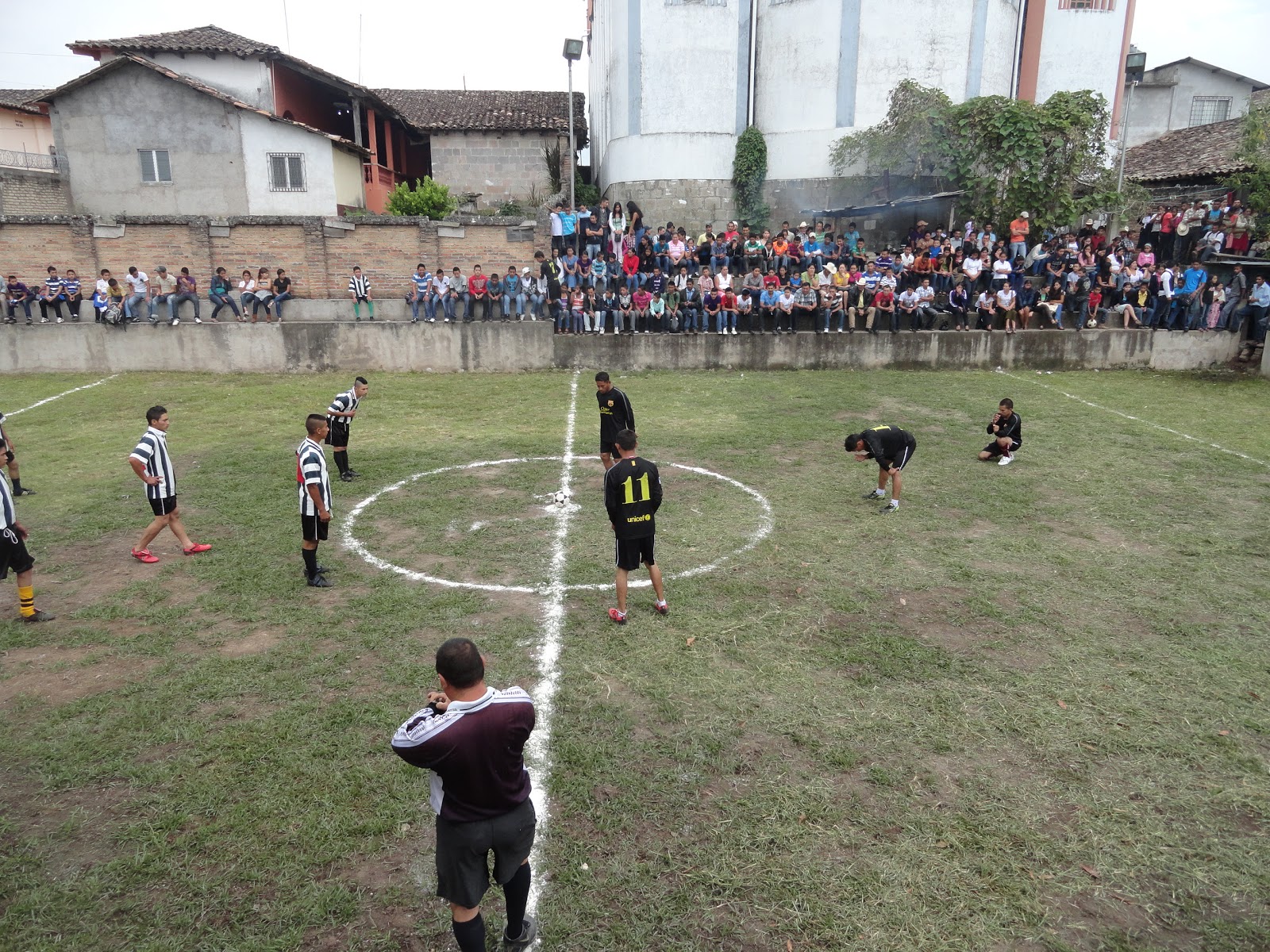
After Mass, we went out to the cancha, the soccer field behind the church where Padre Efraín blessed the field.


And then the games began – 24 teams: 22 men’s teams and 2 women’s. 

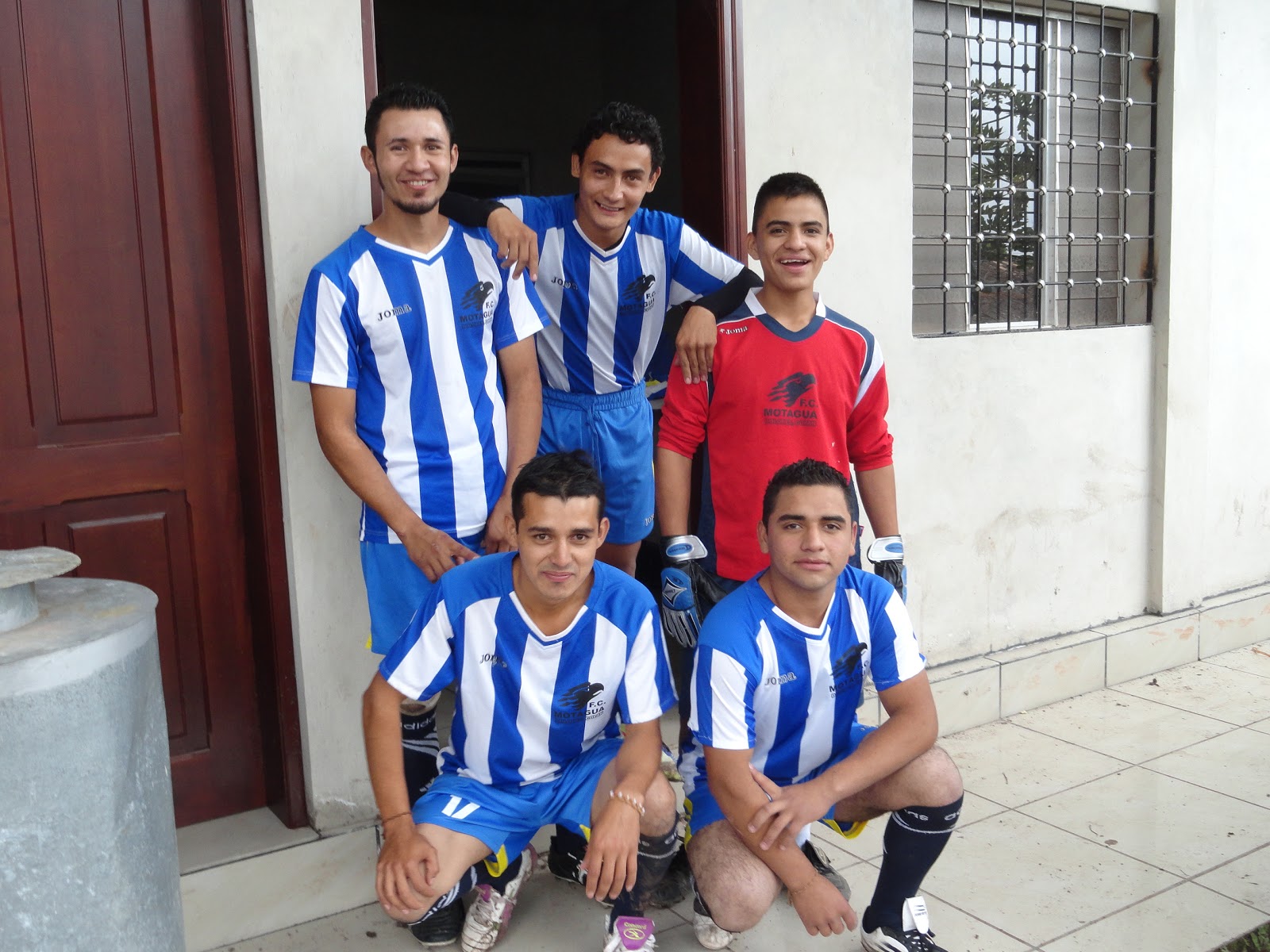
The Dulce Nombre parish team (top row Gabriel, Mauro, Fernando; kneeling Elder, Carlos)

Let the games begin! - ¡Que comience el campeonato!

Las mujeres jugando

The tournament was still going when I left at 4 pm.

Padre Efraín got into play

During the games, all present were served fresh orange juice, empanadas (stuffed tortillas), and ticucos (a local favorite – corn meal with beans, chipilin, and spices, cooked in corn husks.)

A few of the hundreds of ticucos made for hungry young people.

A half-eaten ticuco

As they finished the second round of the tournament a beef soup was served. 

Sopa de res

I left early, content to see so many young people who took their faith (as well as soccer) seriously.

It is good to be here.

It was also great that there were several signs of solidarity in addition to the banner from the youth of St. Thomas Aquinas. Confirmation candidates from a parish of a friend in VInderhoute, Belgium, had sent money which was used for the booklets for the confirmation follow-up. The Knights of Columbus from St Thomas Aquinas Church in Ames, Iowa, had sent money to help feed the young people. Soccer balls that a St. Thomas visitor had left were the prizes for the tournament.

The Church reaches to the ends of the earth – and the young are our hope.

More photos can be found in a set of photos on my FLICKR page. Click here.

Friday, October 26, 2012

Awe

After a thirteen day visit to Ames, Iowa, I am now back in Santa Rosa de Copán, Honduras.

My visit was good, with many opportunities to visit with friends, talk about my ministry here, and to eat at least 13 meals with friends. (The Indian and Thai meals were memorable.)

The visit was marred a bit by the damage that had been done to St. Thomas Aquinas Church in Ames, due to a fire. But I still saw many signs of life in the parish – even amidst this and other crises affecting the parish.

I left Ames on Tuesday and spent the night with Enrique who had spent about seven months living in my house while he was studying English at Iowa State about 2002. He’s now working in Des Moines and happily married with Edy, expecting a baby.

I didn’t get much sleep that night because we spent more than four hours talking. It was one of the most stimulating conversations I’ve had in a long time, much like the conversation I had with my friends Omar and Elizabeth earlier in the visit.

I got up at 3:15 am and left on a 6:20 am flight from Des Moines to Dallas, the first leg of my journey home to Honduras. Behind me was a couple with a young daughter who was experiencing her first airline flight.

I overheard her oohs and ahs as she saw the world from the airplane window. “Awesome” was a word I heard several times.

Hearing this child, I was called to see the world, once again, with awe, with wonder. God’s world is filled with wonder – but so often I forget to see it or hear it.

“The world is charged with the grandeur of God,” wrote Jesuit poet Gerard Manley Hopkins.

In the midst of all the pain and conflict, I am called to see the grandeur of God in each and every person and in all that God created. Seeing this, I am called to help others see this and to live in the love that God has for all of us.

Visits to friends are important if we are open to wonder. Sometimes it takes a child in an airplane to remind us.

Monday, October 22, 2012

Heading home to Honduras


Wednesday I’ll be flying back to Honduras. The short trip has been a good chance to meet with people and to share a bit of my mission in the diocese of Santa Rosa de Copán and especially in the parish of Dulce Nombre de María.

A little while ago I found an e-book on line of Ivan Illich, The Church, Change and Development, which includes talks and articles from about 1970. I started reading them a few days ago. They are quite challenging.

My favorite quote, so far, is from “Yankee, Go Home: The American Do-Gooder in Latin America”:

If you insist on working with the poor, if this is your vocation, then at least work among the poor who can tell you to go to hell! It is incredibly unfair for you to impose yourselves on a village where you are so linguistically deaf and dumb that you don’t even understand what you are doing, or what people think of you. And is profoundly damaging to yourselves when you define something that you want to do as “good,” a “sacrifice” and “help.”

Challenging and worth pondering.

"Hector, I have no idea what I'm doing!" (Photo courtesy of Scott Satterlee)


 ---
There's an article on me this week in the Dubuque archdiocesan newspaper. Download the pdf here.

Addendum: The Illich book can be found here.

Sunday, October 21, 2012

Mission Sunday

Today is Mission Sunday, the day when churches throughout the world recall the call to be missionaries, to be witnesses of the Good News of Jesus to the world.

The past ten days I’ve been in the US doing my missionary work there – instead of in Honduras. I've been in Ames, connecting with people from the parish of St. Thomas Aquinas. It's been a little strange since the church is being repaired after a fire and so Mass is in an auditorium on the university campus.

St. Thomas Mass in the Scheman Center at Iowa State University

Last Wednesday I was part of the Parish Formation Night in St. Thomas Aquinas Church in Ames, Iowa. I shared with two groups of young people what mission is.

I recalled that early in my time in Honduras, Sor Inez, a Spanish Franciscan sister, introduced me at the church of San Martín de Porres, up the hill from where I live in Santa Rosa de Copán.

I introduced myself as a missionary and the priest, Padre Fausto Milla, reminded me that we are all called to be missionaries. In fact, the 2007 meeting of the Latin American bishops in Aparecida, Brazil, called on all people of the Americas to be disciples and missionaries.

The people I work with in the parish of Dulce Nombre de María have a strong sense of mission.  They invite people in their villages to join their Sunday celebrations and their weekly base community meetings. Also, about once a month, pastoral teams in villages go to another village to lead the Sunday Celebrations of the Word.

Meeting with recently confirmed young people in Camalote, Dolores, Honduras

It is important to remember that being a missionary is not merely going to another country. Nor is it a question of preaching to the unconverted.

It is living one’s life in a such a way that people encounter in you and in themselves signs of the presence of God’s kingdom.

I think Thomas Merton said it well:

A saint preaches sermons by the way he walks and talks, the way he picks up things and holds them in his hands.

I can do this wherever I am, though now I have a profound sense that my place is in Honduras.

Yet, once a year, I return to the US, to share the Good News, to help the people here see that God is alive, that the People of God, the Church, is revealing signs of the Kingdom.

I’ll be here a few more days, but I am longing to get back to Honduras. It’s home. It’s where I am missioned – sent on mission and receiving the missionary witness of so many Hondurans.

Gracias a Dios.