Wednesday, February 12, 2014

Cell phone stupidities

Living in the second poorest country in the Americas I expect problems – blackouts, water shortages, occasional fuel shortages, etc.

But now throughout Honduras many of us are experiencing problems with our cell phones that are not a part of what one might expect in a poor country but are due to the stupidity and narrow-mindedness of legislators.

The law was passed in December by the National Party-controlled lame duck congress, probably at the instigation of the current president who had said that he would do whatever has to be done, especially in terms of crime.

There is a problem with cellphones in prisons. From my visits I have seen many cell phones. But one of the problems that has been noted in the press and by the politicians is that gang leaders in prison have cell phones and can direct their gangs from prison. Some say they can also use the phones for extortion.

So, in an effort to show they are serious about violence, the legislators passed a law that has the cell phone companies block calls from the prisons in the country.

There is a technology – from Israel, a friend wrote me – that can be installed in a  prison to block calls.

But instead of investing in this, the legislators demand that cell phones within one kilometer of a prison must be blocked by the cell phone companies. That is very difficult. In fact, many people in the country are without cell phone coverage. Here in some parts of Santa Rosa there is no signal and in other parts calls are cut off after a few seconds. It’s frustrating.

The other problem is that people live within one kilometer of the prisons. The prisons are not in completely isolated areas. Here in Santa Rosa the prison in a poor neighborhood, at the outskirts of the city but not far from the center of town.

And so people are rightfully upset.

People near the prison outside Tegucigalpa blocked the four lane highway in protest.

What did the government do? Blame the victims! One government official claims that organized crime is behind the protests.

Probably not. They’re probably just people fed up with the stupidity and stinginess of legislators who want to look serious about fighting crime.

I guess it’s just another example of the lack of justice here and how people suffer here, especially the poor.


-------
ADDENDUM: February 14, 2014:
There's an explanation of what is happening at Honduras Culture and Politics here.

Monday, February 10, 2014

The presence of the Dubuque Franciscan Sisters

Saturday in Gracias, Lempira, the Franciscan Sisters of the Holy Family (commonly known as the Dubuque Franciscans) celebrated the first vows – temporary vows – of a Honduran member of their congregations, Hermana Erika Calderon.

The ceremony was celebrated in the San Marcos Church, with Padre Elias Calderon (Erika’s uncle) and Padre Loncho presiding at the Mass.


Except for the responsorial psalm, all the music was led by the group from Erika’s home village in the parish of Gracias which included, I believe, her father and two uncles. Cristian, a young boy from Gracias, sang the psalm.
Sister Erika with Sister Nancy Schreck
Sisters Pat Farrell and Nancy Schreck from the governing board of the congregation had come to witness the vows. Pat gave the reflection on the readings.

Sister Pat Farrell giving the reflection
Erika had chosen the call of Samuel in 1 Samuel as the first reading, expressing her willingness to respond to the call of God in her life.

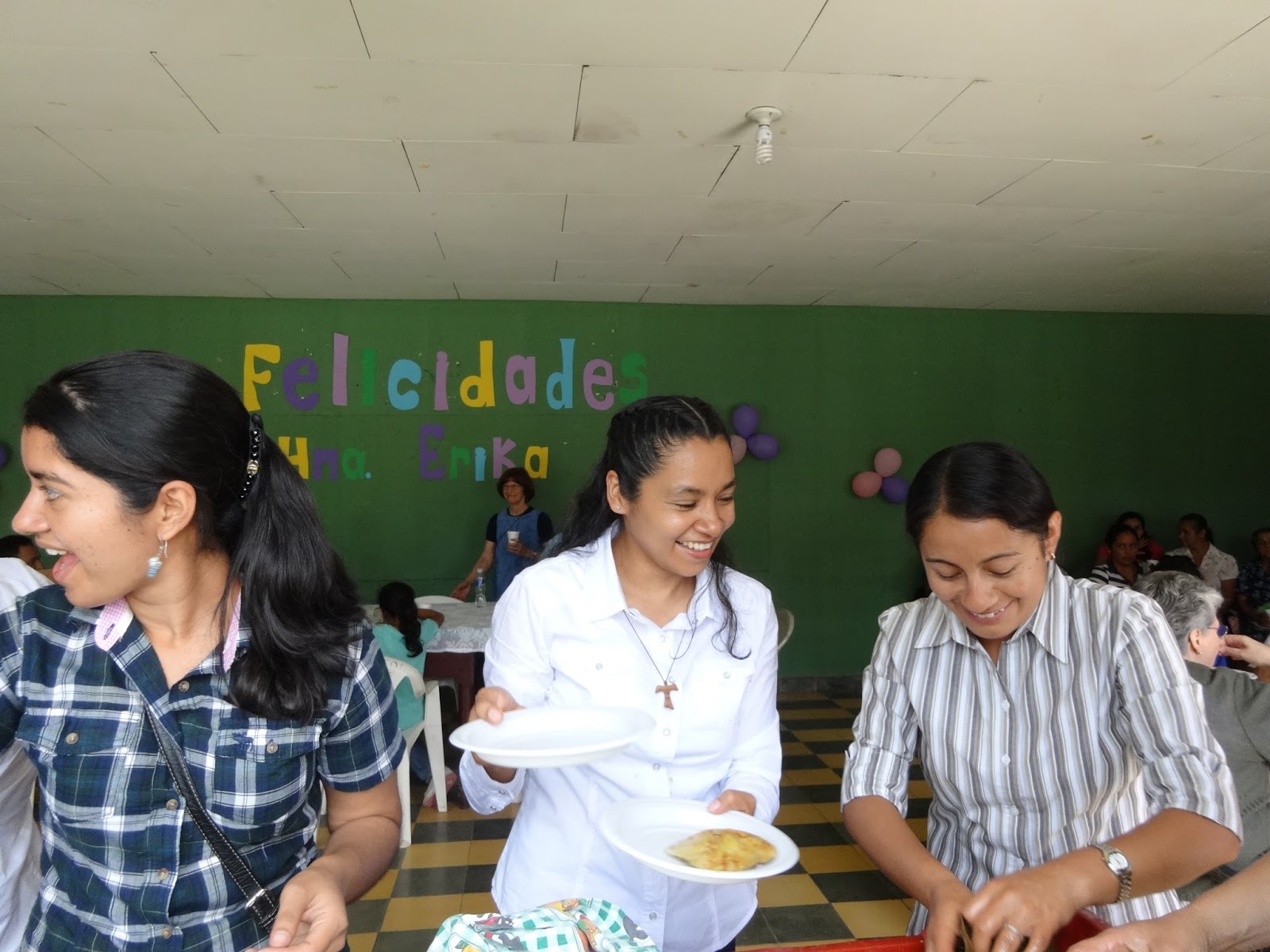
After the Mass there were tamales and rice, which Erika and others served.


It was a beautiful day, a reminder of the presence of the Franciscan sisters here in Honduras for more than 8 years, serving the poor, including the imprisoned.

As I took pictures during Sister Pat’s reflection I couldn’t help but notice the banner beside her, from the previous Sunday:

Blessed are the poor in spirit...


I was delighted to be there, especially since I have been an associate of their congregation for a few years - recovering the Franciscan roots of my life and spirituality.

Sunday, February 09, 2014

Learning together

One of my responsibilities in the parish of Dulce Nombre is preparing materials for religious education and facilitating workshops with catechists on the materials.

This has been a challenge and a blessing for me.

It is not easy writing in a language I’m still learning. But the bigger challenge is to prepare material that is understandable and that helps the catechists grow in their faith and teach children and youth in a way that makes faith real.

Most of the people in the parish have, at most, six years of formal education. Some of the catechists cannot read or write and a fair number of religious education students can’t read or read with great difficulty.

But the biggest challenge – and the one I find exciting – is trying to prepare materials that encourage participation and learning by doing.

Much of the formal education here is rote learning – memorizing information.

But we want formation that involves the young people in discovering their faith in their lives.

This month I have four workshops with catechists – one in each of the zones of the parish.

Last week there were two – one in El Limon and one in El Zapote de Santa Rosa. In El Limon, we had 17 participants, including three new catechists. In El Zapote there were 25 catechists, including five new ones.

I began with a prayer – but decided to have them offer their talents and capabilities to the Lord, writing or drawing them on a piece of paper and placing them before the Lord.

In El Zapote, they had exposition of the Eucharist, as they do all Thursdays, and so we prayed in church and they placed their talents on the altar, before the Eucharist.


After that I explained the processes of sacramental preparation we have in the parish and then went over some of the themes in the preparation for confirmation.

We did a sort of puzzle to help understand the order of the parts of the Mass.


But the first theme was the Church. I had prepared material on this theme but I was trying the week before to find a way to make it more understandable and active.

Looking at 1 Corinthians 12: 14-27, I noted how Paul uses the image of the body for the church.

So after asking them their ideas of what the Church is, I read the first few lines and then drew a silhouette of a body on paper.

I then asked them to write the names of the body on the paper.

After reading the rest of the passage, I asked them to write their names – or draw a symbol - by the part of the Body of Christ which they most closely identified with.

It was moving to watch them come forward and sign the Body of Christ.


We talked a little and I emphasized how all of us are needed, all are important, all have a part in the Body of Christ which is the Church.

Then, to make it a little more real and to show the element of mission, I read the prayer of St. Teresa of Avila:
Christ has no body on earth but yours;
no hands on earth but yours.
Yours are the eyes through which Christ looks out
with compassion on the world.
Yours are the feet with which he chooses
to go about doing good.
I added this prayer at almost the last moment, just before I took the material to the printers last Monday. I had often used this prayer in my work with college students at St. Thomas Aquinas in Ames. It fits so well – and presents a message so needed.

We are the Body of Christ – and all have a role. All have a dignity and a mission.

In a world that looks down on the poor and sometimes despises them, this is a critical message.

Pope Francis wants “a poor church, a church for the poor.” I also want, as Pope John XXIII did, “a church of the poor.”

This is one of the ways we can continue this process, helping the people deepen the faith they already have.


Monday, February 03, 2014

Virgin of Suyapa feast in Plan Grande

Mary, under the title of the Virgin of Suyapa, is the patron of Honduras. The tiny image  - 2/3 inch - was found in 1747 by Honduran campesinos but has become a deeply venerated image of Mary here.


I am especially intrigued by the Virgin of Suyapa because it is not a devotion to a grand image or a miraculous vision of Mary, but a veneration of something very small.

I have become convinced that God chooses the small things of the world to confound the powerful. But this doesn’t stop the politicians from using the Virgin of Suyapa to enhance their image. The celebration of the feast in the basilica in Tegucigalpa will be attended by politicians, military, and economic elites.

But I went to the celebration in Plan Grande, Concepción, Copán. The Virgin of Suyapa is their patroness as well as the patroness of the sector of the parish.

I arrived just in time to drive behind the procession to the church.


Before Mass, as Padre German had confessions, two musical groups sang – La Gran Familia from Plan Grande and Los Enviados por Dios of San Agustín. They were outstanding.

La Gran Familia
Enviados por Dios
Then five young girls from the five communities in the sector were introduced. The first and smallest was Rosa from the small community of Los Descombros. She spoke clearly and gave a great message to those gathered in the church.

Rosa de Descombros
The Mass proceeded as usual – with a long sermon by Padre German, emphasizing the direction the parish is heading, asking people, in the spirit of Pope Francis, to take the initiative in living the faith, to become involved, to accompany others, to bear fruit, and to celebrate our faith.

shrine of Suyapa in the Plan Grande Church
At the end of Mass all were invited to a snack prepared by the base communities of Plan Grande. Gloria said it was not really a lunch.

So two hundred or so stood in line for a “snack” of rice, tamale, four tortillas, curtido (“pickled”vegetables), and coffee or pop. I’d call that a meal.

I was very impressed that the community had provided such a substantial “snack” for so many people. It was a real sign of welcome and of caring for others.

Snack
After this I pulled Padre German over to the spot where I’m thinking of building the guest house where I’ll be staying (and welcoming visitors). I will live in the house until I leave here in a plane or a casket – pending other plans from God. Then the house will be handed over to the parish for its use.

The welcome that Plan Grande had provided for all those at Mass reinforced for me why I chose this community.

Now the fun begins – plans for the house, a design, a budget, contracting a maestro de obras and other workers, and overseeing the construction.

Saturday, February 01, 2014

Praying with the imagination

Yesterday we had an assembly of catechists in the parish of Dulce Nombre. Seventy-four arrived from almost all the villages.


Padre German and I planned the meeting last week. One of the things we noted is how often the prayer and the actual classes become rote, lacking imagination.


I suggested that we use a form of prayer with the imagination, in the style of Saint Ignatius. Padre German suggested that we add rhythmic breathing as part of the prayer.

We had no idea how it would come off – in a noisy, wordy society like Honduras.

I began by asking everyone to sit straight in their chairs with their two feet on the ground and their hands either on their knees or joined face up.

Then we began to breathe in and out in a rhythm. I  spoke quietly. First: one, two, three: inhale; one-two-three: exhale. After several times we switched to the prayer “Señor, ten piedad – Lord, have mercy” inhaling and exhaling. Then, I said only “Jesucristo – Jesus Christ.”

After a few minutes, I asked them to continue breathing rhythmically and to imagine that they were at work – making tortillas, harvesting coffee, weeding the cornfield with a machete, in school, washing clothes, whatever....

Then, suddenly Christ walks in. What do you want to say to Jesus?

After a while I encouraged then to listen to what Jesus was saying to them.

The silence was tangible.

I thought of just letting it go for a long time – but, being too impatient, I decided to end it after a few minutes.

I then asked them to turn to the person next to them to share what they had experienced. Then we shared in common.

Several spoke of what they had experienced – a sense of the presence of God. Some, still in the head, started to talk about what it meant. I gently urged them to speak from experience.

For me, it was an amazing experience of prayer in common.

When we planned it, I had no idea that it would be such a strong experience for me and for the people.

After this we had the catechists gather in groups to prepare a prayer to begin a sessions with students. Padre German gave each of them a theme. Most had long prayers with only one person speaking - sometimes explaining rather than praying. But two groups used their imaginations and prayed with symbols that involved the participants, one placing symbols in a sack as they offered petitions.


God is good. We'll have to try more of this. 

I stayed around in the parish, talking with Padre German and also trying to tie up some loose ends for the partial scholarships that St. Thomas in Ames is providing for about 150 students in the parish. (More on this later.)

It was about 5:30 when I started back to Santa Rosa.

For many years I've noticed that here in Honduras, as in El Salvador, there is a short period just before sunset where there is a very distinctive light that has almost always moved me to awe.

Much of the way back I saw and felt that light - another sign of God's presence here.

Here's a photo that does not capture that light, but shows a bit of the natural beauty here.