Saturday, May 11, 2013

The Blood of the Poor


Some who come to visit Honduras are very concerned about the security issues, especially since the two major cities, San Pedro Sula and Tegucigalpa, are among the five cities in the world with the highest percentages of killings.

This is not helped by the Honduran newspaper which often put bloody scenes on the front page and have three pages of “Successos,” reports of crimes and other violent events, replete with photos of bloody bodies.

Of course, most of those killed are the poor – caught in a web of organized crime, drug trafficking, police corruption, and a “justice” system in which very few crimes are investigated and very few killers are brought to trial and convicted.

But there is one aspect of the blood of the poor that is not seen – the effects of the extremely rich and the political and economic elites that profit from the poor. The world caught a glimpse of this in the bloody deaths in the Bangla Desh clothes factory. But it is much more pervasive, as people die from the effects of a society with glaring inequalities.

Dorothy Day once wrote about St. Ignatius of Laconi, a Sardinian Capuchin brother of the eighteenth century, whose feast is celebrated today by the Franciscans. He was the questor, the official beggar for his friary.

As Dorothy Day wrote in in May 1952 Catholic Worker:

      One way to keep poor is not to accept money which is the result of defrauding the poor. Here is a story of St. Ignatius of Sardinia, a Capuchin recently canonized [1951]. Ignatius used to go out from his monastery with a sack to beg from the people of his town, but he would never go to a merchant who had built up his fortune by defrauding the poor. Franchino, the rich man, fumed every time the saint passed his door. His concern, however, was not the opportunity to give alms, but fear of public opinion. He complained to the friary, whereupon the Father Guardian ordered St. Ignatius to beg from the merchant the next time he went out.
      “Very well,” said Ignatius obediently. “If you wish it, Father, I will go, but I would not have the Capuchins dine on the blood of the poor.”

     
The merchant received Ignatius with great flattery and gave him generous alms, asking him to come again in the future. But hardly had Ignatius left the house with his sack on his shoulder when drops of blood began oozing from the sack. They tickled down on Franchino’s doorstop and ran down through the street to the monastery. Everywhere Ignatius went, a trickle of blood followed him. When he arrived at the friary, he laid the sack at the Father Guardian’s feet. “What is this?” gape the guardian. “This,” St. Ignatius said, “is the blood of the poor.”

Here in Honduras there are church leaders who are tempted to receive the gifts of the rich and to curry favor to the political and economic elites. The temptation affects church leaders from bishops to rural pastors. 

I know of at least one case where a priest was offered money for the church from a local drug lord. He refused. Another priest was offered money by a local politician for himself, but he publicly made sure that the money went directly to the church

 But there are at least two towns that have gorgeous new churches which are probably paid for by drug trafficking or other organized crime leaders.  

And who knows how connected other church leaders are to the powers that support and conserve the radical inequality here in Honduras (and throughout the world). According to Monseñor Luis Alfonso Santos, bishop of Santa Rosa de Copán during the 2009 coup, the coup was the work of political and economic elites. Why was it that he was one of the few religious leaders to condemn it? Another prelate, in 2010, actually compared the leaders of the coup to the founding fathers of Honduras.

The temptation of money and power is strong – for all people, especially those who hold positions of power in the economic sphere, the church, and the state. But it is also a temptation for all of us.

Let us always remember “the blood of the poor.”

-----

The quote from Dorothy Day can also be found in Robert Ellsberg's By Little and By Little: The Selected Writings of Dorothy Day,  pp, 108-109;

Wednesday, May 08, 2013

Reading


The other day a young guy working in a refrigerator repair shop came to take my refrigerator to get fixed and saw my books. His question, like that of so many others, was, "Have you read all of them?"


I do a lot of reading here in Honduras. Almost two years ago I invested in a Kindle and that has enabled me to find some good reads – some fairly cheap.

I also like a real paper book in my hands and slowly bring down a few more of the books I have stored with friends in Ames. Also I will occasionally order books when I’m going to the US or when someone is coming down and willing to bring them.

The Dubuque Franciscan sisters in nearby Gracias are also a source of books. We share books – often mystery and suspense novels, but also books on ministry and spirituality.

My reading interests are varied, as you can see in the list of books I’ve read in the last few years here. (To be totally honest, that list doesn't reflect all the books I've read since I've left off the novels by the likes of John Sanford, Anne Perry, James Patterson, Lee Child, and Jonathan Kellerman.) I also have a big wish list.

But I’m usually reading several books at the same time. Sometimes that due to some books being slow reads or my desire to have something lighter or easier to read while I'm plowing through a tough read.

Right now I’m reading:
     Paul Sabatier’s Life of St. Francis of Assisi
     Sigrid Undset’s Catherine of Siena
     Donal Dorr’s Option for the Poor and for the Earth
     George Lakey’s Facilitating Group Learning: 
                  Strategies for Success with Adult Learners.

Last fall, in preparation for a pilgrimage to Assisi, I started reading a lot of books on Francis. Right now I’m trying to finish Sabatier’s book which is slow reading. I find him verbose and he seems to be going off on moralizing tangents all too often.But i want to finish the book.

Before the feast of Catherine of Siena I started Sigrid Undset’s Catherine of Siena.  About forty years ago I read several of the large novels of this Norwegian Catholic novelist:  Kristin Lavransdatter and The Master of Hestviken, which I thoroughly enjoyed. Her work on Catherine is intriguing. It’s not a straight-forward biography since Undset comments on the life and times in ways that have helped me understand and better appreciate this fourteenth century lay Dominican mystic.

To keep my mind (and heart) attuned to the spirituality that sustains me I recently began the latest edition of Donal Dorr’s  Option for the Poor and for the Earth. I read and enjoyed the earlier editions of his Option for the Poor and find this helpful in thinking through my social ministry here. What is significant is that this new edition added the option for the earth as a major theme.

A few days ago I began George Lakey’s Facilitating Group Learning: Strategies for Success with Adult Learners. One of my concerns here is how I work in the countryside in the formation of pastoral workers and catechists. My approach has been much more participative than is normal here, where people sit for long talks on topics. But I’m always trying to find ways to better involve people here in the learning process. Lakey’s work with Training for Change and nonviolent education projects in the US, informs this work, which I am finding very helpful as I think about how we can structure training in the Dulce Nombre parish. Padre German’s concern for popular methodology has moved me to buy, read, and study this book.

What else?

I have several unfinished books, including Francis of Assisi and the Future of Faith by Daniel Horan, OFM., Willam T. Cavanaugh’s  Migrations of the Holy, and the volume of book chapters, The Ten Best Books to Read for Easter, edited by Jim Martin, S.J. – all of these  are collections of articles. I may get around to finishing them sometime this year. I also started Don Di Lillo’s novel,  Underworld, which is interesting, but not an easy read.

Two other works partly read are Like A Hammer Shattering Rock: Hearing the Gospels Today by my friend Megan McKenna and Barbara E. Reid’s Reconsider la cruz: Interpretación latinoanericana y feminista del Nuevo Testamento.

What do I want to read in the next few months?

A few biographies or novels – but I don’t have any good ones here to read at this point. I’ll have to wait to get some from the sisters or from other visitors.

For my work, I’m planning to read a book by my long-time friend, Dan Ebener. Blessings for Leaders.  I haven’t read his earlier book, Servant Leadership Models for Your Parish, which I’ll probably get the next time I’m in the US. (I’ve know Dan since before 1980 and have long appreciated his commitment to peace and social justice.)

I have on my list of books to read Ultimate Price: Testimonies of Christians Who Resisted the Third Reich, edited by Annemarie S. Kidder, which reflect my long-held interest in those who stood up against Hitler.

There are two books in English related to Honduras I also hope to read: Jeffrey Jackson’s The Globalizers: Development Workers in Action and Robert Brenneman’s Homies and Hermanos:God and Gangs in Central America.

I also should finally get around to reading Ramon Amaya Amador’s  Prisión Verde, on the banana strike in the 1950s. It’s a classic Honduran “novel.”

I’ve had The Duty of Delight: The Diaries of Dorothy Day  on my shelf for a while and need to get around to reading it – before it gets eaten more by some type of wood and book bug.

There are a few philosophy and theology authors I’d like to get around to reading – but they often require more concentrated time than I normally have: Hannah Arendt, Jon Sobrino, Gustavo Gutiérrez, José Antonio Pagola, among others.

Reading is a gift – and I’m glad I can take time to do it. I need to be a little more disciplined. My upcoming birthday might be a good time to again try to read in a more disciplined way.

Sunday, May 05, 2013

Refrain from fornication


Today’s first reading from the Catholic lectionary is the early Christian community’s response to the presence of non-Jews in their community.

The big question was whether they should be circumcised.

The response was a compromise that opened the community to the presence of the Gentiles in the early church (Acts 15: 28-29):

For it has seemed good to the Holy Spirit and to us to impose on you no further burden than these essentials: that you abstain from what has been sacrificed to idols and from blood and from what is strangled and from fornication. (New Revised Standard Version)

‘It is the decision of the holy Spirit and of us not to place on you any burden beyond these necessities, namely, to abstain from meat sacrificed to idols, from blood, from meats of strangled animals, and from unlawful marriage. (New American Bible Revised Edition)

Yesterday I was took part in a meeting of one of the zones of the Dulce Nombre parish.

Padre German had gone to a village for Mass and a wedding. Professor Arnaldo, the parish coordinator, explained that there would be a new policy for infant baptisms. It would not be as limited as it was in the past. The parents would have to participate in five sessions and, possibly, a retreat. (I knew this since he had asked me to put together the materials for the pre-baptismal sessions.)

This surprised a few people and some asked whether this meant that single mothers or people “living in fornication” could have their children baptized.

I reacted strongly, objecting to the use of the word “fornication,” which for me has a strong sense of “living in sin,” “shacking up,” and promiscuous sexual behavior.

A dictionary definition of fornication is “sexual intercourse between people not married to each other.”

The Greek word, translated in several ways including “sexual immorality,” is derived from the word for prostitute.

I suggested that using this phrase was judgmental and that we should use a less “loaded” expression like “not married in the church.” I suggested that if we call all non-married couples “fornicators” that will not help us invite them into the Christian community and into marriage.

This doesn’t mean I am against marriage and would not encourage couples to get married. But I think we have to minister pastorally, with compassion and understanding.

I don’t know why there are many couples who, having several children, still haven’t gotten married by the church.

Is it the cost of a civil marriage, which is a precondition to church marriage?

Is it the sense that a church marriage should be accompanied by a costly celebration?

Some people have said that some don’t marry because they don’t want the commitment. That is probably true in some cases, but I wonder if that fits two interesting cases I know of.

Twice I accompanied the former pastor, Padre Efraín, to visit elderly couples who had not been married in the church. One woman was close to death. He asked them if they wanted to be married. In one case, the old guy – probably with a mind clouded by illness and old age – took some time to answer yes. The couples went to confession and were married by the church in their homes, with at least one grandchild present.

Were these couples fornicators? Did they not want the commitment of the sacrament of matrimony until they neared death?

I doubt it.

I suggest that we need to find ways to welcome unmarried couples into the community and  to encourage them to strengthen their relationships with the sacrament of matrimony.

But calling “fornicators” all couples living together but not married? I think that is too much and lacks pastoral sense

This comment of Father John Kavanaugh, S.J., in The Word Engaged,  p. 67, on today’s reading from Acts is pointed:
One of the most seductive temptations of the believer is to identify the will of God with the will of the believer, and not the other way around.

Monday, April 29, 2013

Corn festival in Vega Redonda


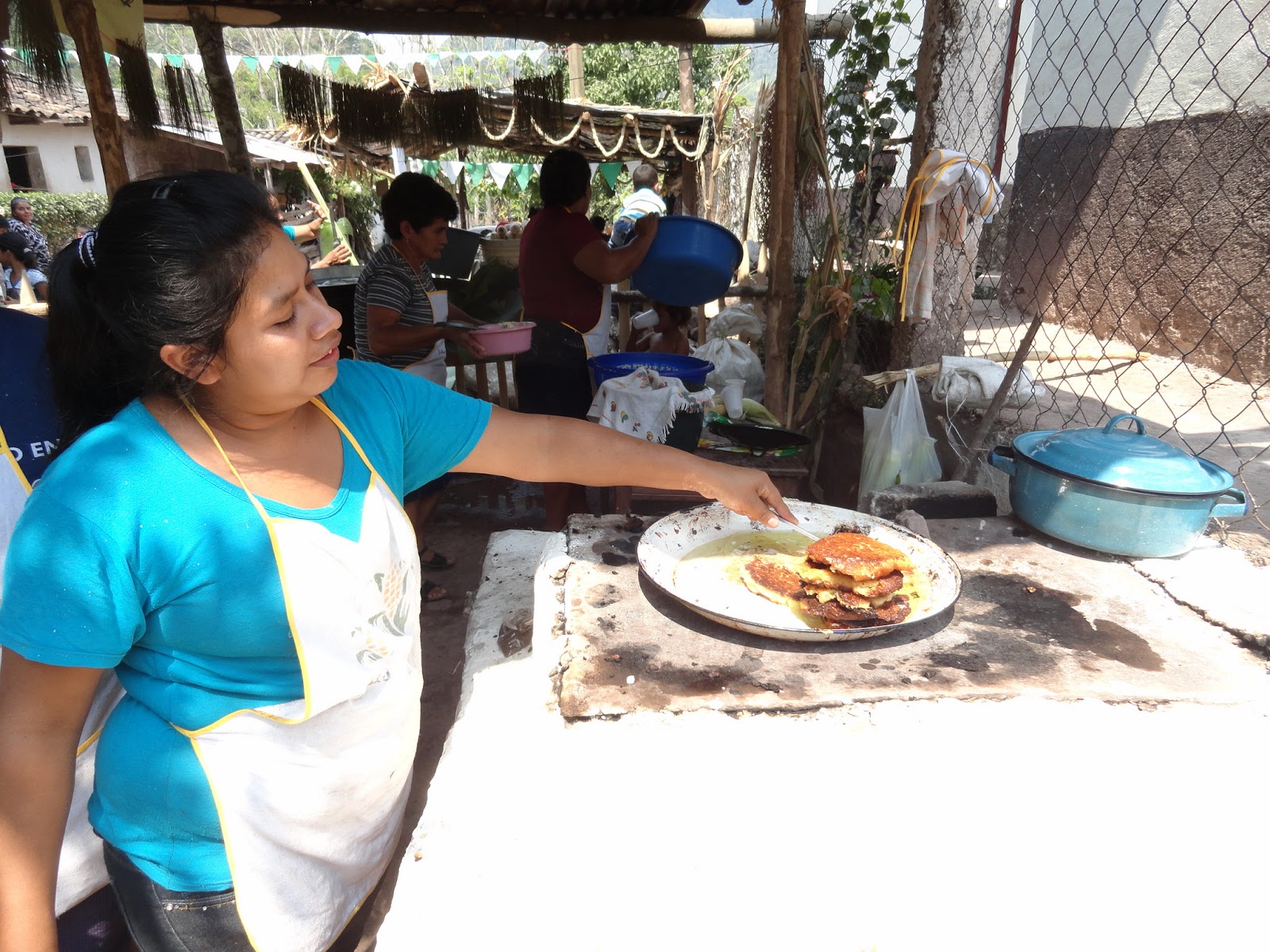
Sunday was the final day of a week-long Festival of Elote in the village of Vega Redonda.


Elotes are ears of corn that are recently harvested and eaten in several different ways.

We eat them as people in the US would eat sweet corn – but this is more like field corn than sweet corn.

They make sweet tamales (tamalitos dulces):


tamales with meat (montucas):


a hot sweet drink (atol dulce):


a hot drink with spices and beans (atol chuco [dirty drink] or atol agrio [bitter drink]):


frittas (fried corn fritters):


and riguas (corn dough cooked on a grill between two banana leaves):


I went out with Padre German and two people from Dulce Nombre for a Mass to end the celebration. Of course, we ate before Mass.


After Mass, there were some cultural events, including singing and a series of dances performed by students from the Maestro en Casa (a distance learning by radio program).


This was the fifth year they’ve had the festival, a good way for them to try to come together as a community as well as to remember their cultural values and traditions.

And the riguas and frittas were great.


--------------------------------------------------------------------

More photos can be found in my flickr set

Sunday, April 28, 2013

Blogging as bridge-building

About 9:30 last night this blog, Hermano Juancito, received its 50,000th hit since June 2008. (I think I had about 12,000 before that.)

I began blogging in June 2006,  a year before coming here to Honduras as a way to share my experience here as a lay missionary in the diocese of Santa Rosa de Copán. I thought it important to share my life, especially with those who were supporting me – especially the parish of St. Thomas Aquinas in Ames.

The blog received a sudden influx of hits in June 2009 after the coup here in Honduras as I began to share my experience living under a coup and sharing here and in another blog what church people were saying in translation.

Last month, I began to reflect on Pope Francis. At one point I decided to translate an article of Jon Sobrino on Pope Francis. It attracted a lot of hits. What a surprise for me. (And also a warning: don't write so that you get more hits than other people. Write because it moves you in the depths of your being.)

In Hermano Juancito, I try to share what I experience and my reflections. I do some analysis and criticism, but I have tried to keep it grounded in daily life here. I have tried not to pontificate nor to bring in too much ideological analysis – though my positions should be fairly clear to those who read me. It is important that I start from my experience and the experience of the people I serve with.

In February 2011, after a friend asked me where to find a blog for daily devotionals, I began a different type of blog: “Walk the Way: Reflections on events and witnesses of faith and justice.”   For years I have been keeping a calendar with dates of important justice events as well as the birth and death anniversaries of saints and heroes, together with quotes from them. I had also edited a Lenten prayer and reflection booklet for St. Thomas for several years while I was a campus minister there. I decided that it would be good to share these to a wider audience.  I have also included in this blog some reflections on the daily lectionary readings.

Writing a blog is not easy, but it has been an important discipline for me, a way I reflect on my life as well as share my thoughts and prayers with others.

I also see it as part of my mission. I am here not only to serve the people here, but also I see my ministry as a work of bridging – providing access to the world here to people in other parts of the world, sharing the lives of my heroes and my reflections on scripture with people who may or may not know me.

A few years ago a spiritual director noted that in many ways my ministry in campus ministry and social ministry in Ames, Iowa was bridge-building, trying to make connections and help people meet each other and share their thoughts.

I think that now, more than ever, a part of my ministry is building bridges and writing blogs is one way I can do this.

I pray that I can continue to do this and do it with integrity.

I also pray that I may know when I should refrain from writing about someone or something.

I also pray that I continue to have the courage to speak boldly, but lovingly, when I see something differently. At times I was reluctant to write something publicly, like my Prayer for Osama Bin Laden or my reflection of the killings at the Boston Marathon.

And so today I offer this prayer for bloggers

Lord Jesus,
as I blog today,
may my heart be compassionate,
my vision clear,
my words true,
my thoughts without anger.
May I help others see not me,
but the reality of the world,
especially the reality of the poor and marginalized.
May my thoughts lead people to see You,
a merciful, all-embracing God;
you have bridged the gap
between ourselves and God.
Let my blogs build bridges – not walls,
reconcile people and not alienate them.
And let my words bring light into the darkness
of a world beset by war, violence, hunger, injustice.
May they be words of hope
so that all of us may begin to experience life
as a gift to be lived in love.
May You shine through my blog
and may my words share love
and inspire hope.