Tuesday, August 07, 2012

Lights in Santa Bárbara, Honduras


Santa Bárbara, is the capital of the department of Santa Bárbara. I went to accompany a meeting of an environmental group there which the Democracy and Participation Project of Caritas is helping.

The group is called Movimiento Más – Movimiento Ambientalista Santabarbarense: the Santa Barbara Environmental Movement.

Santa Barbara has available a large number of concessions for mines (gold, antinomy, and more) as well as for use of rivers, and for damming of rivers. In addition, the Honduras Congress is near to passing a new mining law – which many consider worse than the current law.

This group is trying to reverse these trends and so they discussed issues of mining, climatic change, and use of water resources. In particular they are concerned about several proposed dams which would displace several communities and their lands and, in one case, a Lenca archeological site.

The president of the association had her two children with her. I was impressed by the commitment of the children. The eight-year old had raised 5,000 lempira ($250) for a school in Los Rigores, El Aguán, a community that has been displaced with its buildings destroyed several times. The struggle continues even among the young.

Before the meeting began, Simon took me to see a group working with disabled - Abriendo Puertas - Opening Doors. The director Reynaldo, who helped found the group in 2002, is himself blind. The association was founded by Catholic Church members but is now an independent government-recognized association, though Reynaldo considers it as an apostolate. Rosa, who lost one leg, is the president of the association and accompanied my visit.

Reynaldo and Rosa are full of life, with hope in the face of massive difficulties. Their “disabilities” do not keep them back. Their energy and work are impressive.

The association works in seven municipalities, dealing with a problem that is difficult in the US. Imagine how hard it is to be blind, lacking a limb, with other physical or mental disabilities in a poor country like Honduras.

The group functions with volunteers. They have a small office and space for a classroom for children – which they rent at a reduced cost from the Catholic Church.

They have about 35 children where they offer early-child stimulation as well as several therapies, including speech therapy. They offer also occupational therapy for older young people. But according to a recent census there are 400 children with disabilities in the municipality of Santa Barbara and 7,290, between 6 and 12 years old, in the 28 municipalities of the department of Santa Bárbara.

They also have a workshop for printing t-shirt designs but face a lot of competition – and also don’t have an embroidery machine. They had a carpentry workshop but they lack a place to set it up.

They have recently obtained some land and hope to begin. They hope to build there, having a five stage plan. The first stage alone will cost about $200,000.

I went back in the afternoon and watched as two volunteers (one was the daughter of Rosa) work with a little girl with Downs syndrome who was accompanied by her father. Their work impressed me – as well as the presence of a father with his daughter. 

Part of the classroom used by Abriendo Puertas

Here is a place with vision. They have asked for some government assistance, including one teacher who was promise. But…

There two groups are those who offer signs of life and hope, though the efforts are small. They face great odds, but still struggle forward.

Monday, August 06, 2012

The protests on the walls


-->
In much of the world, people use the walls of public places to get their position out in the open.

Sadly they may also reveal some of the deep divisions within a society, especially if they are accusatory and defaming.

In December, 2012, the night before Monseñor Darwin Andino was installed as bishop of Santa Rosa de Copán, replacing Monseñor Luis Alfonso Santos, several walls supported slogans which – to all who understand the situation – were subtle, but real, attacks on the ministry of Monseñor Santos who has spoken out forcefully on political matters.

On a wall on the road up to the upper town was this message:


"Catholic Church without politics"

On a wall of the Catholic radio station - in both Spanish and Italian (the latter presumably for the Italian papal delegate who was coming for the installation):


"We don't want politics in the Catholic Church."

Last Sunday, Cardinal Oscar Rodríguez of Tegucigalpa was supposed to come to Santa Rosa de Copán to celebrate Mass and then speak at a lunch to raise money for the cathedral rectory.

I was out of town – taking a short vacation on the Caribbean coast, in Tela – and so I wasn’t planning to attend.

The Cardinal cancelled his visit to avoid problems because “insulting messages” were painted on walls in Santa Rosa. Several newspapers claimed the messages were from “supposed followers” of the Resistance, which opposed the coup. Bishop Andino stated. "I do not know who did this but, as always, there are groups who don’t want the church to speak out and for reasons of security he [the Cardinal] abandoned his visit to this region.”

I took a few photos of what I ran across Monday. Some messages may have been blotted out on Sunday.

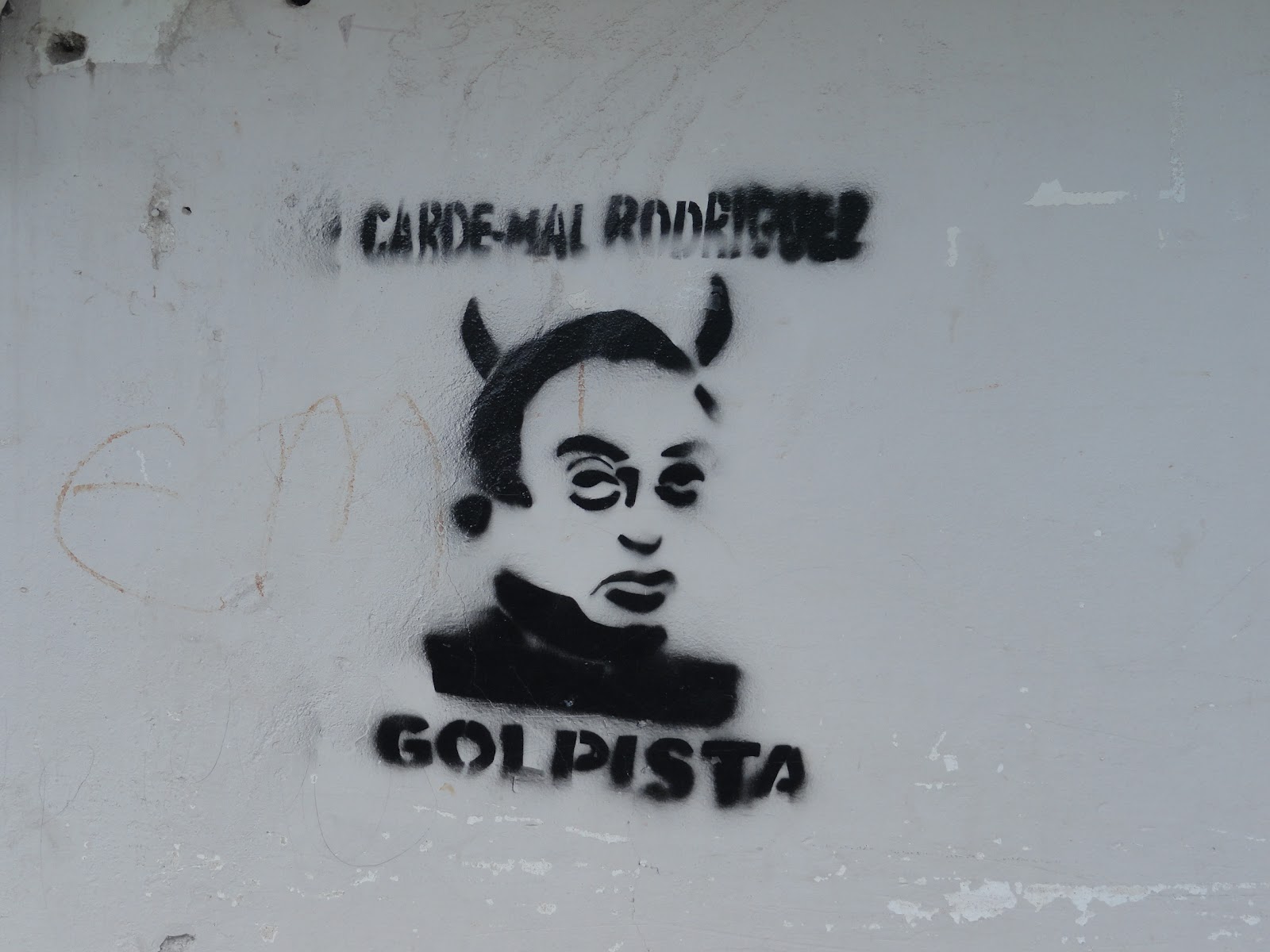
A few are insulting - and all addressed him as "cardemal" instead of "cardenal" - "mal" meaning evil in Spanish:


The first panel says: "Cardemal, neither forgetting nor pardoning."
The second says: "Cardemal, god of evil"


This is a rather offensive stencil that was popular just after the 2009 coup:  
"Carde-mal Rodriguez, coup supporter."


This one was on the wall of the Catholic radio station,
 just to the left of the one above:
 "Cardemal, the dead and disappeared because of the coup, 
we await you in the beyond."

But several offer some food for thought for all of us - not just the cardinal.
 

"Cardemal, violence will beget violence."

 "Cardemal, if the church does not serve the poor, it does not serve God."

These last two may be “the words of the prophets” written on the walls – a la Simon and Garfunkel.

 ---

The photos in this blog entry are copyrighted and may not be used without the explicit permission of the blogger.

Thursday, August 02, 2012

More contrasts in Honduras


Early Sunday morning I set out for Dulce Nombre to meet Padre Efraín.

As I drove out of Santa Rosa de Copán, I saw a BMW car full into a gas station. Shortly after I was passed by a Hummer. I was even more surprised when the Hummer took a left at the turn off to Dulce Nombre. I followed him for a while until I took the road to the center of town.

I am often surprised at the big, expensive cars here in Santa Rosa – especially lots of big new four wheel drive Toyotas and Nissans and any number of SUVs. I wonder where the money comes from. (Some suggest money laundering from drug-trafficking, though I think many are owned by people who make money from coffee and from construction.)

After meeting Padre Efraín in Dulce Nombre, he drove us out to the village of San José El Bosque for Mass.

At the Mass there were 35 baptisms and about 8 first communions. 


It was a nice celebration that squeezed several hundred people into a small church, though the singers could use a little help.


After Mass the people provided a meal for Padre Efraín, me, and René (who’s hoping to enter the major seminary next year). Of course, it was chicken and I declined.

(Being a vegetarian, declining meat so that the people here can eat it instead of me, is a little strange for them. But when I explain it in terms of solidarity – and not taking protein from the poor – it makes some sense to them.)

The town is poor, the road terrible, but the people welcomed us.

In fact, I got volunteered to go back there on August 26 to facilitate a confirmation retreat for the 65 or more that will be confirmed in September from this sector.

I’m looking forward and hoping the road is passable.

---

As we left, Padre Efraín and I talked with some of the leaders about finding ways to expand the church to accommodate more people from the sector, to use for special Masses and meeting.  A few hundred dollars for cinder blocks, tin roofing,  and cement would supplement the work and materials provided by the people.

Tuesday, July 31, 2012

Stirring the spark into flame


July 31 is the feast of St. Ignatius Loyola, founder of the Jesuits.

I have been blest to have studied in two Jesuit universities (the University of Scranton for my undergraduate degree and Boston College for my doctorate). 

I have also been privileged to have met some good Jesuits, one of my favorites was Father Dean Brackley, S.J. After the 1989 martyrdom of the six Jesuits at the San Salvador University of Central America (UCA), he joined their faculty. He died in October 2011 of pancreatic cancer.

One of Dean’s books, The Call to Discernment in Troubled Times, has been extremely significant for my life, particularly helpful as I discerned whether God was rally calling me to Honduras. (I heartily recommend the book, now available in Spanish translation from the UCA.)

In this book Dean wrote:

“The spirituality we associate with [St. Ignatius] is all about tending the flame in us, as it is purified, flourishes, or even flags, and stirring the fire in others.”

In 2003 I went to Peru with a group sponsored by Maryknoll and the Catholic Campus Ministry Association. In Cusco we met with some university students and I sad a few words to them. After the meeting ended, I approached a group of students and one asked me, “You have such chispa. How do you keep it up?” (Chispa  is Spanish for “spark.”)

My immediate answer – without even thinking – was: My contact with students and my direct contact with the poor, especially in El Salvador. As I reflected later, I would have to add that I also need daily time for quiet prayer in the morning

About a year later I was experiencing some conflicts in my ministry. I had sought out a spiritual director and told her that I felt that the spark in me was growing faint. In many ways I was asking the Lord to breathe on it and make it burn more strongly.

This brought to mind for me a passage from Isaiah 42: 3:

“A bruised reed he will not crush, nor will he snuff out a smoldering wick.”

My spiritual director and a counselor helped God restore the spark in me.

Now in Honduras I feel that God is keeping this spark alive, stirring it into flame, as I work with the poor.

I also see that God is working through me to help stir the fire in others. The last few weeks I have seen some marvelous advances in the lives and ministries of so many people in the Dulce Nombre parish. God is truly stirring the sparks into flame and I’ve been privileged to be part of this process.


Saturday, July 28, 2012

Alternatives to Violence Workshop


Violence plagues Honduras. 

The Catholic Bishops of the country have declared a campaign against violence


For the past few years Caritas Honduras has trained people from the Caritas diocesan offices in a process of Constructing Peace, Transforming Conflict. These workshops have been facilitated by Caritas Colombia staff, using materials from Caritas International, largely developed with the help of John Paul Lederach. (The manual in English, Peacebuilding: A Caritas Training, can be read or dowloaded here. Amazon has a page of the books of Lederach here.)

Thursday and Friday fifteen people – 13 from the parish and two from Santa Rosa’s Prison Ministry – participated in an Alternatives to Violence Project workshop in the parish of Dulce Nombre. 


I had attended a training in Gracias, Lempira, more than a year ago and had arranged another session in Santa Rosa.  I found the workshop very helpful, especially in terms of practices of nonviolence, since the workshop is very participatory.

The Alternatives to Violence Project started in the US when prisoners asked Quakers to help them develop ways to deal with the violence in prison as well as with youth beginning to come into conflict with the law.

What distinguishes AVP is its participative methodology, its commitment to nonviolence, and its ways of working on personal nonviolent responses to conflicts.
 
There is an emphasis on discovering and fostering the transformative power that each person has. I see this as based in the Quaker belief that “there is that of God in every person,” which the Catholics here in Honduras would probably better understand as based in our nature, “made in the image and likeness of God.”


A few months ago, thinking about the conflict in the parish and the violence in Honduras as a whole, I began to think about the possibility of a parish workshop. I asked Padre Efraín, the pastor, and he was enthusiastic.

There was some funding for workshops, provided for the workshops by the Dubuque Franciscans  to Sister Nancy in Gracias, Lempira. She agreed that this would be a good use of the funds.

Padre Efraín and I made a list of people who would be good for the workshop and to begin to have a team of parishioners who would help us develop a climate of nonviolent responses to conflict in the parish.


Though we had invited about 17 people I had no idea how many would come. I was hoping for at least ten, including the two women from the prison ministry. I was so glad when fifteen showed up.

The facilitators were women from San Pedro Sula and worked with a program of the Hermanas de la Misericordia there.

Though I was working on many details during the workshop, I was able to attend most of the sessions and I found this to be the best of the three workshops I had been in contact with.

What especially impressed me was the way the facilitators connected with the real life experiences of the people and also made connections to the national reality – the injustices, the structural violence, the poverty. 

It was refreshing to see that the workshop was reflective of a deep critique of the society and politics of Honduras.  This is not a way to avoid dealing with issues of justice, but a way of finding real alternatives to violence as steps on the way to build a society where all people can live a life of dignity.

At the end of the workshop, the facilitators asked if people might be interested in follow-up sessions. Almost all agreed and we set a date.

The facilitators also mentioned that there might be possibilities for advanced training for future facilitators. There were a number of people who were enthused about this option.

I am pleased that we will be able to advance in this process in the parish. I will probably also try to work with some of the people using some of the Caritas tools which are more oriented to analysis of conflict in order to transform situations that are prone to violence. Caritas methodology is participative but it is a little more “heady” than AVP’s approach. Both, I believe are needed, but the workshop we had today is an important first step.

Drawing their dreams for the future

May God use our efforts to help bring a bit more of peace with justice to Honduras, starting in the parish of Dulce Nombre.