These last four days have turned out to be quite an eventful weekend.
As usual on the second Friday and Saturday of the month I went out to two different zone meetings in the parish. It's not that I really do a lot there, but it’s important to show interest and to talk with the people. It’s also a good chance to listen to what people are doing.
On Friday a few people asked me for a ride from El Limón, where we had been meeting.
Two of them worked in the clinic in El Limón. I asked them about problems, especially among children: pneumonia and colds, most of all. I also asked whether any of the communities they worked with were part of the project for infants and mothers, financed by Catholic Relief Services and administered by the diocesan Caritas office. She told me proudly that it had made a difference in the one community, Prado de la Cruz, where none of the infants were below the standard weight.
By the time we got to Dulce Nombre only one person was left and he asked for a ride to Santa Rosa. René is a young man from Agua Buena, Concepción, very involved with the work of the church in his village and the parish. I asked him about his village and he was proud to speak about it. It’s small, only twenty families and all of them are Catholic. They have two base communities and three catechists. They do some work with the youth and all except one seem to be on the straight and narrow; the one, from what I surmise, needs a little encouragement. Most of the people have land for basic grains as well as some coffee. They are involved in the parish’s basic grains harvest and are working on family gardens. The one drawback is that though the coffee prices are higher than two years ago, they still probably aren’t getting the best prices. As René told me they get about 480 lempiras for a lata – about 29to 30 pounds of coffee beans with the pulp removed. That’s less than one dollar a pound. But it is still good to find a community that seems to be working together well.
Saturday it was raining by the time I got to El Zapote de Santa Rosa for the zone meeting there. Almost three days of rain made the area near the church very slippery and we spent a half an hour trying to get my pick up out of the mud – and I was in four wheel drive low! It finally worked when they got a rope and pulled it out of the mud. Ugh! But, again, the generosity of the people – getting muddy and exerting themselves for a stupid gringo who gets stuck in the mud!
 |
| Stuck in the mud in El Zapote |
The meeting was not very well-attended, which is unusual for this zone. I think it was a combination of the lousy weather and muddy roads as well as a meeting at the parish center in Dulce Nombre.
I left early (and almost got stuck again in some mud) and decided to stop for a short time at the meeting. The parish has had a basic grains, garden and fruit project for more than two years, financed by the Spanish Catholic organization, Manos Unidas. The project will go on until August but it has made a lot of difference in some communities.
 |
| Mauro, one of the team for the ag project, with yucca |
Today they were celebrating the successes of the project as well as awarding diplomas to those who had participated. (Here giving people a certificate at the end of a training is very important.)
 |
| Part of the crowd |
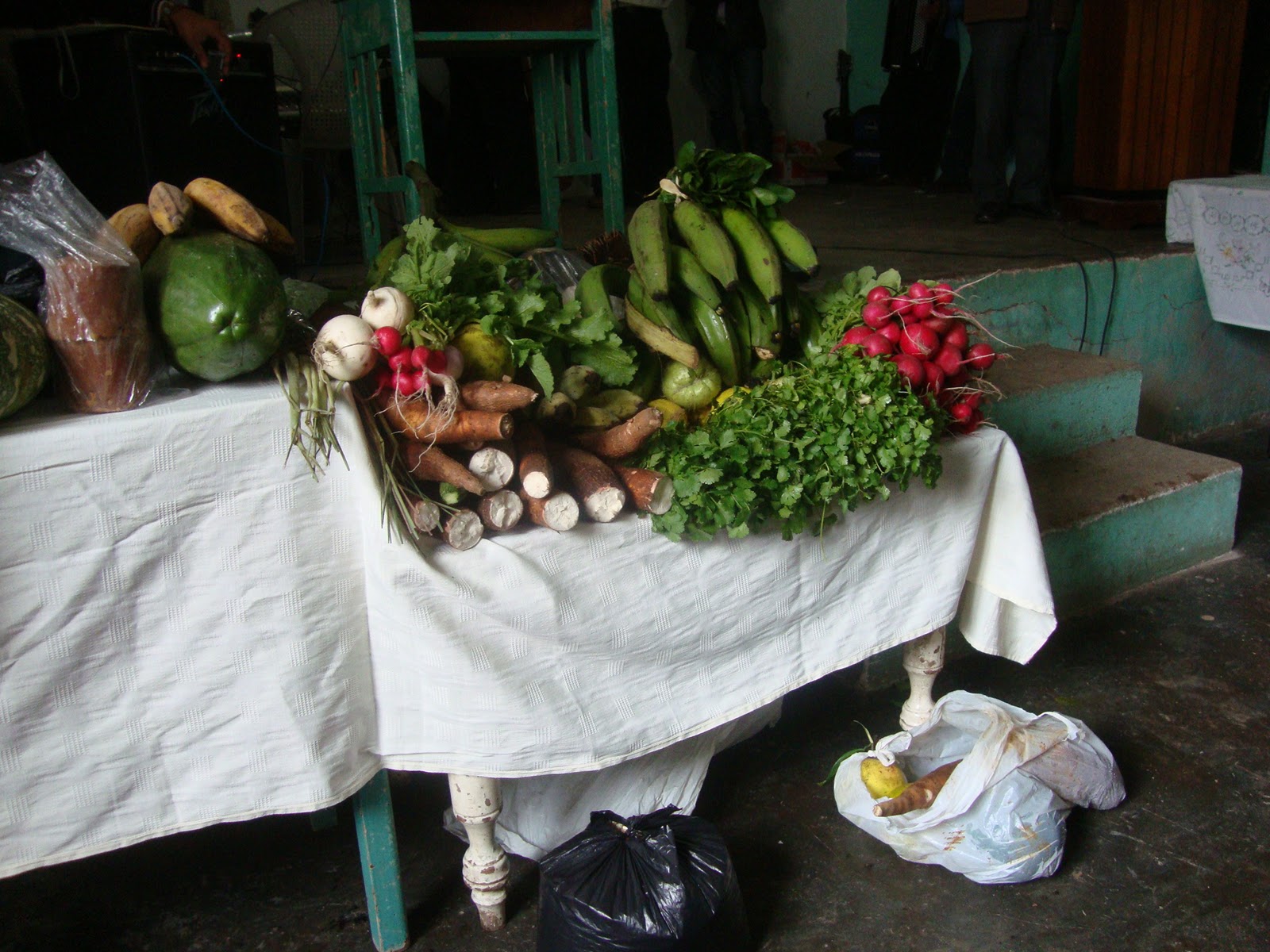
The parish hall was jammed with people. At the front was a table filled with some of the products they had produced. It was quite a diversity: plantains, yucca (cassava), papaya, squash, radishes, pataste, dulce de canela (raw sugar), oranges, tangerines, cilantro, mustard greens, green peppers, cabbage, and - what I never expected to find here – turnips. I’ll have to get some since one of the unusual dishes that my Aunt Mary used to serve at a post-Christmas meal my family often spent with them was mashed turnips.
 |
| How many of the products can you identify? |
I left the parish before lunch because I’d been asked to show up as “San Nicolas/Santa Claus” at the Christmas party of the Santa Rosa campus of the Catholic University. For the past three years the university has invited poor kids from the city to their celebration and provided them with a meal and gifts.
 |
| San Nicolás also showed up at the parish meeting. |
I arrived in the university parking lot in my muddy pickup wearing a red ISU hooded sweatshirt and a Santa Claus hat. I opened the door of the truck and at least twenty kids came running. “Santa, Santa,” they shouted, hugging and holding on to me.
There had been some miscommunication and there was already someone in a Santa costume, but that didn’t matter to the kids. A few asked me if I was Santa – I said I was his helper. That made sense.
I stayed around for a while as the kids broke open piñatas and dived for the candy. Then as they left the kids were given a small gift.
It’s good that something is done for these kids – at least once a year.
Saturday evening I had another surprise. Sister Nancy Meyerhofer. who ministers in Gracias with another Dubuque Franciscan, called. Returning from giving retreats in Guatemala she wouldn’t get to Santa Rosa in time for a bus to Gracias. So she came late and stayed until she got the 5:30 am bus on Sunday. We had a nice visit – a good ending to a full day.
I thought Sunday would not be a very busy day. I slept in till 8:15 (after getting up and taking Nancy to the 5:30 am bus). I washed clothes and did some grocery shopping.
In the afternoon I headed for Dolores where Bishop Santos consecrated the altar and installed the 17 extraordinary ministers of Communion for the parish and two who are now members of the parish of San Juan Bosco. It was a very important day for these men and women who’ve spent two years in the formation process.
The Mass was supposed to start at 5 pm, but people came early and music groups were playing in the church.
At about 5:00 pm most of the people went to place about half a kilometer from the church to greet the bishop when he entered town.
 |
| Waiting for Monseñor Santos |
The bishop arrived about 5:30 pm. He got out of the truck and walked with the people to the church led by a band from the local school. As he entered the church he was warmly greeted.
It is obvious that he is loved by the people.
 |
| Monseñor Santos entering the church in Dolores |
For a number of reasons the Mass didn’t begin until 7 pm.
 |
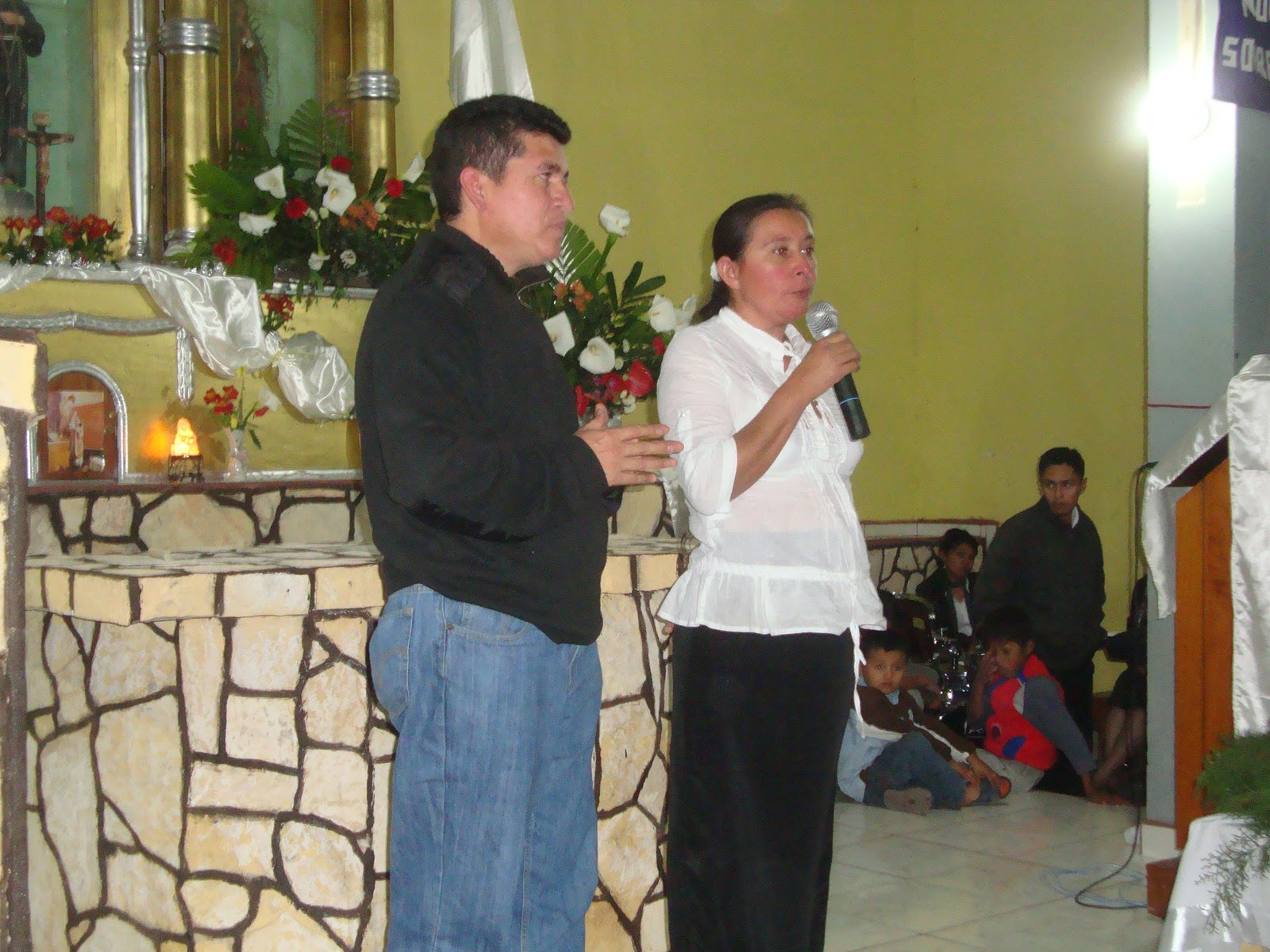
| The ministers were introduced before Mass: Padre Efraín introduces Gloria from Plan Grande |
Mass was an incredible two and a half hour liturgy. Though my camera broke partway through the Mass, I did get two pictures of most of the communion ministers waiting for the opening procession.
 |
| five women extraordinary ministers of Communion |
 |
| Thirteen of the men extraordinary ministers of Communion |
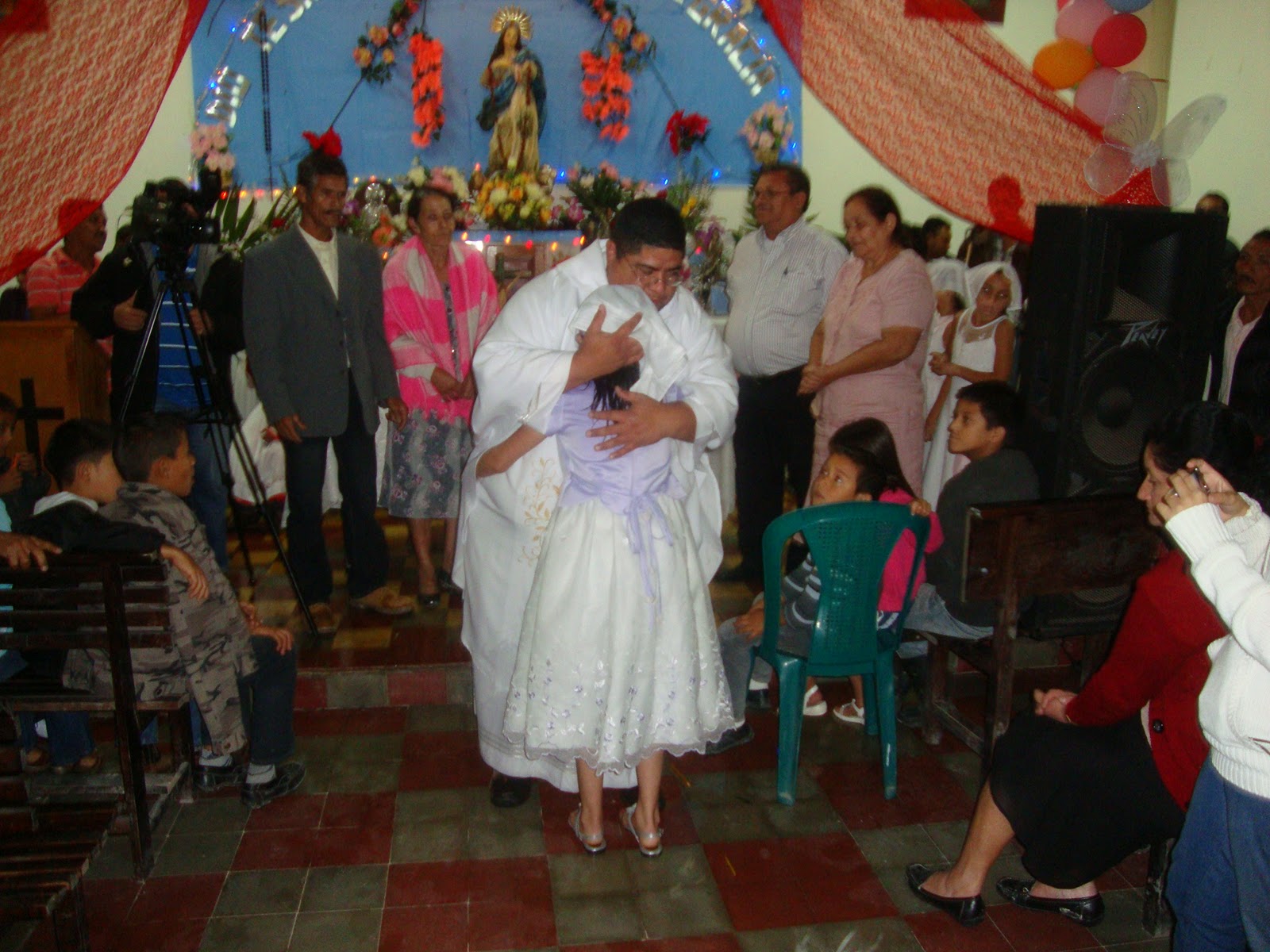
The consecration of an altar is an impressive rite. The bishop anoints the altar with chrism and then lights a fire (in a pan) on top of the altar. Incense is liberally sprinkled over the coals. Candles for the communion ministers were lighted from the fire which was a very symbolic gesture - since they will be distributing the Eucharist, consecrated on altars such as this one.
 |
| Bishop Santos and Padre Efraín leading the Litany of the Saints during the consecration of the altar |
After Mass I left, but not before Padre Efraín had asked me to drive one of the music groups – Los Lirios del Campo, the lilies of the field – to their distant village. It was late, about 10 pm, and I don’t like to drive at night, because it would have been a very long walk for them.
But it ended up being a very long night for the four of them and me. Going up a hill about 25 minutes from Dulce Nombre the car stalled and wouldn’t start. I tried to back it down the hill but got the car stuck in a ditch.
What did we end up doing? We tried to sleep in the car. I urged them to go home (about 45 minutes walking) but they insisted on staying and accompanying me. (The care these people take of crazy gringos like me is humbling.) It was not comfortable trying to sleep in the truck!
About 5:30 they ended up going on the way – and told me they’d send someone with breakfast. I told them I’d call my mechanic and see what he could do.
Well, several trucks passed by taking people to harvest coffee. One of them came back and tried to jump start the car. No luck. After talking with my mechanic in Santa Rosa I decided I’d try to contact a mechanic in Dulce Nombre and got a ride back to El Limon with Antonio, a coffee farmer with about 27 manzanas, about 45 acres. His wife gave me coffee and offered me breakfast as he and I tried to connect with a mechanic. No luck by phone, but a bus passed by and I took it to Dulce Nombre.
On the bus I sat next to a man and his son from El Limon. He tried to pay my bus fare – but I gave him the 20 lempiras (about $1.15).
I found a mechanic and we went to check out the car. The battery he brought ended up being not as powerful as needed and so, after a passing group helped push the car to turn it around, we push started the car. And what did he charge? 100 lempiras, a little more than five dollars. I couldn’t believe how cheap it was for his time and his fuel and gave him an over-generous tip.
Finally I got to Santa Rosa and went to the mechanic who works on vehicle electric systems. Sure enough, a major problem – a short circuit burnt out the alternator. Another expense.
In all this, I do feel somewhat jinxed in terms of the car. But above all, I feel a deep gratitude for the care of the people, which for me is the sign of God’s love.
I felt really awful trying to sleep in the car, but a prayer came to my heart that consoled me and gave me strength: “Me amas, Señor Jesús – You love me, Lord Jesus.”
As I reflect, the Lord was shown to me this weekend by many people – people with love for God and others, people willing to go out of the way to help, people who have made deep commitments to God and to the community.
 |
| Singing at Mass in Dolores |
Thanks, God. This is what Advent is about – waiting in hope, being awake for the signs of God’s breaking into our lives in so many ways.








 Posts
Posts

