A small group from St. Thomas Aquinas Church in Ames is visiting here for about about ten days. It’s different from some other groups since it includes two undergraduates, a graduate student in agricultural and bio-systems engineering who is from Uruguay, and a professor of agricultural engineering from Iowa State University.
Last night we sat down over a dinner of bread, cheese, and fruit to talk about the day and our experiences. I invited a young Honduran just finishing his industrial engineering degree at the Catholic University who is also very involved in his parish here in Santa Rosa de Copán.
After a bit of talking about everything – including soccer, of course, as well as his hopes to sometime study for a masters degree outside Honduras – he suggested we talk about politics. Great, I thought. Then he proceeded to ask the group about the recent British elections. Whoa! He revealed that he is very well read on international politics and recent news.
After a bit, I asked him to talk about Honduras. He expressed his concerns about corruption, the problems of the two main parties, his opposition to the coup, his analysis of former president Zelaya (He’s not very smart – but we don’t get smart people elected here. But at least he was trying to do something for the poor.)
But then he spoke of his concerns about the Lobo government, especially concerns that many have that the government will privatize Hondutel, the public phone company, and other publicly-owned enterprises.
That was, I think, a surprise to the professor and the grad student. The professor spoke of the commonly held belief in the US that competition will lower prices. The grad student, more knowledgeable of the state of “capitalism” in Latin American countries, mentioned that the private sphere is generally more efficient that the public sphere.
The discussion went in many directions at that point. I pointed out that in Honduras it’s not capitalism as in the US – it’s feudal capitalism, in a sense. The Honduran student spoke of the ten or fifteen families who own most of Honduras. I found an article by Leticia Salomon where she listed the coup supporters who own most of the private enterprises and communications media and read a few of the companies or franchises owned by the ruling elite.
But one thing the Honduran student said was critical and easily missed. One of his main concerns about the privatization of Hondutel as well the mining industry is that they take so much and give so little to Honduras. He expressed it in terms of not giving much to the Honduras government, but his concern was that these people and these companies do not contribute to the common good.
Whether they are efficient is another question, but questions of mere efficiency miss the critical point he was trying to make. Honduras is largely being used for personal and corporate profit – not for its good.
I need to return and reflect more on that conversation in the next few weeks, but the Honduran student’s remarks helped me analyze Honduras a little differently and how hard it sometimes is to see what is behind the anti-privatization thinking here.
The concern is that the common good – and the needs of the poorest – are being sacrificed for the enrichment of a few.
But as Pope John Paul II once said, “The needs of the poor take priority over the desires of the rich.”
Wednesday, May 19, 2010


Sunday, May 16, 2010
Signs of resurrection
I spent Holy Week in the town of Vera Cruz, which is the main town in the municipality. It is a very poor municipal seat. The only businesses are pulperias (little mom and pop grocery stores) and two businesses that sell liquoir! There is a school up to the 9th grade but kids have to go to Santa Rosa or other towns for the Honduran equivalent of high school. Housing is poor and malnutrition is a real problem. It is a sad place and I felt the sadness during Holy Week – even in terms of the way people celebrated the liturgies. In some ways, I was shaken by the experience and it didn’t feel a lot like Easter.
This past weekend I was back, with Casey Young and Steve Nicoll from the West Des Moines Christian Church (Disciples of Cross) which is considering helping Vera Cruz rebuild its church, which is falling into ruins.
Casey knows the pastor of the Dulce Nombre parish, Padre Efraín Romero, from Casey’s time as a Peace Corps workers in San Luis, Santa Barbara, where Padre Efraín was before coming to Dulce Nombre.
What is unique, for Honduras, is that a Protestant church will be helping build a Catholic Church.
On Saturday, Padre EFraín, Casey and Steve, and I net with about 40 people from Vera Cruz in the church. The mayor and the vice mayor were there as well as many of the people who have roles in the church and the church community council. The people were quite attentive as the possibility of receiving help with the church was explained. A critical question was whether to repair the church or to tear it down and build a new church..
The mayor and others spoke of building a new church. Steve was very attentive and, as a sort of devil’s advocate, asked whether there might be feeling attached to the old church, which is sort of colonial in style. The people seemed in favor and the mayor asked for a vote. At that moment Doña Albertina rose and raised her hand to be recognized. I wondered whether she might have some real reservations since she does so much to clean the church and prepare it for services. But, no. She was the first to make known her rousing support for building a new church.
It was a sort of a resurrection experience. The people were animated at the chance of a new church and the fact that another church, a US Protestant church, was willing to help. Other hopes about development of the community were shared. It seemed like a new day.
Sunday morning I went back with Casey and Steve for the Celebration of the Word in Vera Cruz. There seemed to be a different spirit. The singing wasn’t all that good – but many joined in. Teodoso was back a one of the celebrators of the Word and Nelson came again from El Ocote to help in the celebration.
They asked me to read the Gospel before the celebration began. But as the second reading was being read, Nelson asked me to preach. Thanks be to God I had reflected on the readings during my morning prayer.
Today the Church here celebrates the Ascension, when Christ bodily ascends into heaven. I made a lot of points – which I can’t remember at this moment. But I recalled that Christ is no longer bodily with us. He had promised to send the Spirit to the community of disciples. Now the Church is the Body of Christ in history.
We are the Church, I reminded the people. We are called to renew the church. In Vera Cruz the challenge is to rebuild the church in two senses – the physical building, the templo, as they sometimes call it here, as well as the church, the Body of Christ. We are called to rebuild and renew both.
As I write this I recall the story of Saint Francis’ conversion experience in the church of San Damiano outside of Assisi. Francis, worn out from the experience of being a prisoner of war, is in some way trying to figure out what to do with his life.
As he prays before the Byzantine style crucifix he hears a voice: “Francis, rebuild my house, which, as you see, is falling into ruins.”
Francis proceeded to do just that. This dandy becomes a worker, hauling stones and rebuilding the church with his own hands. When I visited Assisi in 1973 I met a English-speaking Franciscan at the Church of San Damiano who said that Francis was doing exactly what he needed to do at that time. Francis was emotionally fragile and need physical work to pull him out of his depression and help him figure out where God was calling him. That seems such a good interpretation of the event.
A little bit later that day I went up to the grand basilica of Saint Francis and heard a Conventual Franciscan priest explained to a crowd of pilgrims that Francis got it wrong, at first. The call was to rebuild the church spiritually. At that moment – and even now – I think that priest got it wrong. Francis needed the physical labor at that time in his life.
And so, the work of rebuilding the church is two-fold – spiritual and material. We are body and soul. We are called to grow by loving God and loving our neighbor.
As Teodoso reminded us at that celebration, it’s two-fold – praying to God and working at it. The phrase used here is “a Dios rogando y con el mazo dando” – pray to God and work like mad – literally, hit it with a mallet.
This past weekend I was back, with Casey Young and Steve Nicoll from the West Des Moines Christian Church (Disciples of Cross) which is considering helping Vera Cruz rebuild its church, which is falling into ruins.
Casey knows the pastor of the Dulce Nombre parish, Padre Efraín Romero, from Casey’s time as a Peace Corps workers in San Luis, Santa Barbara, where Padre Efraín was before coming to Dulce Nombre.
What is unique, for Honduras, is that a Protestant church will be helping build a Catholic Church.
On Saturday, Padre EFraín, Casey and Steve, and I net with about 40 people from Vera Cruz in the church. The mayor and the vice mayor were there as well as many of the people who have roles in the church and the church community council. The people were quite attentive as the possibility of receiving help with the church was explained. A critical question was whether to repair the church or to tear it down and build a new church..
The mayor and others spoke of building a new church. Steve was very attentive and, as a sort of devil’s advocate, asked whether there might be feeling attached to the old church, which is sort of colonial in style. The people seemed in favor and the mayor asked for a vote. At that moment Doña Albertina rose and raised her hand to be recognized. I wondered whether she might have some real reservations since she does so much to clean the church and prepare it for services. But, no. She was the first to make known her rousing support for building a new church.
It was a sort of a resurrection experience. The people were animated at the chance of a new church and the fact that another church, a US Protestant church, was willing to help. Other hopes about development of the community were shared. It seemed like a new day.
Sunday morning I went back with Casey and Steve for the Celebration of the Word in Vera Cruz. There seemed to be a different spirit. The singing wasn’t all that good – but many joined in. Teodoso was back a one of the celebrators of the Word and Nelson came again from El Ocote to help in the celebration.
They asked me to read the Gospel before the celebration began. But as the second reading was being read, Nelson asked me to preach. Thanks be to God I had reflected on the readings during my morning prayer.
Today the Church here celebrates the Ascension, when Christ bodily ascends into heaven. I made a lot of points – which I can’t remember at this moment. But I recalled that Christ is no longer bodily with us. He had promised to send the Spirit to the community of disciples. Now the Church is the Body of Christ in history.
We are the Church, I reminded the people. We are called to renew the church. In Vera Cruz the challenge is to rebuild the church in two senses – the physical building, the templo, as they sometimes call it here, as well as the church, the Body of Christ. We are called to rebuild and renew both.
As I write this I recall the story of Saint Francis’ conversion experience in the church of San Damiano outside of Assisi. Francis, worn out from the experience of being a prisoner of war, is in some way trying to figure out what to do with his life.
As he prays before the Byzantine style crucifix he hears a voice: “Francis, rebuild my house, which, as you see, is falling into ruins.”
Francis proceeded to do just that. This dandy becomes a worker, hauling stones and rebuilding the church with his own hands. When I visited Assisi in 1973 I met a English-speaking Franciscan at the Church of San Damiano who said that Francis was doing exactly what he needed to do at that time. Francis was emotionally fragile and need physical work to pull him out of his depression and help him figure out where God was calling him. That seems such a good interpretation of the event.
A little bit later that day I went up to the grand basilica of Saint Francis and heard a Conventual Franciscan priest explained to a crowd of pilgrims that Francis got it wrong, at first. The call was to rebuild the church spiritually. At that moment – and even now – I think that priest got it wrong. Francis needed the physical labor at that time in his life.
And so, the work of rebuilding the church is two-fold – spiritual and material. We are body and soul. We are called to grow by loving God and loving our neighbor.
As Teodoso reminded us at that celebration, it’s two-fold – praying to God and working at it. The phrase used here is “a Dios rogando y con el mazo dando” – pray to God and work like mad – literally, hit it with a mallet.
Saturday, May 08, 2010
The wisdom of the campesinos
Cementera
Last Thursday I went to the village of Cementera where Caritas has a project on Community-based management of natural disasters. A team from El Salvador that is teaching the people how to make videos was having their second training day.
I’ve been to Cementera several times and know a few folks there, but this was different. Most of the twenty-some persons in the video production training are under twenty.
They had been divided into three teams to treat themes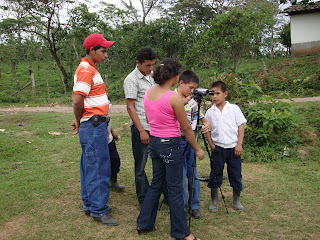 they chose – reforestation, the medicinal qualities of the orange tree, and preserving forest animals. It was amazing to watch them filming their community and trying to learn how to make short documentaries.
One thing that struck me was the enthusiasm of a number of the young people including Erlin who has one year left to finish high school, the two brothers Miguel and Denis, and eight year old Lenin.
But I also noticed how timid some of the young people are, especially the girls, as well as how hard it was for some of them to answer some basic questions on what had been explained to them the day before. I attribute the former to the low self-esteem that many people in the countryside suffer from since the poor are often looked down upon. The difficulty to answer basic questions is, I believe, due to the inadequacies of the Honduras educational system, where memorization is the preferred method of teaching and where many young people don’t go past the sixth grade.
But this community disaster management project can help with many things - not just how to deal with disasters. It's helping them take charge of their lives and value their dignity.
But it is also not just a project from institutions outside; it touches some of the wisdom that comes from within the community. Anselmo, the oldest person taking part the workshop, mentioned how his father who never had a training session but said that they had to leave a certain group of trees untouched, because “tree give life.” The wisdom of the ancients – at times, lost – need to be recovered. Projects like this may help that process.
Intellectual discussions
One thing I have missed here is the opportunity for many stimulating intellectual discussions. I don’t have many. Partly this may be due to the limitations of my Spanish, but I also have not met many people who really like these types of discussions. (I had one today over lunch with a young grad student from the U.S. doing research in Copán Ruinas.)
But during the Catholic Social Teaching workshop I facilitated for people from the rural sector of the cathedral parish I had one of the best intellectual discussions I’ve had for a long time. We spent over an hour trying to understand what social sin is. It was, fro me, a profound experience of real intellectual dialogue. But here’s the most important part. Of the twelve participants in the workshop there was only one professional, a retired teacher. My guess is that most of the others had less than six years formal education.
But it was a great discussion and I learned a lot from them and their wisdom.
The wisdom of the poor!
Last Thursday I went to the village of Cementera where Caritas has a project on Community-based management of natural disasters. A team from El Salvador that is teaching the people how to make videos was having their second training day.
I’ve been to Cementera several times and know a few folks there, but this was different. Most of the twenty-some persons in the video production training are under twenty.
They had been divided into three teams to treat themes
 they chose – reforestation, the medicinal qualities of the orange tree, and preserving forest animals. It was amazing to watch them filming their community and trying to learn how to make short documentaries.
One thing that struck me was the enthusiasm of a number of the young people including Erlin who has one year left to finish high school, the two brothers Miguel and Denis, and eight year old Lenin.
But I also noticed how timid some of the young people are, especially the girls, as well as how hard it was for some of them to answer some basic questions on what had been explained to them the day before. I attribute the former to the low self-esteem that many people in the countryside suffer from since the poor are often looked down upon. The difficulty to answer basic questions is, I believe, due to the inadequacies of the Honduras educational system, where memorization is the preferred method of teaching and where many young people don’t go past the sixth grade.
But this community disaster management project can help with many things - not just how to deal with disasters. It's helping them take charge of their lives and value their dignity.
But it is also not just a project from institutions outside; it touches some of the wisdom that comes from within the community. Anselmo, the oldest person taking part the workshop, mentioned how his father who never had a training session but said that they had to leave a certain group of trees untouched, because “tree give life.” The wisdom of the ancients – at times, lost – need to be recovered. Projects like this may help that process.
Intellectual discussions
One thing I have missed here is the opportunity for many stimulating intellectual discussions. I don’t have many. Partly this may be due to the limitations of my Spanish, but I also have not met many people who really like these types of discussions. (I had one today over lunch with a young grad student from the U.S. doing research in Copán Ruinas.)
But during the Catholic Social Teaching workshop I facilitated for people from the rural sector of the cathedral parish I had one of the best intellectual discussions I’ve had for a long time. We spent over an hour trying to understand what social sin is. It was, fro me, a profound experience of real intellectual dialogue. But here’s the most important part. Of the twelve participants in the workshop there was only one professional, a retired teacher. My guess is that most of the others had less than six years formal education.
But it was a great discussion and I learned a lot from them and their wisdom.
The wisdom of the poor!
Monday, May 03, 2010
WORK
While Labor Day is celebrated in the US on the first Monday of September, most of the world celebrates May 1 as the Day of the Worker. What is ironic is that the celebration of international workers day has its origins in the Haymarket Square massacre in Chicago in 1886.
As I mentioned in my last blog entry, I spent Labor Day with 12 campesinos in a workshop on Catholic Social Thought. One of the themes we treated was work.
I began the section on work with an activity. We stood in a circle and each person had to mime an activity from their daily labor. It was fascinating to see them mime planting, hoeing, sweeping, making tortillas, sawing, and more.
I then asked them what work they liked to do. One young woman told us she liked to sweep because she liked to have a clean house. Another told us she liked to make bread which she sells.
What I found refreshing was that they liked their work. They enjoyed basic manual labor, the daily tasks to sustain their lives.
When asked why they worked, the answers included:
For me, the contrast between the satisfaction these people derived from their work and the grand injustices workers suffer is stunning – and, of course, unjust!
As I mentioned in my last blog entry, I spent Labor Day with 12 campesinos in a workshop on Catholic Social Thought. One of the themes we treated was work.
I began the section on work with an activity. We stood in a circle and each person had to mime an activity from their daily labor. It was fascinating to see them mime planting, hoeing, sweeping, making tortillas, sawing, and more.
I then asked them what work they liked to do. One young woman told us she liked to sweep because she liked to have a clean house. Another told us she liked to make bread which she sells.
What I found refreshing was that they liked their work. They enjoyed basic manual labor, the daily tasks to sustain their lives.
When asked why they worked, the answers included:
- If you don’t work, you don’t eat.
- To entertain ourselves.
- To relieve stress
- To maintain the family
- Because I like to be able to buy what I want, to have my own things
- To serve
- To earn some money
- It’s an obligation.
All work has a threefold moral significance. First, it is a principal way that people exercise the distinctive human capacity for self-expression and self-realization. Second, it is the ordinary way for human beings to fulfill their material needs. Finally, work enables people to contribute to the well-being of the larger community. Work is not only for oneself. It is for one's family, for the nation, and indeed for the benefit of the entire human family.We talked a bit about the ideal of work – how it is sharing in the creation of God. But we also discussed how work can be degrading. Here the list was long – and revealing.Economic Justice for All, # 97, italics mine
- Salaries are insufficient for a decent life.
- There aren’t enough sources of work.
- It’s hard to find stable, ongoing work.
- Workers are looked down on.
- Mistreatment
- Violation of human rights, including the right to form unions.
- Agricultural products don’t get a good price
- There are not good markets for campesinos
- The middle men buy products at a low price
- Inputs (like fertilizer and seeds) are expensive
- At times people are not paid on time
For me, the contrast between the satisfaction these people derived from their work and the grand injustices workers suffer is stunning – and, of course, unjust!
Sunday, May 02, 2010
Workshops
Last Friday and Saturday I was busy with two workshops, where I was the major presenter – all in Spanish. (These people are really tolerant of my butchering of their language.)
The workshop for catechists began Friday morning in the Dulce Nombre parish. There were two locations for the workshop which lasted until noon Saturday. But I was only helping with the Friday morning session in Dulce Nombre.
On Monday Padre Julio César had suggested that I do something on the role of the catechist. I searched and searched and even asked help from Kathy White, the Director of Religious Education at St. Thomas Aquinas in Ames. She sent me lots of good resources, but I found a prepared program from the US bishops in Spanish which I adapted.
As almost always I am overwhelmed by these people.
It was a small group – 22; they had expected 30. But many had come from distant villages, walking hours or finding a ride on the back of a pick up for an hour.
During the workshop some people shared how they became catechists. Dilia recounted how her older sister had been a catechist and so she wanted to do the same. After her first communion she started and has been a catechist for 14 years. She loves it and, she said, when she doesn’t teach a class on Sunday she feels a void in her life.
 At the end of my presentation the catechists were invited to write a letter to Jesus expressing their commitment as catechists. Two women are illiterate and so I said they could draw or do whatever; God will read whatever is in your heart. But I was especially struck by an elderly catechist who I presume can read but can’t write very well. Her grandson, who was with her, wrote her letter as she dictated her thoughts to him. It was touching to see them working together.
I left about three o’clock to get to the other workshop that weekend. The priests at the cathedral parish in Santa Rosa had asked me to do a workshop on Catholic Social Teaching for the leaders of the social ministry in the rural sector of the parish. I gladly agreed.
But I worked my tail off. I know Catholic Social Teaching but choosing what to emphasize in two days and preparing it in a way that would be understandable were challenges. The day before the workshop I finally had the booklet prepared, but of course I didn’t use it exactly during the workshop.
They had expected 30 people but only 12 arrived. As a result we truncated the workshop to finish at 5:30 on Saturday instead of 1:00 on Sunday.
But what a group it was. What fun I had and I learned an awful lot from them.
The workshop was in progress when I arrived about 4. They were in middle of an intense discussion about the reality of Honduras with Ismael Garcia, a Caritas staff person. It was a heated discussion at times, especially when they talked about the role of the church. Some were concerned about the divisions in the church after the coup. Some were concerned that many of the lay people were not listening to the diocesan priests and the bishop, especially in regard to their opposition to the coup. That discussion could have gone on the whole weekend. But Father Henry, the associate pastor of the cathedral, suggested we move on.
And so I began my work, facilitating the sessions, using a popular education approach – lots of activities, questions and activities but not much lecturing.
There were a few things that struck me. One was the difficulty of understanding social sin and sinful social structures. I thought I knew what these are and could explain them. But they are not so easy to explain. We finally got around to using examples to help understand them. These helped me to distinguish between sins that have social consequences, sins that are social by nature (sins against justice and peace) , and structures of sin. I’m beginning to think that structures might also be discussed as cultures or customs of sin. They allow sin to take place, or encourage sins to take place, or make goodness difficult.
I had prepared a booklet – which I will be updating and working on – especially this section on Social sin. But the extended discussion we had really helped me clarify my thoughts. I couldn’t get to sleep right away after that discussion (partly due to dive-bombing insects where I was sleeping) and had time to work out a formulation which I shared with the participants the next morning. They had really helped me. (The poor are great teachers!)
 We had morning prayer at 6:30 in the chapel where we were staying. Saturday was May 1, Labor Day, for almost all the world. (There were marches for labor rights and in support of the resistance throughout Honduras and there were marches in support of immigrant rights in the US!) The Catholic Church has taken advantage of this and made May 1 the feast of St. Joseph the Worker.
And so we reflection on the gospel for the feast, Matthew 13: 54-58: Jesus returns to his home town of Nazareth where his authority is questioned since his father was a carpenter among them.
I was deeply moved at the reflections – especially as I noted the image of Jesus the worker on the wall of the chapel: Jesus is there with his hoe and machete. I could not help recall the hymn from the Nicaraguan Campesino Mass: “Vos sos el Dios de los pobres.”
I suggested we end our reflection with the hymn, which they sang heartily, though off-key.
That day, after we worked on the basic principles we treated two major themes, work and the land: work which was appropriate for the day and land, which was appropriate for these people, campesinos.
Talking about caring for creation I mentioned ecological agricultural practices. But I was challenged – a challenge I had partly anticipated - by Rigo, one of the participants ,who informed me that many campesinos work on rented land and therefore it makes no sense for them to initiate expensive practices which won’t benefit them in the future. I was partly ready for this since the next theme was the unjust distribution of the land, but I was surprised at the responses to the informal poll I took. Not a single one of the seven men who farmed worked on land they owned. Three had some land where they planted coffee but not one of them had their own land to plant the basic crops of corns and beans. They have to rent the land – for about $105 a manzana (1.68 acres). Thus there is no incentive for long-term improvements to the land.
After this dicussion, I changed a bit what I had planned to do in this section and shared the story of Naboth’s vineyard in 1 Kings 21. The king wants Naboth’s land but Naboth doesn’t want to sell it because it’s been in his family for ages. So the queen arranges to have Naboth killed and the prophet Elijah comes in and chews them out in very strong terms. We reflected how this is related to the situation here. In most of the villages where these people live just a few families own most of the land; in addition, large land owners have come in and cut down forests so they can graze cattle. Land grabbing is the norm – not sharing the goods of the earth.
After this I shared with them the strong statements of the church for land reform, but I know that is a long-term struggle here in Honduras. And I'm not sure how many people in the church are willing to stake their lives struggling for this.
At the end of the workshop we came back to the theme of politics and the right and duty of all to participate in politics (in the broad sense) to promote the common good. We got back to the question of the church and political opinions. Rigo again impressed me as he spoke of the need for the laity to speak their mind. It was encouraging to hear someone with a critical consciousness.
The workshop ended with Mass and I left wishing we had had more time. They were so much fun to be with and I wish I could get to know them more. (But at Mass Father Henry encouraged them to invite me when they replicate the workshops in their sectors of the parish.)
They are probably not a representative group since they are involved in the social ministry in their rural villages, though one woman told me that before the workshop she had thought of social ministry almost exclusively in visiting the sick.
On a personal note, I was very pleased that during the evaluation they liked the methodology we used. I guess I managed to find a few good ways to get the message across. They also thought I was clearer than some presenters they’ve had – even though they suffered my grammatical errors. At one point we laughed when I spoke of the holy potato (la papa) instead of the pope (el papa), an error I quickly corrected!
I returned home exhausted but feeling very blessed.
The workshop for catechists began Friday morning in the Dulce Nombre parish. There were two locations for the workshop which lasted until noon Saturday. But I was only helping with the Friday morning session in Dulce Nombre.
On Monday Padre Julio César had suggested that I do something on the role of the catechist. I searched and searched and even asked help from Kathy White, the Director of Religious Education at St. Thomas Aquinas in Ames. She sent me lots of good resources, but I found a prepared program from the US bishops in Spanish which I adapted.
As almost always I am overwhelmed by these people.
It was a small group – 22; they had expected 30. But many had come from distant villages, walking hours or finding a ride on the back of a pick up for an hour.
During the workshop some people shared how they became catechists. Dilia recounted how her older sister had been a catechist and so she wanted to do the same. After her first communion she started and has been a catechist for 14 years. She loves it and, she said, when she doesn’t teach a class on Sunday she feels a void in her life.
 At the end of my presentation the catechists were invited to write a letter to Jesus expressing their commitment as catechists. Two women are illiterate and so I said they could draw or do whatever; God will read whatever is in your heart. But I was especially struck by an elderly catechist who I presume can read but can’t write very well. Her grandson, who was with her, wrote her letter as she dictated her thoughts to him. It was touching to see them working together.
I left about three o’clock to get to the other workshop that weekend. The priests at the cathedral parish in Santa Rosa had asked me to do a workshop on Catholic Social Teaching for the leaders of the social ministry in the rural sector of the parish. I gladly agreed.
But I worked my tail off. I know Catholic Social Teaching but choosing what to emphasize in two days and preparing it in a way that would be understandable were challenges. The day before the workshop I finally had the booklet prepared, but of course I didn’t use it exactly during the workshop.
They had expected 30 people but only 12 arrived. As a result we truncated the workshop to finish at 5:30 on Saturday instead of 1:00 on Sunday.
But what a group it was. What fun I had and I learned an awful lot from them.
The workshop was in progress when I arrived about 4. They were in middle of an intense discussion about the reality of Honduras with Ismael Garcia, a Caritas staff person. It was a heated discussion at times, especially when they talked about the role of the church. Some were concerned about the divisions in the church after the coup. Some were concerned that many of the lay people were not listening to the diocesan priests and the bishop, especially in regard to their opposition to the coup. That discussion could have gone on the whole weekend. But Father Henry, the associate pastor of the cathedral, suggested we move on.
And so I began my work, facilitating the sessions, using a popular education approach – lots of activities, questions and activities but not much lecturing.
There were a few things that struck me. One was the difficulty of understanding social sin and sinful social structures. I thought I knew what these are and could explain them. But they are not so easy to explain. We finally got around to using examples to help understand them. These helped me to distinguish between sins that have social consequences, sins that are social by nature (sins against justice and peace) , and structures of sin. I’m beginning to think that structures might also be discussed as cultures or customs of sin. They allow sin to take place, or encourage sins to take place, or make goodness difficult.
I had prepared a booklet – which I will be updating and working on – especially this section on Social sin. But the extended discussion we had really helped me clarify my thoughts. I couldn’t get to sleep right away after that discussion (partly due to dive-bombing insects where I was sleeping) and had time to work out a formulation which I shared with the participants the next morning. They had really helped me. (The poor are great teachers!)
 We had morning prayer at 6:30 in the chapel where we were staying. Saturday was May 1, Labor Day, for almost all the world. (There were marches for labor rights and in support of the resistance throughout Honduras and there were marches in support of immigrant rights in the US!) The Catholic Church has taken advantage of this and made May 1 the feast of St. Joseph the Worker.
And so we reflection on the gospel for the feast, Matthew 13: 54-58: Jesus returns to his home town of Nazareth where his authority is questioned since his father was a carpenter among them.
I was deeply moved at the reflections – especially as I noted the image of Jesus the worker on the wall of the chapel: Jesus is there with his hoe and machete. I could not help recall the hymn from the Nicaraguan Campesino Mass: “Vos sos el Dios de los pobres.”
You are the God of the poor,
a God human and simple,
a God who sweats in the street,
with a tanned face;
that’s why I am talking with you
as I talk with my people,
because you are a worker God,
Christ the worker.
You walk hand in hand with my folk,
you struggle in the countryside and city,
you get into line in the camp
where they pay you your day’s wage.
a God human and simple,
a God who sweats in the street,
with a tanned face;
that’s why I am talking with you
as I talk with my people,
because you are a worker God,
Christ the worker.
You walk hand in hand with my folk,
you struggle in the countryside and city,
you get into line in the camp
where they pay you your day’s wage.
I suggested we end our reflection with the hymn, which they sang heartily, though off-key.
That day, after we worked on the basic principles we treated two major themes, work and the land: work which was appropriate for the day and land, which was appropriate for these people, campesinos.
Talking about caring for creation I mentioned ecological agricultural practices. But I was challenged – a challenge I had partly anticipated - by Rigo, one of the participants ,who informed me that many campesinos work on rented land and therefore it makes no sense for them to initiate expensive practices which won’t benefit them in the future. I was partly ready for this since the next theme was the unjust distribution of the land, but I was surprised at the responses to the informal poll I took. Not a single one of the seven men who farmed worked on land they owned. Three had some land where they planted coffee but not one of them had their own land to plant the basic crops of corns and beans. They have to rent the land – for about $105 a manzana (1.68 acres). Thus there is no incentive for long-term improvements to the land.
After this dicussion, I changed a bit what I had planned to do in this section and shared the story of Naboth’s vineyard in 1 Kings 21. The king wants Naboth’s land but Naboth doesn’t want to sell it because it’s been in his family for ages. So the queen arranges to have Naboth killed and the prophet Elijah comes in and chews them out in very strong terms. We reflected how this is related to the situation here. In most of the villages where these people live just a few families own most of the land; in addition, large land owners have come in and cut down forests so they can graze cattle. Land grabbing is the norm – not sharing the goods of the earth.
After this I shared with them the strong statements of the church for land reform, but I know that is a long-term struggle here in Honduras. And I'm not sure how many people in the church are willing to stake their lives struggling for this.
At the end of the workshop we came back to the theme of politics and the right and duty of all to participate in politics (in the broad sense) to promote the common good. We got back to the question of the church and political opinions. Rigo again impressed me as he spoke of the need for the laity to speak their mind. It was encouraging to hear someone with a critical consciousness.
The workshop ended with Mass and I left wishing we had had more time. They were so much fun to be with and I wish I could get to know them more. (But at Mass Father Henry encouraged them to invite me when they replicate the workshops in their sectors of the parish.)
They are probably not a representative group since they are involved in the social ministry in their rural villages, though one woman told me that before the workshop she had thought of social ministry almost exclusively in visiting the sick.
On a personal note, I was very pleased that during the evaluation they liked the methodology we used. I guess I managed to find a few good ways to get the message across. They also thought I was clearer than some presenters they’ve had – even though they suffered my grammatical errors. At one point we laughed when I spoke of the holy potato (la papa) instead of the pope (el papa), an error I quickly corrected!
I returned home exhausted but feeling very blessed.
Subscribe to:
Posts (Atom)


 Posts
Posts

