Friday, May 02, 2014

Really helping?

A question that ought to be central for anyone from the first world who works with the poor is whether we are really helping.

Do we help when we give people things?

Sometimes, yes – sometimes I wonder.

Do we help when we bring backpacks for kids with toothbrushes, toothpaste, soap and a washcloth?

When a group brought these a few years ago and wanted to “teach” the children how to brush their teeth, I insisted that they do the demonstration with a salt and bicarbonate of soda paste that is easy to make and is very cheap. When we got to the first group of kids, I looked around and knew that there had to be kids who knew how to brush their teeth and so I insisted that the kids show the other kids how to do it. I don’t think this went over very well with some of the visitors.

Do we help when we use aid as ways to win people over to political or religious ideological positions?

Do people really help when a group of evangelical Christians from the US stay a week in a rural village, which is mostly Catholic, giving out clothes and goods and use the school as a place to “evangelize” the kids? Is this not another version of the “rice Christians,” a term used of Christian missionaries in China who arrived with rice to convert the starving.

A woman from a village who experienced this asked me to come to the village in June when the group will be showing up again.

How do we really help?

Do we help when we bring them together for meetings and pay their way and give them snacks and lunch?

All too many non-governmental organizations do this as part of their work.

Doe we help when we bring technologies that the people did not ask for in response to “needs” that didn’t surface from the community?

I have seen a few agricultural projects that do this, including a project to promote soy production. How many people here drink soymilk or eat soybeans?

Do we help when we come into a community and don’t take the time to listen, to hear what they have been doing, to rejoice with them in their successes?

Do we help when we come and the first question we ask is “What’s wrong here?” or “What do you need?”

Do we help when we come to share our solutions rather than listen to them?

Friday I went to Gracias, Lempira, facilitating a workshop for Caritas on Catholic Social Teaching for the Social Ministry of the Gracias parish.

The first thing we did was identify where they have been successful in their ministry. A marvelous list of their accomplishments followed. We put the papers on the front of the altar.  I identified these accomplishments as signs of the presence of the risen Christ in their communities.


Then they worked in groups to identify their dreams. The dreams were different but complimentary – a good place to live and human rights, reforestation of the water sources and organic agricultural practices, and harmony in communities and solidarity with people in need.

Then we identified difficulties.

In the afternoon, a Caritas worker led them in an exercise to identify what the Reign of God would look like in their communities. The drawings showed their hopes for a full life for themselves and their families – with a school, a health clinic, a community center, and decent roads. What each drawing contained was a large church – faith is central to their understanding of a full life.


Afterwards Simon asked them to identify what they needed to attain such a community.

Tomorrow we’ll deal with two concerns they mentioned – the need for a solid spirituality and issues about the environment.

In this type of working with the poor we in Latin America owe a lot to Paolo Freire who died on May 2, 1997, who promoted a liberating styling of education, beginning with his classic work, The Pedagogy of the Oppressed. He once wrote:
Authentic help means that all who are involved help each other mutually, growing together in the common effort to understand the reality which they seek to transform. Only through such praxis — in which those who help and those who are being helped help each other simultaneously — can the act of helping become free from the distortion in which the helped dominates the helped. For this reason there can be no real help between dominating and dominated classes, nor between “imperial” and so-called “dependent” societies. 
It is so easy to be a “do-gooder” if one does this from a position of power. But can we do good, working at the side of people in need, listening to them, letting them lead us in a common pursuit of a decent life for all God’s children on this earth?


Wednesday, April 23, 2014

Burying a friend

I don’t know if I could really call Nicolas Sanchez a friend – but he made himself a friend of many in his quiet way. I always enjoyed being with him. I wrote about him in a blog entry earlier today - here.

Today he was buried.


A Mass was celebrated in the morning, presided by Padre Julio, since Padre German is on vacation with his parents in Guatemala.

Before the Mass, the coffin was carried to the church from the home of Gloria and Nicolas which is right next to the church. The children from the grade school in Plan Grande stood in two rows as the body of Nicolas passed between them.


Mass was simple – and Gloria maintained an incredible sense of calm. Her faith is so tangible that, though I could see the grief, there was a gentle peace in her presence.

Gloria by the casket of her husband, in church
After Mass the casket was taken to the cemetery in the next town. As is the custom here, a large number of people walked behind the casket. Several others and I drove since it was easily two or three kilometers – up and down hills.


I had never witnessed a burial here. I wish that they had the consolation of the prayers at the graveside, but it was a moving experience.

The casket was paced beside the concrete vault at the gravesite. The family and others gathered around to get a last glimpse of the deceased. (Most caskets have a window and only the face can be seen.)

Then the body was lowered into the vault with a rope. Roses were dropped on the casket.


Then a concrete lid is poured over wooden planks, reinforced by rebar.  


Then flowers are placed on and around the grave and the nine days of mourning are begun.


There will be prayers in the family home each night, ending with a special celebration on Friday, May 2.

May Nicolas rest in God’s peace and may his family be strengthened in hope and courage.


------
More photos of the funeral and burial can be found here.

A humble Christian

Some people are almost always in the shadows. One of them died Monday night.

I looked for photos of Nicolas to print for the family. I could find very few good ones of him, but I cropped one photo to get this picture which represents his spirit.


Nicolas was a gentle soul.

Nicolas was a hard-working husband and father.

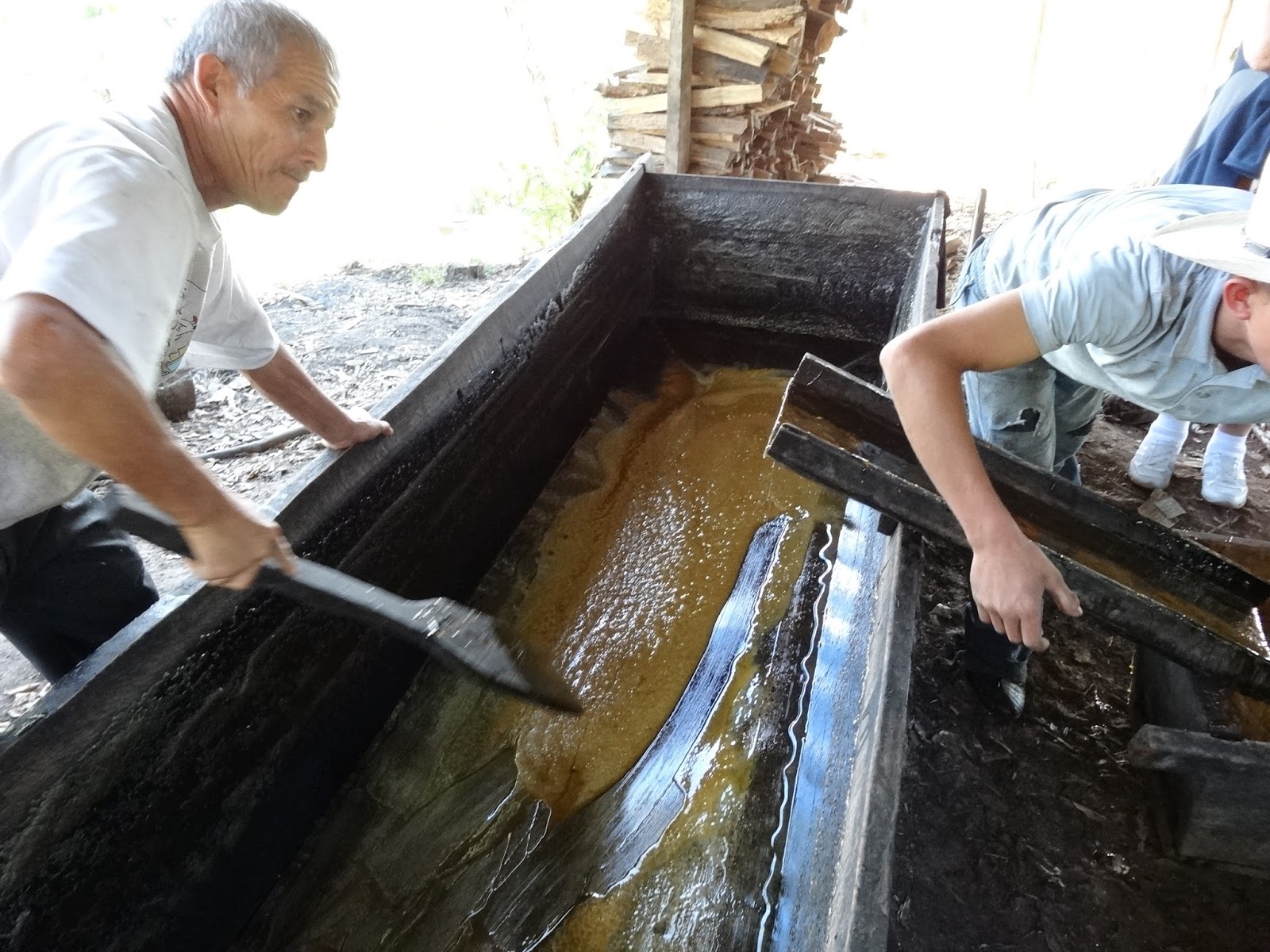
Twice I have had groups come and watch while he and his sons and others made dulce – a sugar product made by boiling the juice of sugar cane. He showed people the process, invited them to participate, and made sure people had a chance to taste it.

Here’s a photo of Nicolas with Fr. Jon Seda from St. Thomas and two other visitors this past January – Joey and Tyler. The photo is cloudy because of the vapor from the boiling sugar cane.


I almost always saw him with a smile.

I don’t know how he was as a father, but his daughter and two sons are incredible people. I imagine he could be strict in a gentle way – but loving.

For all I could see, he was also a good husband. His wife, Gloria, is a leader in the community and in the church. I don’t think he felt threatened by a strong woman who was his wife. But Gloria is an extraordinary woman, who is also quite humble.

Nicolas with Gloria, daughter, two sons, and son-in-law
She is also a woman of faith. When I stopped by on Tuesday morning during the wake, she spoke of how her faith sustained her, despite the loss.

I will miss Nicolas when I visit Plan Grande – and I expect that I will miss his presence when I move there later this year.

But his family will miss him even more – his wife Gloria, his children, his grandson, and his brothers and sisters.


May God give them courage and comfort – and give Nicolas rest. I hope Nicolas gets to share some dulce with Jesus and Mary.


Sunday, April 20, 2014

Christ is risen in Dulce Nombre

The Easter Vigil is the most solemn and important liturgy in the Catholic Church, commemorating that Jesus who died is now risen.

“Cristo es vivo” resounded in the church of Dulce Nombre several times on Saturday evening.

I have no idea how many participated, but several women spent most of Saturday making 1300 tamales and there were only less than 100 left (and some people didn’t eat.)

The liturgy began in a football field about two kilometers from the church. When I arrived a fire was blazing and people were gathered around.


At about 6:45 pm, Padre German blessed the fire, then blessed the Easter Candle and shard the light with the crowd who walked to church.

I drove and waited since I had not been feeling all that well.

The liturgy proceeded with the singing of the Easer Proclamation. All the assigned readings were proclaimed with psalms sung.

Padre German began his sermon recalling what he had said the day before. There are five diabolical enclosures (cercos): poverty, ideological structures, classism, a feeling that there is no sense to life, and living without God. (He later told me that the loss of a sense of life and living without God were combined in his original homily on Friday and he had added another enclosure: the destruction of the environment.) The resurrection is God’s response.

After this the baptism began. About 60 mostly young people were baptized.


It was moving to watch the various reactions of those being baptized – some with hands at their sides or with one hand in a pocket, several with open hands joined together in front, one with his hands folded in prayer.

What I also noticed was the reaction on the faces of many of them. Perhaps it was because of the cold water, but I saw some smiles of joy as the last words of baptism were said over them.

The baptized were not confirmed, because the bishop here reserves confirmation to his visits to the parishes.


The baptized received their first communion.


The liturgy ended about 1:00 am. Though it was more than six hours, I did not have the sense that it was long.

Most people went home, though a few stayed overnight because they lived so far away.


There was one event that threw the shadow of the evil of violence over the celebration of the risen Christ. In Dulce Nombre a young woman about 20 years old was knifed by another young woman upset that the woman had been seen with the attacker’s boyfriend. The woman was taken to the hospital in Santa Rosa and the attacker was apprehended by the police and brought before the prosecutor on Monday. (Corrected April 21.)

But the signs of life abounded, even in the face of violence.


 ---------------------------------

More photos of the Easter Vigil can be found in this set on my Flickr site.