Showing posts with label Holy Thursday. Show all posts

Friday, April 03, 2015

Holy Thursday: oil, water, Eucharist

When the parish began planning what to do for Holy Week in the villages, I asked Padre German where he wanted me to go. He told me to go where I wanted. But I insisted and so he sent me to three of the most remote and poor villages. So I celebrated Holy Thursday and Good Friday in Agua Buena, El Bálsamo, and Delicias in the municipality of Dolores.

Thursday started out with a trip into Santa Rosa de Copán for the Chrism Mass, the Mass where the bishop blesses the oils of catechumens and the sick and consecrates the Sacred Chrism used in Baptism, Confirmation, Ordinations, and other special consecrations.

Two Communion ministers asked me or a ride and so I took Gloria with her son Eliú and Marco Tulio with his son Darlin.

They, with other communion ministers had visited villages where there is no communion minister, to bring communion to the sick and, if possible, to have a Celebration of the Word with Communion. I was humbled to hear how far they had gone and how much time they had put into their visits. On one day, Marco Tulio had walked four hours to go to two communities, accompanied by his son and another young man from their village.

The parish had encouraged each village to have a collection of basic food needs this week to give to families in need in their villages. Marco Tulio told me how El Zapote de Santa Rosa had gathered almost one hundred pounds of beans, rice, and other food. The generosity of the poor always surprises me.

The Chrism Mass was long – but there was one part that really touched me. The priest who carried in the Oil of the Sick had been very ill – with cancer, I think.

Bishop Andino and Deacon Manuel de Jesús distributing communion
I got to see a number of friends who live in Santa Rosa and also some priests I know but didn’t stay around after Mass since I had to get out to the village of Agua Buena.

 I got to Agua Buena about three pm and we started the celebration a little later.

Key to the Holy Thursday celebration is the Washing of the Feet.

Several places in the parish had the custom of re-enacting the Last Supper, complete with crackers and pop (or so to you non Mid-Westerners), followed by the washing of the feet.

Padre German and I decided that this practice should not be continued, especially where there are Communion ministers to distribute Communion.

In addition, I explained to the people that the washing of the feet is not a drama or an enactment of a past event. It is reliving what Jesus calls us to do. I consider the Washing to the Feet to be a sacramental – a sign that helps reveal the presence of God in our midst, but decided not to use that terminology with people here since it can easily be misunderstood. Yet they did understand that it is not a mere drama – it is a call to serve.

In Agua Buena they had 11 boys ready for the foot washing and were looking for another. I suggested they find a young woman – and they did.


I had the privilege to wash their feet. I noted the stubbed toes, probably due to ill-fitting shoes. And these were young people in their early and mid-teens.

After I washed the feet of the twelve, I decided to encourage others to come forward to wash the feet of others or let their feet be washed. 


It took a while for someone to step forward but finally a good number of men can forward.  Later, with a lot of encouragement, a number of women had their feet washed.


 Finally, realizing that I was being the most reluctant of all, I took off my shoe and let my foot be washed.

While I was encouraging some to come forward for the foot-washing, a woman commented that she was so sinful. I reminded her that Jesus washed the feet of both Peter and Judas. After a few minutes, she came forward to have her foot washed.

At the end of the celebration, at 5:30, I placed the Eucharist on the altar and invited the people to spend time on the next few hours, in slice with Jesus. I explained this was a way of accompanying Jesus in the Garden of Gethsemane. I told them that we could do this for two hours if they wanted. It ended up being three hours of quiet prayer by many members of the community.

At first, there was only one person praying before the altar. I wondered if the adoration would end early. But I was astounded by the incredible stillness one man maintained while praying on his knees before the altar.


But gradually people started arriving in groups of five or ten. The church was a real place of quiet prayer. Someone later told how important it was for them to have the opportunity to spend time before the Eucharist.

I went in and out of the church, spending some time in the area around the church talking with folks. I think I was a good source of entertainment for some guys when we saw a huge spider.


At about 8:15 the church was half-full. One of the lay leaders told me that we would end at 8:30 pm.

I decided that it might be good to have a closing prayer and so we prayed a shortened version of Compline, the night prayer of the church.

I soon went to bed.

So this Holy Thursday was full of little wonders, little signs of the presence of God and of faith in the people.

It was also a day when I challenged two guys who were living with a woman outside of marriage and had kids to consider getting married.  I have no idea why I have started this gentle encouragement to marriage, but I also continued this on Friday in another village.


Friday, April 18, 2014

Holy Thursday in Dulce Nombre

Holy Thursday is a busy day here. It didn’t help that I’ve got a chest cold. But it was a good day.

In the morning there was the Chrism Mass in Santa Rosa de Copán where the bishops celebrates with the priests and blesses the holy oils used in the sacraments.

I thought it started at 10 am and so arrived late, but I just missed the readings and part of the bishop’s sermon. When I arrived at 10:45 he was speaking and spoke until about 10:15.

The Mass was held in an auditorium since the cathedral is too small. But, in order to accommodate more people, the bishop had celebrated a Chrism Mass with the priests in the Intibucá deanery, since there are places there that are far from Santa Rosa.

Nothing special about the Mass struck me, except for one thing. There were more than thirty police men and women in and outside the auditorium during the Mass. I don’t know why. At the end of the Mass the bishop did tell the police that they are supposed to "protect and serve" and, referring to the words of Monseñor Romero that they should refuse orders to kill. 

But still the presence of the police is disturbing. Are the police saying that we can even show our presence even inside the church?

After the Chrism Mass I set out for the Dulce Nombre. Padre German had asked me to go to the village of El Prado de la Cruz, for the Celebration of the Word, with the Washing of the Feet, and Communion.

When I arrived I realized that there was a bit of miscommunication. They expected me to come in the morning or at 1 pm, even though Padre had told the coordinator of the zone that I’d come at three.

People slowly came in and when we had a decent sized group we started.

For the washing of the feet we had men, women, and children. Some of the feet were rough – from poor shoes or walking barefoot, some were dirty from walking the dirt streets of the village. But it was a privilege to be able to wash their feet.

After the celebration, I was asked to bring communion to a bed-ridden woman. Of course, I said. But then between ten and fifteen people, mostly women and kids, crammed into the truck.


We went and prayed with the woman and I gave her communion. Then I asked all the people to extend their hands over her in prayer. I placed my hands on her head and then many others joined me.

What solidarity with the sick. Not only a few people but even children went to pray. What a sign of the service that we see in Jesus’ washing the feet.

I went back to Dulce Nombre in time for the evening Mass and more.


The Mass began with 12 men walking in with the priest in the entrance procession. Padre German gave a strong sermon on service of others and then washed the feet of the twelve men.

My first thought was, “Oh, no. Restricting this to men.” I am sure this is due to the piety and tradition of the people in town, where each “apostle” wore a sash with the name of an apostle.

But after he washed the twelfth man, Padre approach a woman in a wheel chair and asked if he could wash her feet. It was moving – and woman nearby, the daughter of the woman, was close to tears.

After Mass, the Eucharist in the monstrance was carried in procession to what they call here the monumentum, the monument – a shrine set apart for private prayer before the Eucharist. In some places people pray in groups until midnight. It’s a tradition that I really like, but they had different plans here.


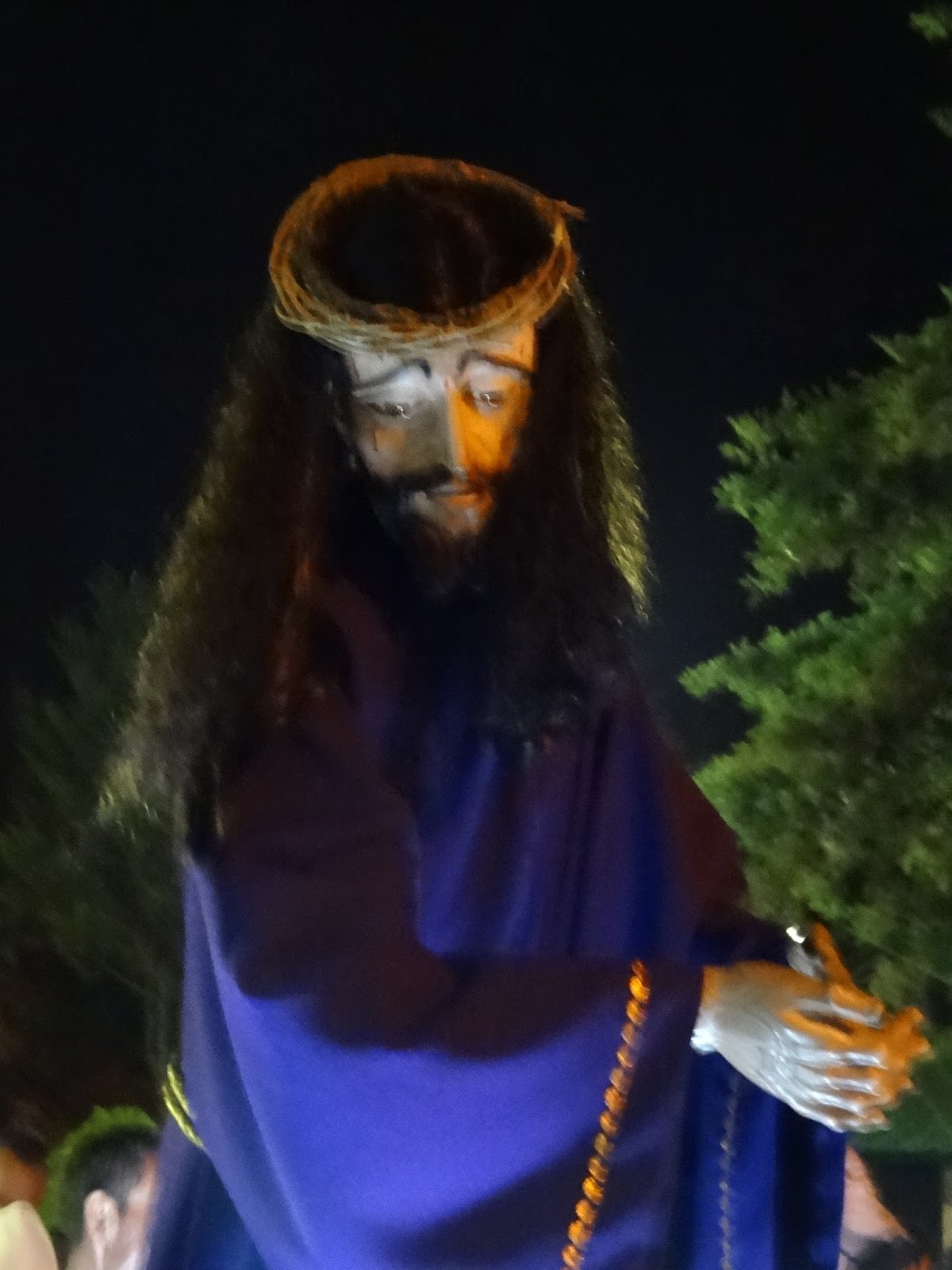
The statue of the Nazareno was taken in procession to another chapel in town in a procession called the prendimiento, the capture of Jesus.


I begged off taking part in the procession, because of my chest cold and because Good Friday will be a fairly busy day for me.


Friday, March 29, 2013

Holy Thursday in Plan Grande


This year in the parish of Dulce Nombre de María we are trying to get a Eucharistic Minister out to every one of the 46 towns and villages during the Triduum so that all have the opportunity to receive Christ in the Eucharist.

This Lent Father German Navarro, the pastoral administrator, has visited almost every village and town to hear confessions, preside at Mass, and meet the community church council.

Holy Thursday I went out to Plan Grande, a village I dearly love. I had thought that two local leaders would lead the celebration and I would only distribute the Eucharist. But they asked me to preside, preach, and wash feet.

The ritual of the washing of the feet has been for me a highlight of the Holy Thursday liturgy. At St. Thomas Aquinas in Ames, Iowa, where I served as a campus minister, it is the custom to invite everyone to come forward to wash the feet of other members of the congregation. I was often moved as parents washed the feet of their kids, who returned the gesture. It was for me a profound sign of the loving service that Christ Jesus showed us by his life, as well as by his washing of the feet of his disciples at the last supper.

Since the election of Pope Francis I have been astounded by the images of Cardinal Bergoglio washing the feet of women and troubled youth. It reminded me of the beautiful talk of Jean Vanier on foot washing, which you can read here. It is a rich reflection, but as I prepared to wash others’ feet, I recalled that Vanier sees the washing of feet as a way to let people know their dignity, their worth – especially those whom the world considers useless and marginalizes.

And so I felt blessed to be asked to wash the feet of people in Plan Grande.

In the reflection I spoke of all three readings and shared the stories of Pope Francis, as a cardinal and even that very day, washing the feet of people at the margins and how he was giving us an example of how to follow Jesus.

Then twelve came forward – eight males and four women, from children to an older woman. Assisted by one of the community leaders, I washed their feet – and was moved to tears. Not only was the hymn being sung moving, being able to touch tenderly the feet of people, some poor, touched something deep in my heart.

I was especially moved washing the foot of an older woman. She was wearing only flip-flops on her well-worn feet. Here was a woman who had served so many for so many years. She is an example for people like me. But I had been given the gift to wash her feet – and gently press my face to her foot.

Sharing the Eucharist with the people was another highlight of the celebration. This village has a communion minister (who is visiting two other villages Holy Thursday and Good Friday) and so they are accustomed to have the opportunity to  the Eucharist.

At the end of the service, I place the pyx with the Host on the altar, for all to see. Since there will be no procession here and they haven’t put up a special altar for adoration, I invited them all to kneel in prayer before the Eucharistic Christ.

And so, having knelt before twelve people in the village, I knelt before Jesus again.

When I returned home I watched a video of Pope Francis washing the feet of the young people in the prison.

His words strike me deeply, full of a theology of service and offering a simple but challenging message:

… washing your feet means I am at your service. And we are too, among each other, but we don’t have to wash each others' feet each day. So what does this mean? That we have to help each other…

Help one another. This is what Jesus teaches us. This is what I do. And I do it with my heart. …it is a duty that comes from my heart and a duty I love. I love doing it because this is what the Lord has taught me. But you too must help us and help each other, always. And thus in helping each other we will do good for each other.

Washing feet is a sign that the Reign of God is in our midst – and to see a pope kneeling before young prisoners gives me hope.

--------

More photos from Holy Week in the parish of Dulce Nombre de María can be found here.