Tuesday, September 28, 2021

Novena of Saint Francis of Assisi, day four

Francis and the sacredness of life 
 
Let all creatures praise the Lord – and let us respect all of them. 

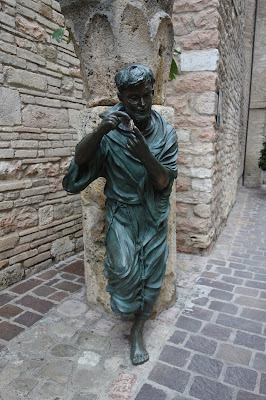
Visiting Assisi in 2018, I came across this statue at the exit from the friary at Our Lady of the Angels. Francis sees the glory of God in a locust and treats the creature with respect.
Today I came across this quote in Jack Wintz, ofm, Lights Along My Path, A Friar's Journey in the Footsteps of St. Francis:
“Where the modern cynic sees something ‘buglike’ in everything that exists,” observed the German writer– philosopher Max Scheler, “St. Francis saw even in a bug the sacredness of life.”
Here's one that visited my home during Holy Week, 2017:


Monday, September 27, 2021

Novena of Saint Francis of Assisi Day Three

Francis – the austerity of solidarity 

Austerity was for many years considered a nasty word. It usually meant that international institutions forced poor countries to take austerity measures – especially cutting social programs – in order to receive aid to bolster a failing economy. With this type of austerity, the poor suffered. 

Several decades ago, I came across a different notion of austerity in the works of Denis Goulet, whom I first met in the early 1970s at a week-long educational program. A scholar of development, he lived among the poor in several parts of the world including France, Spain, and Algeria, and he has done research in Guinea-Bissau, Lebanon, Mexico, Brazil, and other countries. His final work was at the University of Notre Dame.

In The Uncertain Promise: Value Conflicts in Technology Transfer, he looks at two different notions of austerity:
An important difference is to be found in the underlying imagery: austerity seen as a necessary evil or as a permanent component of developmental humanism. The former conception is purely instrumental: under certain conditions austerity or belt-tightening is accepted as undesirable but necessary. But the second view considers austerity as a value for its own sake, even if it is not strictly necessary on purely economic grounds. (p. 161) Austerity understood as “sufficiency for all as its first priority” is the only path which can directly attack the poverty of the poorest majorities. (p. 164)
Many may argue whether this is possible but reading a passage a passage of The Mirror of Perfection reminded me that this is the wisdom of the saints. The anonymous author (whom some identify as Brother Leo) recalls:
Blessed Francis was used to say these words to his brethren, “I have never been a thief concerning alms, in getting them or using them beyond necessity. Always have I taken less than I needed, lest I should defraud other poor folk of their portion, for to do the contrary would have been theft.”
The poverty of Francis is directly related to his desire to identify completely with Christ, who emptied himself and became poor for our sake. But his poverty also has this dimension of solidarity with the poor. 

Many of us live lives that are fall from austere. And I acknowledge my lifestyle is far from the forced austerity of my neighbors here in Honduras.

But Francis gives us a real challenge. Will we live in real solidarity? 

The saints suggest that this emptying, austerity, detachment, brings freedom and joy. Denis Goulet noted this in A New Moral Order: Development Ethics and Liberation Theology:
Gospel poverty is not a disdain for material goods but the refusal to let the desire for even necessary goods destroy one’s spiritual freedom…. Not by accident have Dorothy Day, Charles de Foucauld, and others discovered liberating joy in gospel poverty to the degree that they have fought unrelentingly against social privilege and the institutional idols of wealth and acquisition. (pp. 138-139)
May Saint Francis open for us the way of spiritual freedom through giving up, solidarity, and sharing.

Francis and the beggar, in a chapel near Chiesa Nuova, Assisi


Sunday, September 26, 2021

Novena of Saint Francis of Assisi Day Two

Going out to the margins 

 In The Joy of the Gospel, Pope Francis laid out his vision of our call to be disciples-missionaries. This means a church that “goes out” even to the peripheries, to the margins. In paragraph 20, he wrote:
In our day Jesus’ command to “go and make disciples” echoes in the changing scenarios and ever new challenges to the Church’s mission of evangelization, and all of us are called to take part in this new missionary “going forth”. Each Christian and every community must discern the path that the Lord points out, but all of us are asked to obey his call to go forth from our own comfort zone in order to reach all the “peripheries” in need of the light of the Gospel.
Saint Francis of Assisi went out to the peripheries in many ways, going beyond his comfort zone.

Francis enjoyed a comfortable existence as a young man. His father was a fairly prosperous merchant in fine cloth. He enjoyed a social life with other young people of his social class.

But after his experience as a prisoner of war something happened. My guess he may have been somewhat fastidious. He tried to avoid any encounters with lepers, but one day, moved by the Spirit, he embraced a leper. That was for him a moment of real conversion – what appalled him became a source of joy and peace. As he wrote in his testament:
The Lord granted me, Brother Francis, to begin to do penance in this way: While I was in sin, it seemed very bitter to me to see lepers. And the Lord Himself led me among them and I had mercy upon them. And when I left them that which seemed bitter to me was changed into sweetness of soul and body
He then began to attend the lepers – not as one who comes in, does a good work, and then leaves. He began to accompany them and to be with them. Soon after, reflecting on the Gospels and the call of the Lord in his life, Francis embraced holy poverty and mingled with the marginalized. I am sure that he shared the smell of the sheep, that Pope Francis has recommended.

For Saint Francis being poor and being with the poor were central elements of his calling. It wasn’t easy at first, but he embraced it and shows us the way to embrace the poor and marginalized not as objects of charity, but as our sisters and brothers.

As Pope Francis said in Havana Cuba, in 2015:
Service always looks to their faces [the faces of the most vulnerable], touches their flesh, senses their closeness and even, in some cases, ‘suffers’ that closeness and tries to help them. Service is never ideological, for we do not serve ideas, we serve people.
Saint Francis gives us an example of seeing the face of Christ in the face of the poor. Recalling his life and the admonitions of Pope Francis we can begin to bridge the gap between peoples and live as witnesses of the Reign of God, of the life filled with love and joy. As Pope Francis noted in The Joy of the Gospel:
We achieve fulfillment when we break down walls and our hearts are filled with faces and names!
We know the poor - by name.
Sculpture outside San Damiano, Assisi

Saturday, September 25, 2021

Novena of Saint Francis of Assisi Day One

The Message of Christ at San Damiano 

It is a Catholic custom to prepare for a feast with a novena, nine days of prayer. The feast of Saint Francis of Assisi is on October 4, although he died on the evening of October 3. So today is the first day of the novena to honor Saint Francis.

In 1973, I took the summer off and bicycled around Europe (mostly, France, Italy, and Greece).


One of the highlights was my time in Assisi. One day I went down to San Damiano, the church where Francis heard Jesus speaking from the cross, “Go, repair my church, which you see is falling into ruins.” Francis began to work on the repair of the church.

The church of San Damiano

At San Damiano, I encountered a British Franciscan friar who spoke with me and a few young people. He told the story and remarked that Francis’ response was what the saint needed. 

Francis had spent time as a prisoner of war, after an unsuccessful war between Assisi and its nearby rival, Perugia. He returned a broken young man. After an attempt to join the army in support of the pope, he returned home after a strange dream. He also went on pilgrimage to Rome where he spent time with the beggars at St. Peter’s Basilica. 


Returning again to Assisi, he wandered the countryside, where he came upon the ruined church of San Damiano and experienced the call to Jesus. 

The Franciscan friar explained that Francis needed the physical work in order to be healed. I now wonder whether Francis was experiencing a form of trauma, suffering from post-traumatic stress syndrome. Getting out of himself, doing something was what he needed. 

This made a lot of sense to me – and I see the wisdom of God in calling Francis, the privileged son of a prosperous textile merchant, to begin to heal.

After spending some time at San Damiano that day, I went up to the Basilica of Saint Francis where the saint is buried and where the frescos of Giotto in the upper church detail his life. 

There I heard a Conventual Franciscan friar speaking to a group of pilgrims. He described the event at San Damiano but added that Francis got it wrong. His real mission was to repair the universal Church. 

My immediate reaction was that the friar in San Damiano had it right, not the friar in the grand basilica. Francis needed physical work, needed to repair what was around him, so he could be healed.

The way of healing begins where we are.

Any future mission arises from a faithful response to the small mission at hand. For Francis, this meant hauling rocks to the site and rebuilding the walls of the church. 

By working with his hands, Francis experienced the healing power of God. This was his mission at that moment. Rebuilding the universal Church by living a life of poverty and preaching to the people flowed from his response to the voice of Christ that day at San Damiano.

Can we repair the church if we don’t undertake the simple tasks of rebuilding the church around us? This includes letting God repair us, heal us. 

It is a temptation to think we have to wait for a grand mission to begin the work of Christ in our lives. 

This reminds me of one of the entries in Markings, the notebook of Dag Hammarkskold, the United Nations Secretary General who was killed in a plane crash in the Congo in 1961.
“The ‘great’ commitment is so much easier than the ordinary everyday one — and can all too easily shut our hearts to the latter. A willingness to make the ultimate sacrifice can be associated with, and even produce, a great hardness of heart.... 
“The ‘great’ commitment all too easily obscures the ‘little’ one. But without the humility and warmth which you have to develop in your relations to the few with whom you are personally involved, you will never be able to do anything for the many. Without them, you will live in a world of abstractions, where your solipsism, your greed for power, and your death-wish lack one opponent which is stronger than they – love. Love, which is without an object, the outflowing of a power released by self-surrender, but which would remain a sublime sort of super-human self-assertion, powerless against the negative forces within you, if it were not tamed by the yoke of human intimacy and warmed by its tenderness. It is better for the health of the soul to make one [person] good than ‘to sacrifice oneself for [hu]mankind.’ For a mature [person], these are not alternatives, but two aspects of self-realization, which mutually support each other, both being the outcome of one and the same choice.”
Francis responded to the immediate need – and thus opened himself to a mission larger than himself.

Where is God calling us – in little missions of our daily lives– to serve, and to let God repair us, the Church, and the world?

San Damiano in the mural of St. Clare in the church of Dulce Nombre de Copán, Honduras 


Thursday, September 23, 2021

A homiletic dilemma

A homiletic dilema I’m trying to write next Sunday’s sermon. I need help. 


The readings are way too critical of privilege and of wealth, and of a privileged class instead of a prophetic people.
"Come now, you rich, weep and wail over your impending miseries." (James 5:1)
"Teacher, we saw someone driving out demons in your name, and we tried to prevent him because he does not follow us.” Jesus replied, “Do not prevent him. There is no one who performs a mighty deed in my name who can at the same time speak ill of me. For whoever is not against us is for us." (Mark 9: 38-40)
It looks as if the choices are between castigating wealth and condemning clericalism.

If I were in the US, I would probably defer to James and get into a lot of trouble. Here’s what I wrote seven years ago. 

James is way too bold: 

Accumulating wealth? “Come now, you rich, weep and wail over your impending miseries. Your wealth has rotted away…” 

Not paying a living wage? “…the wages you withheld from the workers who harvested your fields are crying aloud.” 

Living a luxurious lifestyle? “You have lived on earth in luxury and pleasure.” 

Ouch. 

Then I remembered a blog I had written seven years ago that noted the challenge of this passage from James.

But there are challenges in the other readings. 

If I were preaching to a group of priests or deacons, I’d probably concentrate on Numbers and the first part of the Gospel. These are clear critiques of trying to monopolize the gifts of prophecy. They castigate any form of clericalism, of privilege, of presuming one’s superiority, of thinking we have the answers or a privileged access to the message of God. 

That would probably also get me into trouble, because, I believe, clericalism is way too deeply engrained among us clergy. (I wrote something on this a few years ago.) 

But I’ll be preaching to the poor, here in Honduras. 

What do I want to say to them? 

I want to cry out: “Would that all the people of the Lord were prophets!” 

All too often the poor here defer to the powerful, the educated, the “authorities,” whether in the church or public life. 

The “powers that be” try to mute the voices of the poor, sometimes in violent ways by repressing demonstrations as well as defenders of creation and the rights of the poor. Sometimes their voices are not even heard. 

And all too often I have heard the poor put down – not just by educated elites or political bosses, but even by progressive clergy. 

But how can we let the people of the Lord speak out forthrightly? How can we open the path so that all the people of the Lord can be prophets? 

I am rather perturbed when preachers emphasize the sinfulness of the people sitting before them.

Yes, there is sin – and it abounds. The domestic abuse and violence, the resentment and vengeance that sometimes result in murder, the machismo which puts down women – these are real evils. 

But there are also the real evils of the impoverishment of people, of corrupt politicians manipulating the poor for their benefit, of structures of injustice and impunity that leave the poor without recourse to justice, of systemic use of violence and repression by political and economic elites.

Yet, in the midst of this, there are signs of grace.

There’s the young man I know who decided on his own to try to raise money for a young man in aa neighboring village who seriously injured in a motorcycle accident.

There are the families which care for the sick elderly in their homes and the single mothers who care for children and adults with special needs. 

And there are those who welcome the marginalized in their midst. 

I’m working with people in the countryside to try to find ways to prepare for natural disasters, like the two hurricanes we had last year. Today, someone shared how, in his village, the young people came to help the people who were displaced from their houses and sought shelter in the hall of the local church. He noted, with some satisfaction, that even some young drug-addicts came and helped. 

There are more signs of grace – and there are signs of great wisdom, but all too often, who listens? 

In my preaching I want to open those who are listening to the great work that God is doing in their midst, and in their lives. 

At times, I will recall the obstacles to God that we find around us and even within ourselves. It is important to remember that the name Satan means the adversary, the one who opposes. 

But how can we open a way for the people to know and share the gift of prophetic wisdom that is part of our baptismal heritage? 

Walter Brueggemann, in The Practice of Prophetic Imagination, writes:
Prophetic preaching is an effort to imagine the world as though YHWH, the creator of heaven and earth, the Father of our Lord Jesus Christ whom we name as Father, Son, and Spirit, is a real character and the defining agent in the world.
God is working among us – and the poor are God’s messengers. But at times our imagination is suppressed and we find it all too hard to see the working of God in our midst.

May they and I find ways to recognize this and open a space where God can work in us, among us, and through us. 

What a task!